Human Impact on Ecosystems (Edexcel IGCSE Geography)
Impact of Farming Systems
Spec point —
4GE1-S6.068
-
To obtain food humans use and modify the ecosystems through farming
-
There are four groupings commonly used to categorise farming:
-
Categorisation by outputs
- Arable (the cultivation of crops) and **pastoral **(raising livestock)
-
Categorisation by whether a profit is made****
- Commercial (farming to gain profit) and subsistence(farming to feed farmer and family)
-
Categorisation by the inputs
- Extensive (a farm with low inputs or yields per hectare) and intensive(a farm with high inputs or yields per hectare)
-
Categorisation by location
- Nomadic (farmers moving seasonally with crops/livestock) and sedentary(where the same area of land is farmed every year)
-
-
A farm that has both livestock and grows crops is a mixed farm
Farming systems
- All farms are systems, they have inputs, processes and output
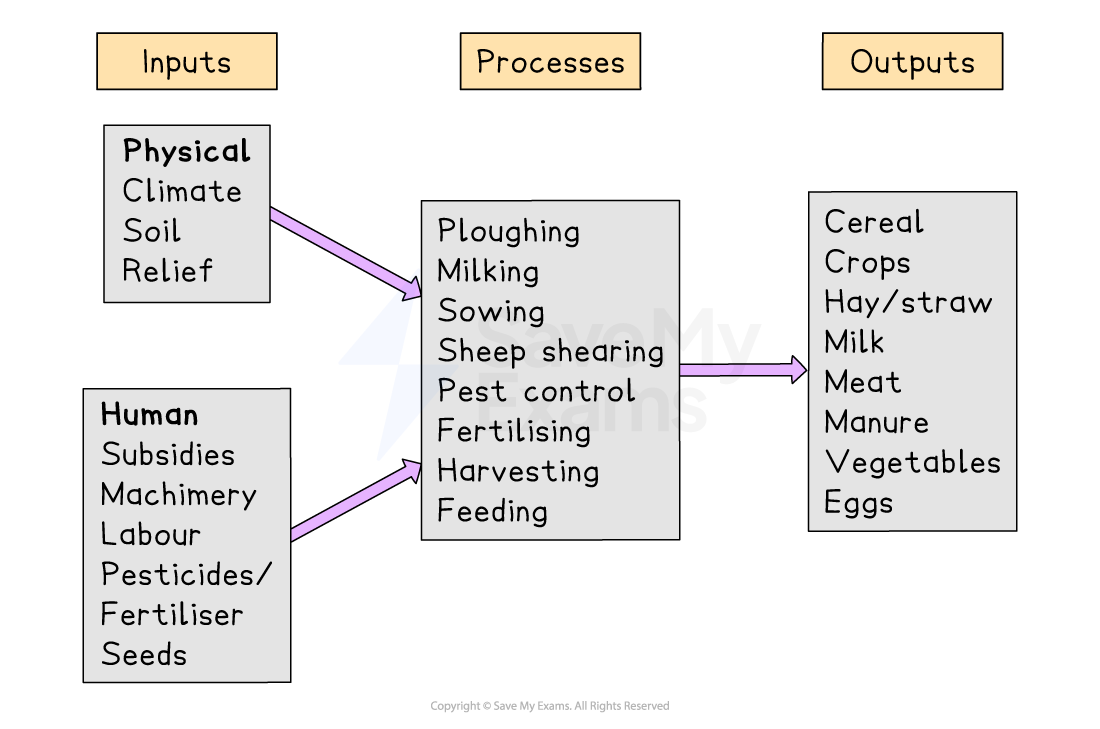
Diagram to illustrate a farm system
Impacts of farming systems
-
All farming systems impact the ecosystem in which they are located
-
Some have more impact than others
-
Commercial arable and pastoral farming tends to:
- increase monocultures which reduces diversity because the animals have no access to a wide range of foods
- mean that nutrient cycling is dependent on fertilisers added to the soil, which may be natural (manure) or artificial fertilisers
- modify the ecosystem with inputs of seed, fertiliser, pesticides, herbicides and the use of machines
- reduce the links within food webs
- reduce the amount of biomass
-
Intensive farming has more impacts than extensive farming because it is more likely:
- to rely on high levels of fertilisers and pesticides
- to be a monoculture which reduces biodiversity
- have increased use of machines
-
Subsistence and nomadic farming have less impact on the ecosystem because they tend to be smaller scale and make less use of:
- machines
- fertilisers
- pesticides
Exam Hint Remember farms do fit more than one category. For example, a sheep farm in Cumbria, UK would be categorised as pastoral, commercial, extensive and sedentary.
Was this revision note helpful?