Movement of People (Edexcel IGCSE Geography)
Push-Pull Mechanism
Spec point —
4GE1-S3.065
-
People have always migrated from one place to another either within their country (internal migration) or across borders (international migration)
-
Globalisation has made this move easier and faster
-
There are different types of migration
- Forced (involuntary)
- Voluntary
- Circular
- Political: refugees and asylum seekers
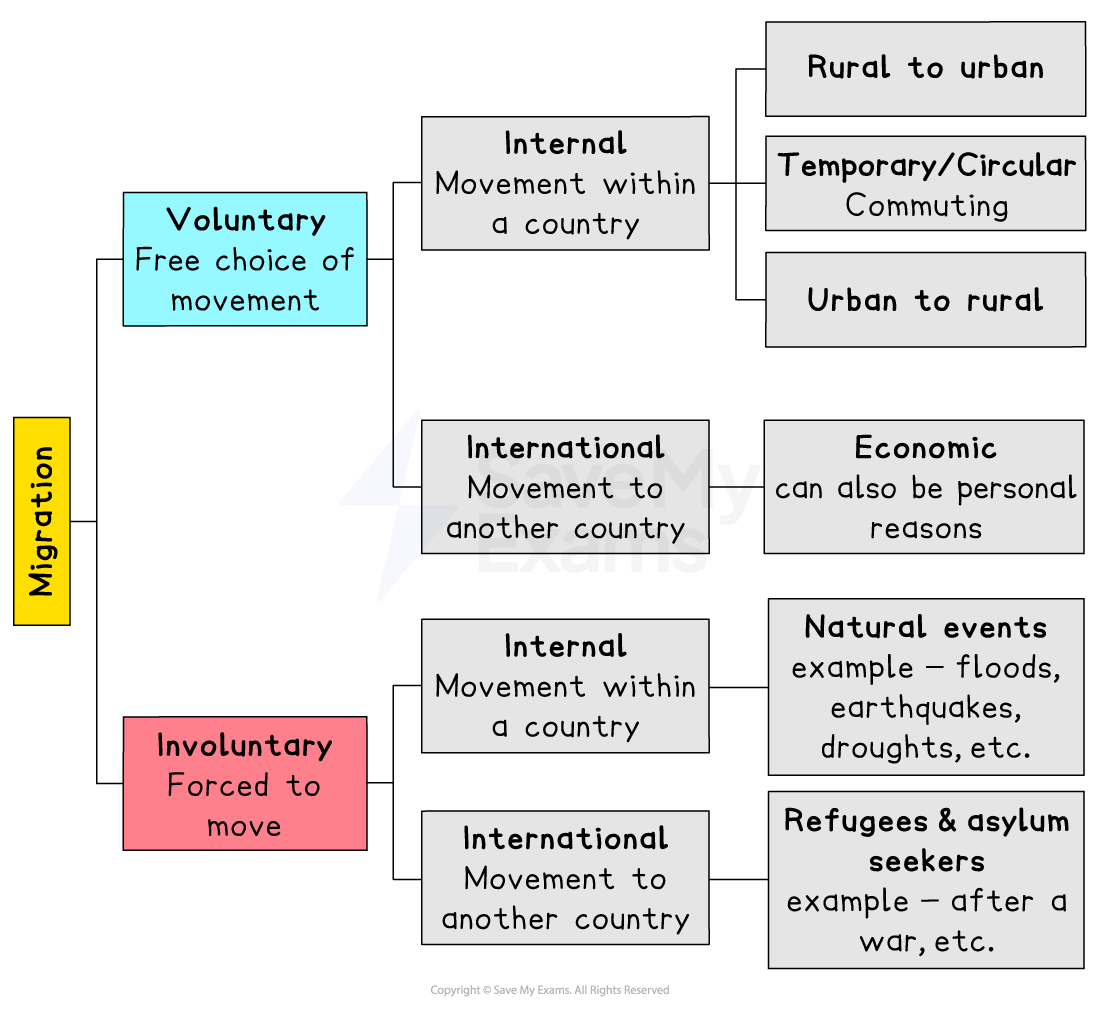
Types of migration
-
The main reasons for migration are push-pull factors
-
The push factors are the reality of the current situation for the migrant
- It is what makes the person consider moving from their place of origin
-
The pull factors are the perceived outcome
- It is what they imagine the move will bring to their place of destination
-
Push-pull factors are unique to each migrant, depending on their end goal
-
These factors can be divided into:
- Social
- Economic
- Political
- Environmental
Exam Hint
- Remember do not just state the opposite when asked to give push-pull factors
- Poverty is a push factor, however, everywhere has certain levels of poverty, so a pull factor could be better welfare and healthcare services
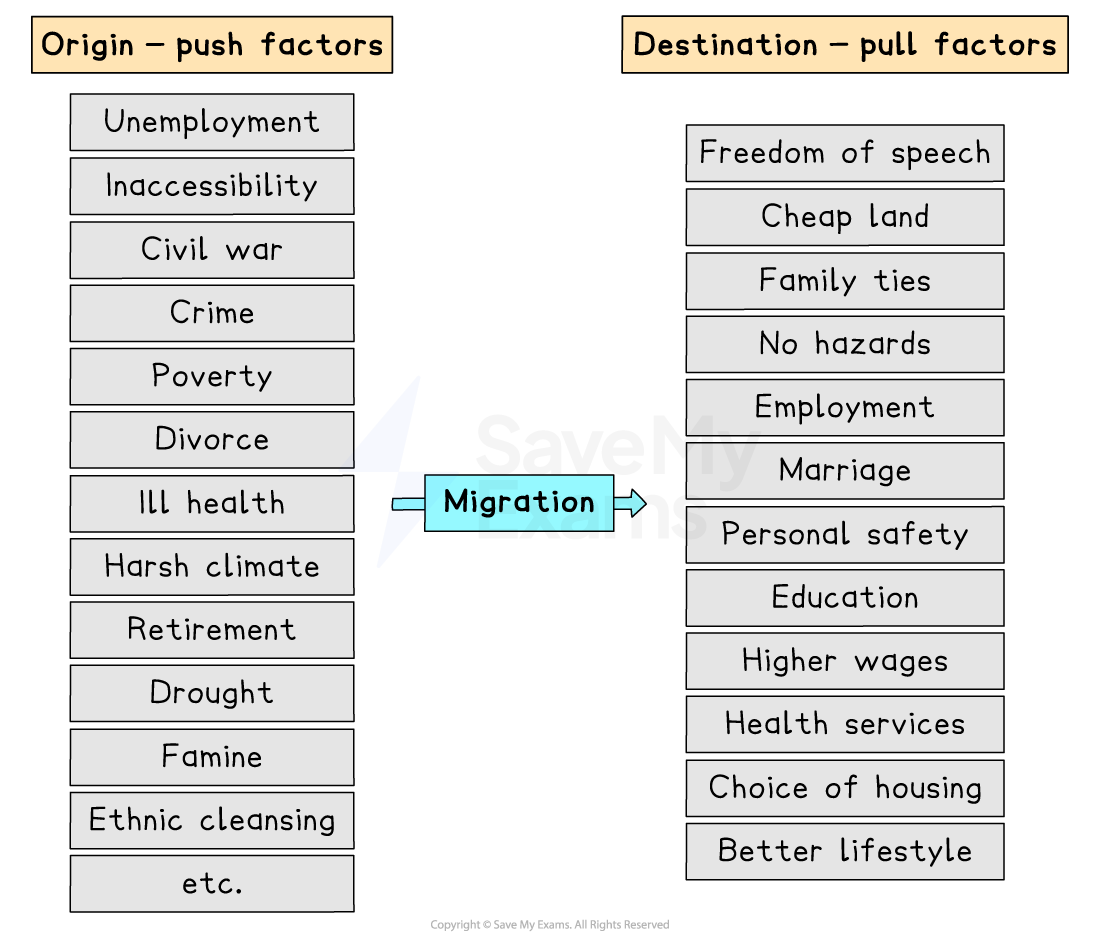
Push-pull factors of migration
-
High levels of unemployment are a push factor, but higher wages and a better lifestyle are a pull factor
-
Three other factors related to migration are:
-
modern communications
- Mass media allow people to 'see' and 'feel' distant places without the risk of moving to an unknown and potentially unwelcoming destination, making people more willing to migrate
-
modern transport
- This moves the migrant to their destination quickly and cheaply once the decision has been made to migrate
-
relaxed national borders
- Globalisation has made many countries more willing to relax their boundaries, particularly if it is to their advantage, e.g. skilled migrant workers, doctors, scientists, etc.
-
Voluntary Migration
Spec point —
4GE1-S3.065
-
Voluntary migration is the free choice to migrate or not
- This can be internal(within the same country) or international(to another country)
-
Voluntary migration is usually for economic reasons such as work, promotion, higher wages, etc
- In developing countries, this is usually internal, from rural to urban areas
- In developed countries, counter-urbanisation is more common, from urban to rural
-
Temporary economic migrants (short-stay workers) are those people who migrate purely for economic purposes, stay for a few years or less and then move on
-
Retirement migration is a new form of voluntary movement where pensioners retire and move elsewhere
- Retirees no longer need to live close to a place of work
- Warmer climates: Las Vegas is home to a large number of retirees due to its dry, warm climate
- Downsize into a smaller and/or cheaper home to save costs with their pension (pensions are usually less than regular wages)
- Retirees want a quieter, calmer or more attractive environment
-
Professional migration involves sports people signing contracts to play for foreign clubs—footballers, cricketers, etc.
- Players benefit from higher wages and bigger media profile
-
Medical migration is where doctors, surgeons, etc migrate to other countries where their skills are in demand or patients migrate for health reasons
Circular Migration
Spec point —
4GE1-S3.065
-
Circular migration is where there is no intention of a permanent move
- This can be for work, medical, educational or pleasure reasons
-
Seasonal workers are circular migrants who work in one place and return home after a short contract
-
Students at university return at the end of the term to their normal place of residence
-
Medical treatment encourages people to move to other countries temporarily
-
Tourism encourages circular movement with longer stays
Forced Migration
Spec point —
4GE1-S3.065
-
This is where a migrant has no choice but to leave their place of origin
-
This is usually international but can also be internal
-
There are several reasons for internally forced migration, including:
- natural hazards
- war and persecution
- ethnic cleansing
Natural hazards
- natural hazards such as volcanic eruptions, tropical storms, floods and droughts
- in most cases, survivors will move back home when it is safe to do so
- jobs become available again
War and persecution
-
The most common reasons for forced migration are war and persecution
- This includes events such as the Jewish people fleeing German and Russian troops during the Second World War
- More recently, the Syrian civil war, where more than half of the country's population (13 million) has been forcibly displaced
Ethnic cleansing
-
Ethnic cleansing forces out entire groups or communities from the country
- Bosnian Muslims in the former Yugoslavia
- Rwanda in 1994, where the Hutus attempted to wipe out the Tutsis in 3 months, forcing 2 million people to flee
Refugees & Asylum Seekers
Spec point —
4GE1-S3.065
-
The UN High Commission for Refugees (UNHCR) is responsible for those people forced to migrate—a 'person of concern'
-
There are four different categories:
-
Refugee
- a person who lives outside their country of nationality because of well-founded fears of being persecuted, either through race, religion, political opinions or social groups
-
Asylum seeker
- a refugee who has applied for citizenship in a country that has provided protection
-
Internally displaced person (IDP)
- forced to flee their home but do not cross international borders
-
Returnee
- a refugee or asylum seeker who has voluntarily returned to their own country or an IDP who has returned home again
-
-
In 2021, UNHCR estimated that there were 89.3 million people worldwide who were forcibly displaced
-
Of these, 27.1 million were refugees, 53.2 million were IDPs, and 4.6 million asylum seekers
-
Children account for 41% of forcibly displaced people
-
Five origin countries account for 69% of all refugees:
- Syrian Arab Republic (27%)
- Venezuela (18%)
- Afghanistan (11%)
- South Sudan (9%)
- Myanmar (5%)
Was this revision note helpful?
Build on this topic