Urban Challenges in Developed Cities (Edexcel IGCSE Geography)
Spec point —
4GE1-S6.069
Urban challenges in developed cities
-
Challenges faced by developed world cities fall under 3 categories:
- Social
- Economic
- Environmental
-
These challenges are varied and unique to each city
Social challenges
- Social services
- Housing
- Poverty and deprivation
- Ethnic segregation
- Quality of life
- Ageing population
- Tourism and crime
Economic challenges
- Globalisation
- Food supply
- Transport and traffic
- Energy supply
- Deindustrialisation
- Service provision
Environmental challenges
- Pollution and waste
- Sustainability
- Ecological footprint
- Energy, land and water
- Hazard risk
- Green space
General Examples
Food
-
Getting food for the over a million inhabitants is difficult
- Food is often imported from other countries
-
Transportation costs add to the price the consumer has to pay
-
This also increases the carbon footprint of the city
Energy
-
All cities require energy for their residents and businesses
-
The production of energy is mostly through the burning of non-renewable fossil fuels
-
With the continued growth of cities, energy security is becoming an issue
-
A mix of energy types is needed depending on the location
- Wind power isn't possible for all cities or a continuously reliable source (not windy every day)
-
Regardless of how a city generates its energy, large amounts of resources will be used to add to a city's 'footprint'
Transport
- Any large city will face problems with congestion on roads due to the volume of people trying to get about the city
- Cars and lorries will be polluting through exhaust emissions; buses and trains can be electric, reducing their impact
- Despite technology helping more modern cars produce less pollution, the remaining city's transport infrastructure (rail, tube, buses, etc.) will also be under a lot of stress
Water
- The supply of safe, clean water poses a major challenge for developed cities
- A megacity will often have a higher demand for water than it can supply
- This means that water needs to be brought in from other areas or other solutions need to be drawn up, such as a desalination plant
Waste
-
Every person and business produces waste, making the combined rubbish of a city, huge
-
Much of this waste will end up going to landfill
- This is both expensive and wasteful
-
Space is running out and new laws restrict the dumping of certain wastes in landfill sites, adding to a city's problems in dealing with its waste
Segregation
- There is a tendency for people to live near others of similar backgrounds and status
- This can be through employment, wealth, ethnicity, etc.
- This makes for little interaction between the groups, which isolates and limits social mobility
- Isolation breeds fear and suspicion of 'differences' within the urban area
Example Case Study of a World City - Hong Kong
Spec point —
4GE1-S6.069
Example case study of a world city – Hong Kong
Case Study
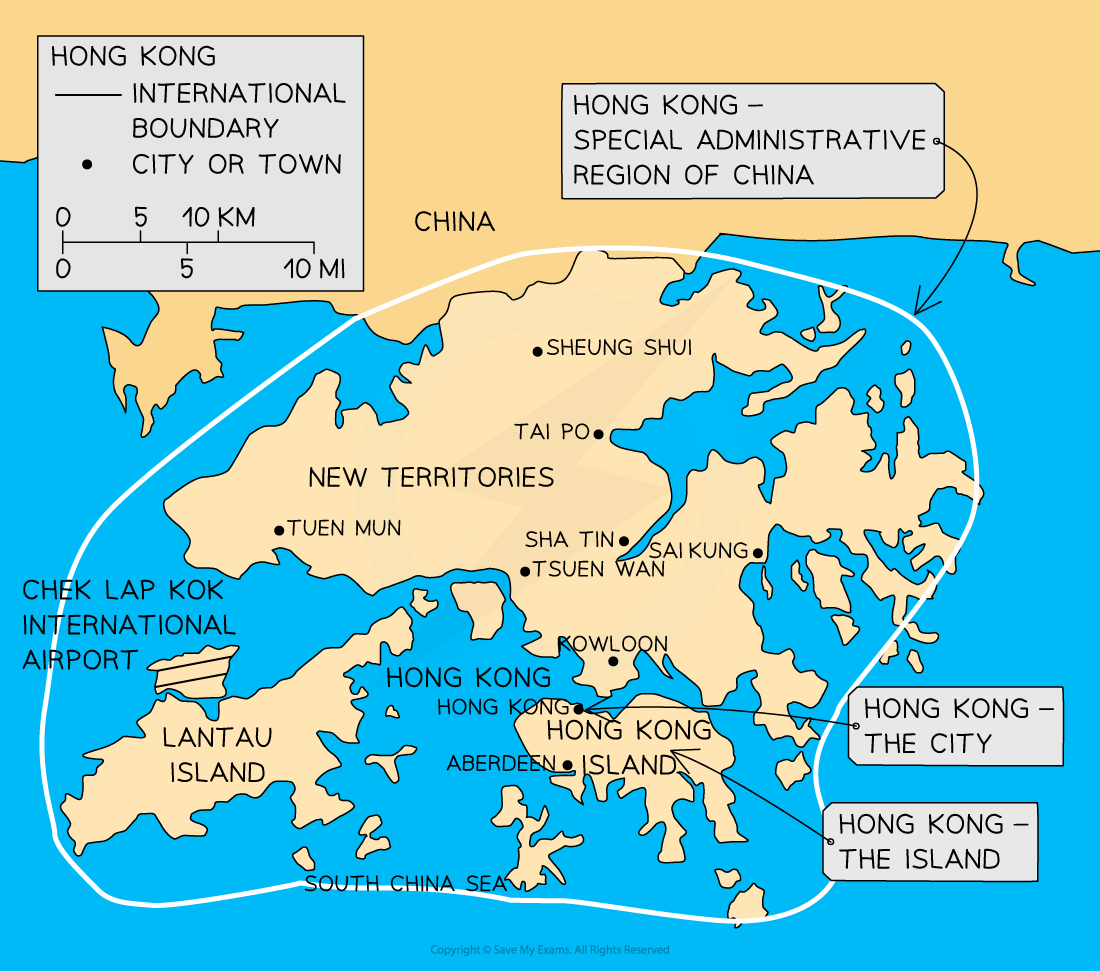
Hong Kong – A world city
- Hong Kong as one of the most advanced cities, has had to overcome several development issues
Hong Kong
- Hong Kong has a land area of over 1000 km2 with over 7m people
- It is a Special Administrative Region of China
- It is also an island and a city
- It has a world city status in Asia
- It is amongst one of the world’s top financial and business centres
Economic challenges
De-industrialisation and globalisation
Hong Kong has benefitted from globalisation
Its economy is based on trade and financial services so manufacturing has never been a major part of the economy
- This means it has not really been affected by **deindustrialisation **
It is the world’s 11th-largest trading country and the world’s largest re-export centre
- The majority of the products being made in mainland China
Food supply
- With very little arable land on which to farm, agriculture contributes only 0.1% of its GDP
- Most food is imported
Energy supply
- The energy supply is mostly from electricity
- About** 75%** is generated from **fossil fuel power stations **(mostly coal)
- Approximately** 25% i**s generated from nuclear power, imported from China
Transport and traffic
- Traffic congestion is a major issue for most cities, along with smog and traffic pollution
- Hong Kong has a well-developed transport network, making movement around the city relatively easy
- Of the 11 million daily journeys, over 90% are made on an integrated network of public transport – rail, bus, and ferry
- Smog is still an issue, but not at levels seen in other cities
Social challenges
Social services
Hong Kong has good provision of social services, particularly education and healthcare
There is inadequate support for the ageing population
- Some older residents scavenge and sell boxes and scrap to survive
Housing
As one of the world's most densely populated islands, the only way Hong Kong can grow is upwards
- It has become a vertical city
Around half of Hong Kong's residents live in government-rented public housing
- This is mainly high-rise apartments
Private housing is ranked 3rd in the world as the most expensive
Social mobility and polarisation
Social mobility is reduced as private house prices are high
- This makes it extremely difficult for people to move from the public to the private sector
- This creates dramatic social polarisation, with extreme wealth, poverty and deprivation found together in the compact urban area
Poverty and deprivation
Despite its overall prosperity, Hong Kong has pockets of poverty and deprivation
- There were several squatter settlements in Kowloon City, but these were cleared out in the 1990s
A new form of squatter settlement has arisen to accommodate the homeless – the 'penthouse slum' or 'rooftop shanty town'
- These are illegal homes and are thought to be unique to Hong Kong
- Restrictions by the government on access to social housing, along with the high cost of private renting
- People have been forced to utilise the spaces on the roofs of apartment blocks
Other forms of cheap housing are obtained through renting a locking cage in a dormitory room with several other people
- These cages allow just enough space to sleep in, whilst having some safety in being able to lock personal items away during the day
Ethnic segregation
About 94% of the population is of Chinese descent; 6% are from the Philippines, Indonesia, Nepal and India
Most people are employed within the domestic service industry
British, Japanese, American, Canadian and Korean employees work within the higher-paying jobs of the commercial and financial sector
- These people also living in the wealthier areas of Hong Kong
Environmental challenges
Ecological footprint
In Hong Kong, large amounts of fossil fuels are burned
There is a need to reclaim large amounts of land from the sea to create new space for urban growth
- This subsequently damages the marine environment
Smog drifts across the territory from industrial developments on the other side of the Pearl River Delta
Waste disposal
- Hong Kong's 7 million residents produce an estimated 6.4 million tonnes of waste a year
- Until recently, this was dumped in landfill and land reclamation sites
- Increased recycling and waste-to-energy are being attempted
Water supply
Providing a water supply is difficult, as Hong Kong territory has few rivers and lakes
Groundwater sources are difficult to access
A growing population with seasonal variations in rainfall means Hong Kong has to import 70% of its water supply from mainland China
- This adds to a deepening ecological footprint
Sustainability
Due to its size and economic success, Hong Kong is a huge and concentrated consumer of resources
- These resources range from land and water to energy and recreational spaces
All this adds to the deepness of Hong Kong's ecological footprint
Hong Kong's challenge lies in becoming sustainable, which is some way away
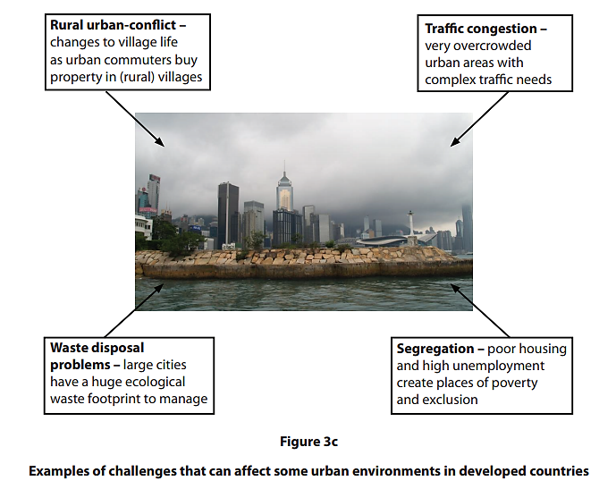
Worked Example Study Figure 3c
Analyse the different challenges that affect urban environments in developed countries
(8 marks)
You must mention the figures and use examples
There are four groups of challenges here:
- Rural-urban conflict – this is a problem of people moving in both directions, adding to traffic congestion and changing house prices
- Traffic congestion – Traffic congestion is a major issue in many large cities
- Waste disposal – large cities have problems disposing of their waste in a long-term and sustainable way
- Segregation – this leads to a division of rich and poor
What questions should you ask yourself?
- Why are they happening?
- Which ones are the hardest to solve?
- Are these the only four challenges faced by developed cities?
- Are all developed cities experiencing this growth and these challenges?
Why are they happening?
- Urbanisation is the main cause of these challenges, where there is an increase in the proportion of people living in towns and cities compared to rural regions
- Even in developed cities, ensuring there is sufficient transport, sanitation, education, health care, housing and utilities means overcoming major obstacles such as the cost, available space and any planning restrictions
Which ones are the hardest to solve?
- Waste because many developed cities have old sewage systems that need updating or are unable to cope with the increased use
- Landfill space is running out and disposing of household and other waste is difficult; many cities ship this overseas
- Segregation is also difficult because of historic and cultural factors
Are these four the only challenges faced by developed cities?
- No, they will vary across time, place and space
- Hong Kong does not have issues with traffic congestion due to an efficient public transport system
- However, Hong Kong does have major issues with social polarisation and poverty
Are all developed cities experiencing this growth and these challenges?
- No, some populations are in decline due to an ageing population such as Tokyo, Japan
- Lifestyle choices – many couples are choosing not to have children or are moving out of the city (counterurbanisation)
Remember that as this is an eight-mark question, you will be expected to have paragraphs and some examples to support your answer.
Was this revision note helpful?