Characteristics of Coastal Ecosystem (Edexcel IGCSE Geography)
Characteristics of Coral Reef Ecosystems
Spec point —
4GE1-S3.043
-
An ecosystem is a community of interacting biotic organisms and abiotic factors
-
All ecosystems, whether on land or in water function in the same way
-
All survive by nutrient cycling around three stores
- Biomass
- Litter
- Sea Water
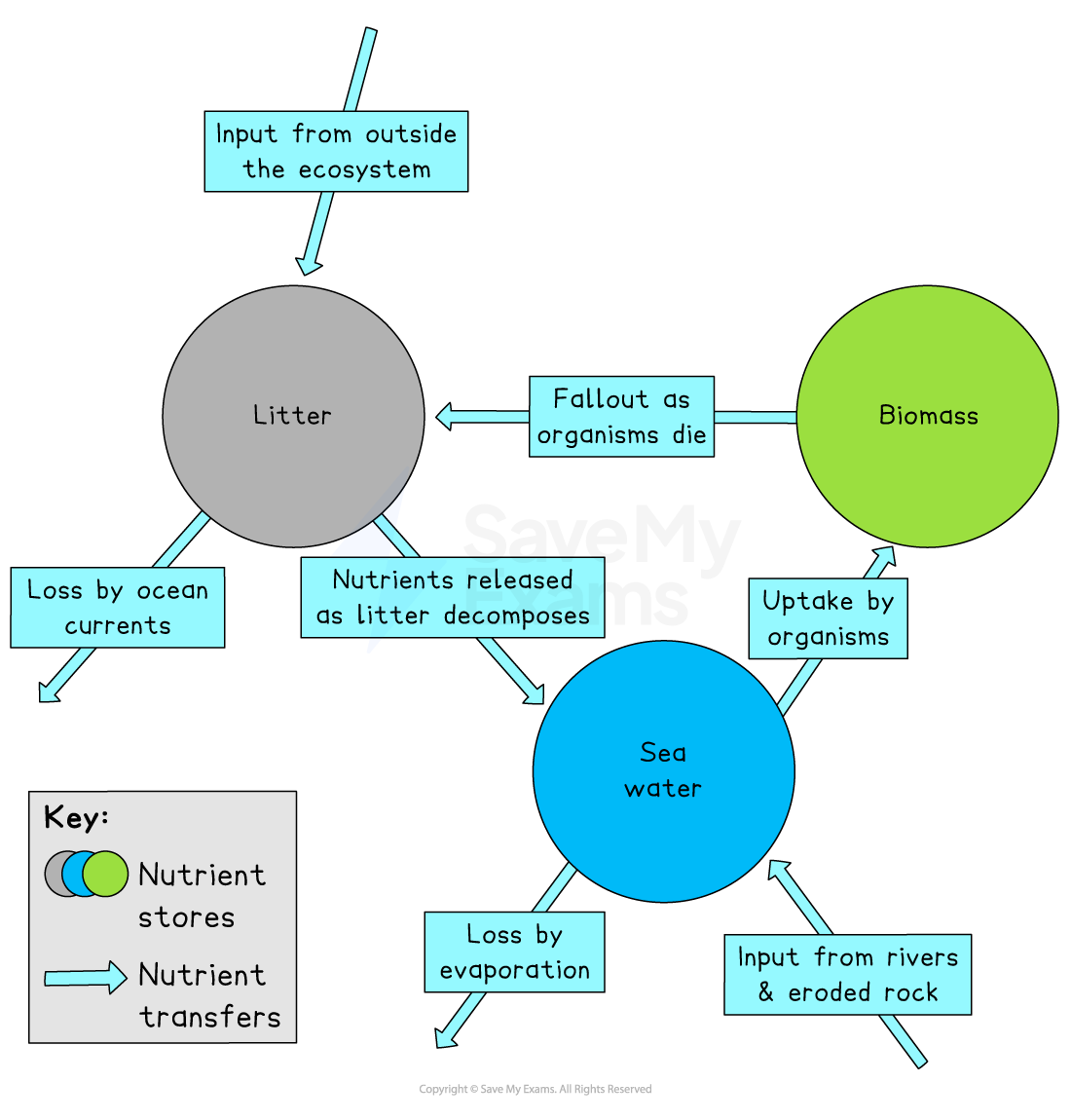
*Nutrient cycle of a coastal ecosystem *
Nutrient cycle of coastal ecosystems
Mangroves
- Nutrient store– mud/sand
- Biomass store– plants and animals
- Litter– dead plants and animals
- Degrades in water
- Transfers– water
Sand dunes
- Nutrient store– mud/sand
- Biomass store– plants and animals
- Litter– dead plants and animals
- Degrades in water
- Transfers– land
Salt Marsh
- Nutrient store– mud/sand
- Biomass store– plants and animals
- Litter– dead plants and animals
- Degrades in water
- Transfers– land
Coral
- Nutrient store– sea water, rivers entering the sea, on-shore currents
- Biomass store– coral polyps, seaweed, fish, crustaceans and invertebrates
- Litter– dead coral polyps, seaweed, fish, crustaceans and invertebrates
- Degrades in seawater
- Transfers– tidal and ocean currents
Exam Hint Please ensure you have a clear understanding of nutrient cycling in these ecosystems, especially the distinction between abiotic and biotic factors. Examiners might ask you to name one or both of these factors from a list.
Biotic components of a coral reef
-
A coral reef is a well-organised food web comprised of:
- producers
- consumers
- scavengers
- decomposers
Producers
- Producers in a coral reef include seaweed, seagrass, and phytoplankton. zooxanthellae are also producers that provide the nutrients from photosynthesis to coral
Consumers
-
Consumers are organisms that eat other organisms to gain energy.
-
There are three main types of consumers in a food web: primary, secondary, and tertiary
- Primary consumers only eat producers – the green sea turtles graze on seagrass
- Secondary consumers eat primary consumers – stingrays, octopuses, squid, and larger fish, for example
- Tertiary consumers, also called apex predators, are carnivores that do not prey upon themselves. These consumers help maintain the balance of the ecosystem - sharks, dolphins, tuna, barracuda, etc.
-
Scavengers
- Scavengers feed on dead and decaying plants and animals – crabs and lobsters scavenge for food
Decomposers
- Decomposers bring nutrients back into the ecosystem to support another cycle – examples include bacteria, sea cucumbers, and fungi
Abiotic features of a coral reef
-
Corals need a certain amount of sunlight to survive
- Too little light and the zooxanthellae will not be able to photosynthesise and produce food for corals
- Too much light may cause corals to expel zooxanthellae, causing bleaching
-
Depth: As corals need light, they are typically found at approximately 25 meters
-
Water temperature: Corals thrive in the warm waters of the tropics. They prefer a temperature range of 23-25°C but will survive at lower and higher temperatures for short periods
-
Salinity: Corals need salty water
-
Air: Can survive out of water for very short periods
-
Water: Corals need clean, clear water
Characteristics of Mangrove Ecosystems
Spec point —
4GE1-S3.043
Biotic components of a mangrove
Producers
-
Mangroves are the producers of their own ecosystem
- Many organisms feed on the detritus created from falling leaves
- Phytoplankton can float on the surface of the water and algae grow on the mangroves' roots
Consumers
- Primary consumers are usually the decomposers (e.g. the mangrove tree crab). Small fish, crabs, clams, and shrimp feed off of the detritus. Very few consumers directly feed on the mangroves
- Secondary consumers are the larger predatory fish, turtles, and crabs
- Tertiary consumers include birds (e.g. herons and ospreys), eels, saltwater crocodiles, tigers, and humans
Scavengers
- Scavengers include shrimp, crabs mussels and mullet
Decomposers
- Decomposers include worms, bacteria and fungi
Abiotic features of mangroves
- Temperature: Mangroves typically grow in areas where the temperature does not drop below 19°C
- Oxygen: Just like other plants, mangroves need oxygen to survive. Complex root systems allow the mangroves to receive the oxygen they need by sticking out of the water
- Salinity: Mangroves have adapted to live in salt water, with some removing excess salt through their leaves
- Soil: Mangroves can grow within the intertidal zone of a coast. The soils are made up of sand, silt, and mud
- Wave energy: Mangrove vegetation cannot develop on exposed coasts with a lot of wave energy or currents that move sediments, which would stop seeds from colonising
- Ocean currents: These distribute mangrove seeds and help keep the areas full of trees
Characteristics of Sand Dune Ecosystems
Spec point —
4GE1-S3.043
Biotic components of sand dunes
Producers
-
Producers that provide the initial beach fuel for dunes include:
- phytoplankton, microscopic algae (green scum found on a beach), detached seaweeds (such as kelp and seagrass), and blown-in seeds.
- These support the growth of pioneer species such as couch grass and lyme grass. As succession continues, multiple species of vegetation begin to colonise – marram grass, gorse, sea buckthorn, heathers, red fescue, etc.
Consumers
- Primary consumers: beetles, butterflies, moths, bees, wasps, flies, rabbits, etc.
- Secondary consumers: sand lizards, snakes, spiders, frogs, bats, etc.
- Tertiary consumers: seagulls, waders, hawks, swans, bats, etc.
Scavengers
- Scavengers: crabs, beetles, flies, wasps, crows, rats, etc.
Decomposers
- Decomposers: flies, fungi, bacteria, weevils, etc.
Abiotic features of sand dunes
- Wind – an onshore prevailing wind is needed to blow the dried sand into ridges
- Tidal range – needs to be large to allow sand to dry
- Water – a mix of fresh and saline to support pioneer species
- Sand – large quantities needed
- Beach – needs to be wide
- Obstacles – needed for sand to accumulate behind
Characteristics of Salt Marsh Ecosystems
Spec point —
4GE1-S3.043
Biotic components of salt marshes
Producers
- Producers – algae, seaweed, rushes, samphire, cord grass, salt marsh hay etc.
Consumers
- Primary consumers – fish, insects, mussels, crabs, bees, oysters, shrimp, etc.
- Secondary consumers – fish, mice, frogs, herons, lizards, sandpipers, bats, etc.
- Tertiary consumers – harriers, sea eagles, gulls, etc.
Scavengers
- Scavengers – snails, rats, crows, flies, crabs, etc.
Decomposers
- Decomposers – fungi, bacteria, worms, etc.
Abiotic features of salt marshes
- Waves – sheltered away from the open sea & destructive waves, usually behind a spit or in sheltered bays
- Water – brackish (mix of fresh and salty)
- Tidal Range- this is large with occasional flooding. Mudflats need to be exposed to colonise
- Mud – sediment needed to build up mud flats
- Elevation – needs variation in height to build up mud flats and stabilise marshes
Worked Example Explain two factors affecting the distribution of coral reef ecosystems.
(4 Marks)
Answer:
You need to state 2 reasons why coral reefs grow where they do or why they might stop growing there
- Need temps of 23-28 degrees **(1)**so only found in the tropics (1)
- Light is needed for coral to grow (1), as they only grow in areas of shallow water where the light can penetrate (1)
- Global warming (1) leading to sea-level rise (1)
- Human impact (1)for example climate change causing the temperature of water to change/coral bleaching (1)
- Pollution from tourist activity** (1)** damages coral (1)
- Any other appropriate response
Was this revision note helpful?