International Management Strategies (Edexcel IGCSE Geography)
Intergovernmental Agreements
Spec point —
4GE1-S3.066
-
Intergovernmental organisations (IGOs) have a significant role in reducing uneven development
-
Organisations include many which are part of the United Nations (UN):
- World Health Organisation (WHO)
- Food and Agriculture Organisation (FAO)
- United Nations Conference on Trade and Development (UNCTAD)
- United Nations Educational, Scientific and Cultural Organization (UNESCO)
-
There are also organisations which are part of the UN but are not completely controlled by the UN including:
- The World Bank
- International Monetary Fund (IMF)
-
The World Trade Organisation (WTO) is not part of the UN but has strong links with it
Role of IGOs
-
Governments of countries around the world donate money to IGOs
-
This money is then allocated to countries around the world for projects to assist the development
-
The IMF, World Bank and WTO promote free trade and globalisation
-
The UN developed the Sustainable Development Goals which have been agreed upon by 193 countries:
- Include 17 goals including zero hunger, clean water and quality education
-
Debt relief is also used by IGOs to assist development:
- Allows countries to focus on developing and investing in areas such as infrastructure and education
- There is no guarantee that the country will spend it effectively
Trade Agreements
Spec point —
4GE1-S3.066
-
Trade is often promoted as the key to economic development
-
Trade allows countries to sell the resources they have so they can then invest in things which will improve development such as education and healthcare
-
The money generated by trade also means they can import resources that they don't have including:
-
tractors or communication technology
- This can enhance development
-
-
Trade is not always fair:
- Developing countries are often paid less for their exports than developed countries
- Developing countries are often disadvantaged by trade barriers
- Trade agreements often favour developed and emerging countries
Aid Agreements
Spec point —
4GE1-S3.066
-
There are different types of international aid
-
International aid can be given as:
- advice
- technology
- food
- money
-
Aid must be appropriate meaning that it fits the needs of the developing country
- Aid in the form of tractors may not be appropriate if the community cannot afford the diesel or doesn't have the skills needed to maintain them
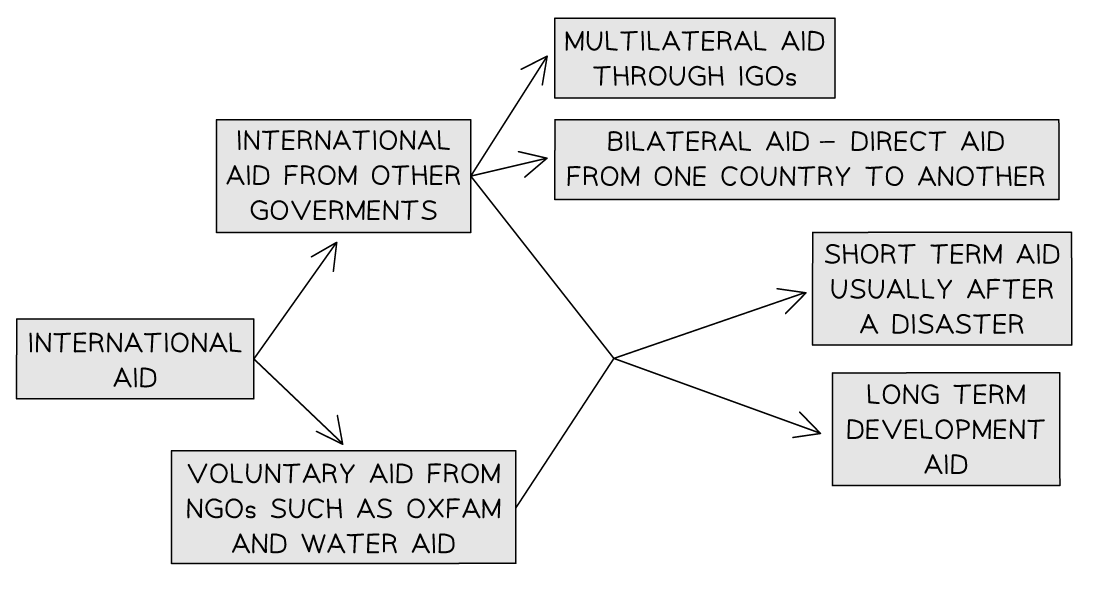
Types of international aid
Disadvantages of international aid
-
International aid does not always reach the people who need it due to corruption and mismanagement
-
It is not always appropriate
- Large-scale projects such as dams can end up creating more poverty for some people
-
Countries may become dependent on aid and development may be stalled as a result
-
Aid is often tied aid which means that countries have to spend their money in specific ways rather than on the development which is needed
-
Aid can be used by the donor country to apply political or economic pressure
-
It can result in food and water costing more
Worked Example **Explain one way that international aid can reduce uneven development **
(3 Marks)**
Answer
- Transferring resources (food, water, skilled workers) from developed countries to developing countries** (1);helps to provide the skills and resources that the people need (1); income will increase and this can be invested in infrastructure improvements(1)
Was this revision note helpful?
Build on this topic