Rural change in Developed Countries (Edexcel IGCSE Geography)
Case Study - Changes in Rural Environments UK
Spec point —
4GE1-S6.068
-
In developed countries rural change has occurred as a result of:
- depopulation where areas experience a decrease in population over a period of time
- Tourism
- counter-urbanisation where people move from an urban area to a rural area
- suburbanisation when urban areas spread outwards into the surrounding rural areas
-
In the UK 19% of people live in rural areas
-
Rural areas are defined as areas with a population of less than 10,000
Case Study
Depopulation in the Western Isles
Areas experiencing depopulation in the UK include the Western Isles, Scotland:
- The population has decreased by over 50% in the last 100 years
Depopulation is most common in the remote, less accessible rural areas due to:
- the mechanisation of agriculture which has led to the decreasing availability of jobs
- the younger generation leaving to gain a wider variety of opportunities
- rural services decline with the closure of schools, shops and post offices
- rural isolation due to poor transport and communication links
- low wages
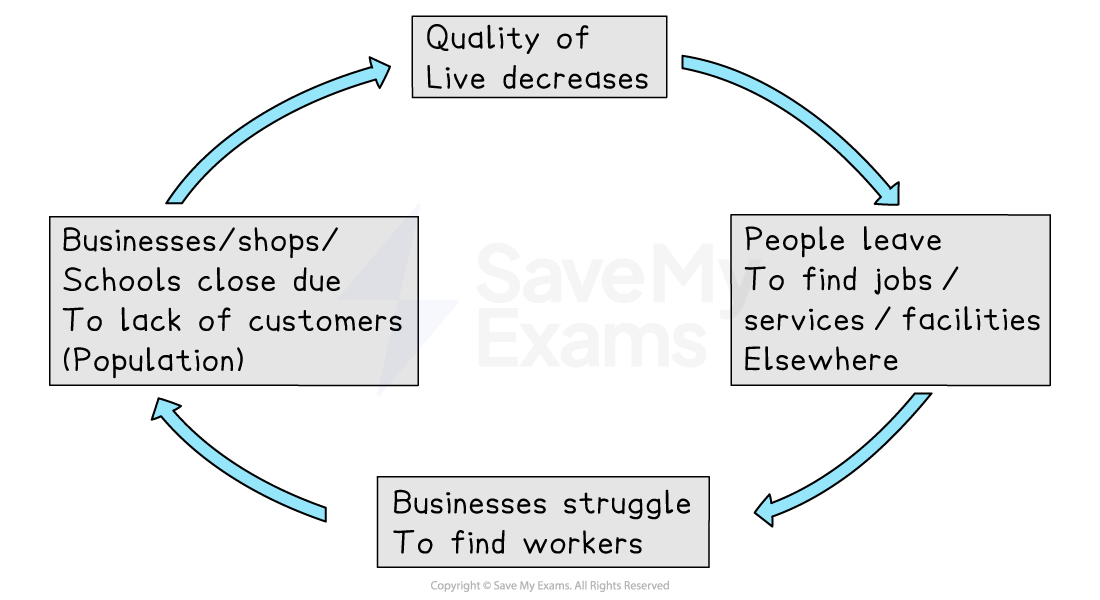
Negative Multiplier Effect
- Depopulation leads to a spiral of decline which it is difficult to stop or reverse
Depopulation and the negative multiplier effect
Impacts on the Western Isles
Impacts include:
- school closures due to fewer children
- an ageing population require higher amounts of social care, which will have social and economic impacts
- further decline in the fishing and farming industry as the younger generation choose better-paid jobs and the ageing population retires
- maintaining transport services for the smaller population is not cost-effective
- tourism is increasingly important but the infrastructure is not suited to large numbers of visitors
- abandoned crofts and land
Worked Example **Suggest two factors which might have encouraged the depopulation of the Western Isles **
(2 Marks)
Answer:
- Remote/ low accessibility (1)
- Poor service provision (1)
- Limited employment opportunity** (1)**
- High/rising unemployment (1)
- Farming difficulties/mechanisation (1)
- Limited facilities (1)
- Harsh weather (1)
Case Study - Tourism Pressure on Rural Regions
Spec point —
4GE1-S6.068
- Many rural areas in the UK have experienced a growth in tourism and leisure
- People in developed countries have more disposable income and spare time to spend on leisure activities
- Tourism is often focused on honeypots
- Tourism and leisure need to be managed to ensure they are sustainable
Case Study
Lake District
- Designated a National Park in 1952
- Over 15 million tourists visit the National Park each year
- In 2017 it was awarded World Heritage Site status
- The population is about 41,000
Tourism pressures
Transport pressure
Pressures Management strategies - Many visitors travel by car
- The rural roads are narrow
- This leads to congestion and air pollution
- Not enough parking available- 'Drive Less, See More' initiative to connect public transport
- Increased parking facilities
- Park and Ride schemes in Wasdale
- Increased charging points for electric vehicles
- Zero carbon busesHousing pressure
Pressures Management strategies - Increase in second homes - 50% of houses in Keswick are holiday lets or second homes
- Increase in house prices due to the demand average price in Keswick is £370,000
- Local people cannot afford to buy homes- New low cost homes are built which can only be purchased by local people who work in the area
- New bill to increase the amount of council tax paid by second homeowners
- Planning restrictions stating that houses have to be permanently occupiedEmployment pressure
Pressures Management strategies - Many jobs are in primary economic activities or tourism
- These jobs are often low paid and/or seasonal- Improvements in connectivity to the internet
- Encourage new businesses to locate in the Lake District through the use of development grantsEnvironment pressure
Pressures Management strategies - Footpath erosion on the fells due to the sheer numbers of walkers
- Litter
- Disturbing livestock and damaging crops
- Erosion of the lake banks
- Destruction of habitats- 'Fix the Fells' and National Park Authority working to repair the footpaths
- Additional bins
- Posters to encourage people to keep dogs on leads and close gates
- Speed limits on the lakes
Case Study - Suburbanisation and Counter-urbanisation
Spec point —
4GE1-S6.068
Suburbanisation
-
Rural spaces (greenfield sites) on the edge of towns and cities are being built on as the urban areas grow
-
New homes in large housing estates are the main land use
-
The population also require schools, shops, healthcare centres
-
New roads - ring roads and bypasses are built to increase accessibility
-
Industrial estates, businesses and retail parks also move to the area attracted by:
- lots of customers and workers living nearby
- more space for expansion, large stores and car parking
- cheap land
- more attractive environment
Case Study
Counter-urbanisation in St Ives, Cambridgeshire
In some areas, rural settlements are growing as people move to smaller settlements from towns and cities
St Ives is within a one-hour train journey of London and is also close to Cambridge
People moving to the area are:
- young families with children
- professionals with high-paying jobs
Pull factors of the area include:
- larger houses for less money than in London
- gardens and more open space
- less crime
- lower pollution levels
- attractive environment
Impacts of counter-urbanisation
Transport
- Increased commuters lead to more traffic and congestion
Housing
- Increase in house prices as people moving in can afford more
- Young locals cannot afford house prices
- Demand means more houses are built
- Older housing is renovated and extended
Environment
- Increased traffic leads to more air pollution
- Building on greenfield sites
Services
- Greater numbers of people may keep healthcare and schools open
Community
- Communities can become divided into new residents and old locals - conflicts can occur with disagreements about new developments
Was this revision note helpful?