Development of Rural Urban Fringe (Edexcel IGCSE Geography)
Rural-Urban Fringe
Spec point —
4GE1-S6.069
-
Also called the urban fringe
- It is where green, open spaces meet the built-up areas of towns and cities
-
Growth at the urban fringe is due in part to:
- counter-urbanisation
- population growth
- lack of space
- spiralling land costs
-
These can be divided into push factors (negative factors causing people/businesses to leave central urban areas) and pull factors (positive factors pulling people/businesses to the rural-urban fringe)
Push factors
-
Housing is old, congested and relatively expensive
-
There are various forms of environmental pollution – air quality is poor, and noise levels are high
-
Companies find that there is a shortage of land for expansion or building shops, offices and factories
-
Brownfield sites are expensive to build on due to the added costs of cleaning the land (especially if contaminated with asbestos) before building
- Also there may be restrictions on what can be built
-
Access for heavy goods vehicles is limited or difficult, adding to congestion and air pollution
Pull factors
- Land is cheaper so houses are larger and have gardens
- Factories can be more spacious and have plenty of room for workers to park their cars
- Closeness to main roads and motorways allows for quicker and easier customer contacts
- Closeness to main roads and motorways allows for quicker and easier commutes for car drivers and access for lorries
- Changing working patterns thanks to technology, e.g. flexible working, working from home, etc.
Changes along the urban fringe
-
Some of the biggest changes in the urban landscape can be seen in the rural-urban fringe
-
Other than new housing estates, there are also:
-
Retail parks
- These have a large sphere of influence due to being easily accessible, ample free parking, the concentration of businesses in one place, longer opening hours, and a large choice of goods
-
Industrial estates
- Space for expansion, purpose-built road networks, cheaper land, sited away from housing
-
Business parks
- Space is created for a nicer working environment, easier access and commute for workers, the area is specifically created for office space and includes a conference hotel
-
Science parks
- Purpose-built to encourage research and development (R&D), high-tech industries and other quaternary activities, close to a university and transport networks (including airports) to allow for knowledge transfer
-
Airports
- Increase in air traffic and low-cost carriers, but also airports feed into businesses on the fringe through imports and exports but also knowledge with speakers and investors having easy access to businesses
-
Motorways and ring roads
- Feed into ease of access for residents, workers, lorries, buses, cars etc.
-
The Greenfield vs Brownfield Debate
Spec point —
4GE1-S6.069
-
Urban growth involves building on land, which is in short supply in the urban centres
-
This makes the open land around the urban fringe desirable for:
- housing
- industry
- shopping
- recreation
- public utilities such as reservoirs and sewerage works
-
However, some people feel too much countryside is being lost through this outward growth of towns and cities
-
Some urban areas have a planned and protected greenbelt on which no development is allowed, but urban areas still need to grow
-
This means there are two choices, either build on a greenfield or brownfield site
-
With all land uses there are arguments for and against each type of site
Brownfield sites
Advantages of brownfield sites
- Helps revive old and disused urban areas
- Reduces the loss of countryside for agricultural or recreational use
- Services such as water, electricity, and sewage, are already in place
- Located near to main areas of employment.
- Reduces the risk of squatter settlements developing
Disadvantages of brownfield sites
- Often more expensive because old buildings must be cleared, and land made free of pollution
- Often surrounded by rundown areas so does not appeal to wealthy people
- Higher levels of pollution
Greenfield sites
Advantages of greenfield sites
- Healthier environment
- Close to the countryside, leisure, and recreation
- The layout is not restricted by the existing layout
- Relatively cheap and the rate of house building is faster
- Access and infrastructure easier to build
Disadvantages of greenfield sites
- Valuable farmland lost
- Encourages further suburban sprawl
- Wildlife and habitats lost or disturbed
- Recreational space and attractive scenery lost
- Lacks access to public transport
- Development causes noise and light pollution in the surrounding countryside
- Cost of installing services such as water, electricity, sewage, etc.
Conclusion
-
There are no clear winners in this debate
-
It depends on the particular land use:
- Housing is flexible in terms of where it could be built, but shops and offices need more space and specific locations
- Depends on the needs of the town or city
- What value is the greenspace really to the town or city?
- The issues and costs in reusing the brownfield site (asbestos etc.) need to be considered
Example Case Study - Southampton's Rural-Urban Fringe
Spec point —
4GE1-S6.069
- Southampton has a population of over 270,000 with detached suburbs or commuter dormitories
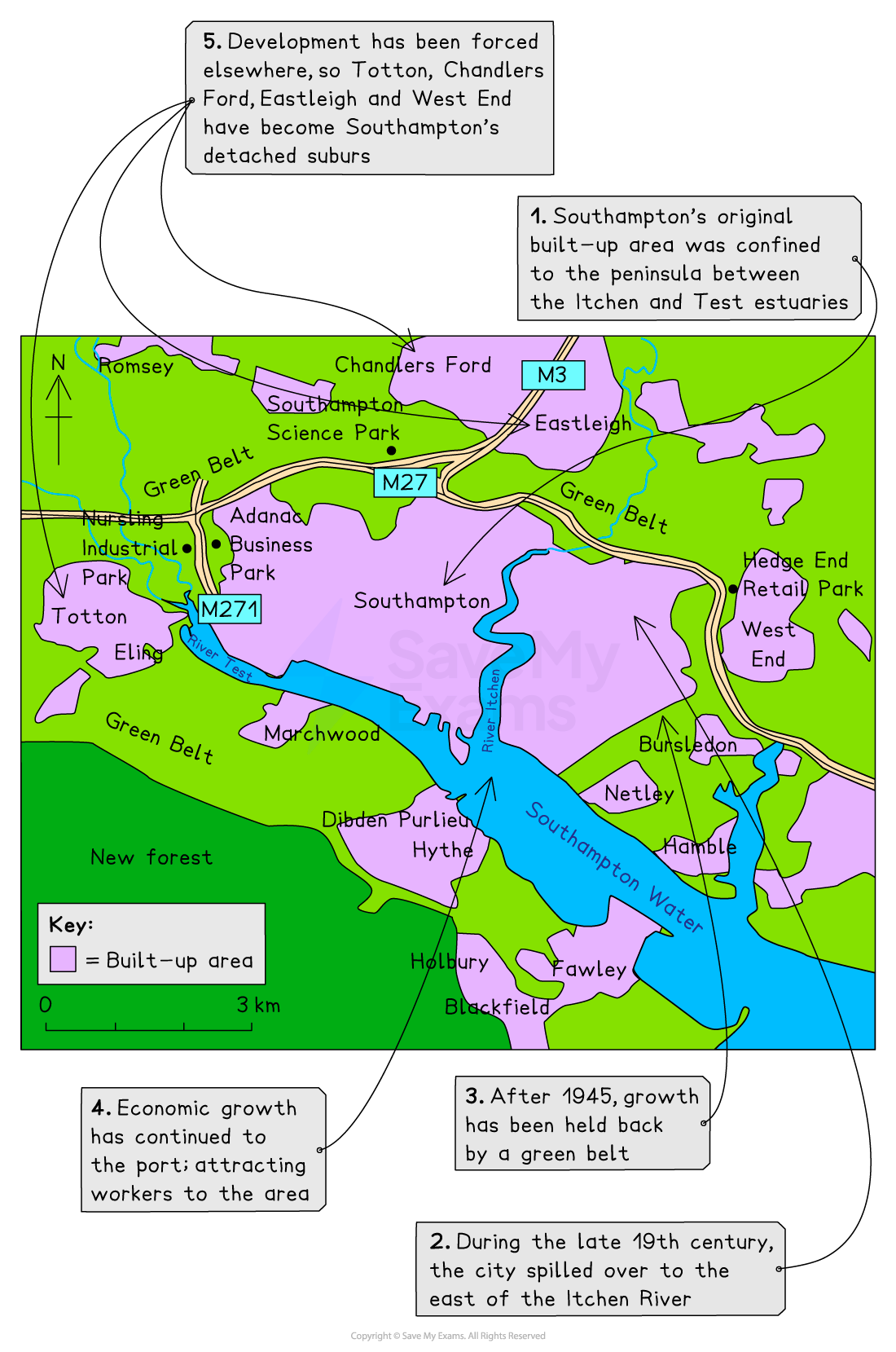
Growth of Southampton's residential areas
- Pressure from developers resulted in green belt restrictions being relaxed
- Motorways were added through the green belt, giving Southampton good access all round
- As a result, certain types of businesses have been allowed to build on a limited number of sites
Nursling Industrial Park
- Located beside the M271
- This large estate has service industries of which distribution and storage are the main ones
Southampton Science Park
-
In a prime location close to the London M3 motorway
-
A 17-hectare park which provides high-quality office and laboratory space in attractive landscaped surroundings
-
Over 60 companies, dealing in high-tech research fields, sit side by side
-
This has resulted in a thriving community of young and old sharing ideas and knowledge
-
Businesses are attracted by the:
- strategic location
- quality of the environment
- access to some of the UK’s leading scientific expertise at the University of Southampton
Hedge End Retail Park
-
Located just off the M27
-
One of the largest out-of-town retail parks in the South of England
-
Home to:
- Marks and Spencer
- Sainsburys
- Currys/PC World
- Many more stores
Adanac Business Park
- Approved in 2008
- A 74-acre site
- Home to the Ordnance Survey (OS), which produces all the maps of the UK
- The park is earmarked for major office developments and large space occupiers
Worked Example **Explain one advantage and one disadvantage of developing greenfield sites. **
[4 marks]
- 1 mark for the initial explanation
- 1 mark for development through further explanation or exemplification
Final answer: Possible Answer:
- Advantage: Greenfield sites are often flat and uncontaminated** [1],** which makes it cheaper to develop land compared to the clearing cost of brownfield sites. [1]
- Disadvantage: Uses permeable land that, when developed, increases surface run-off [1], which can increase urban flood risk in an area. [1]
Was this revision note helpful?