Roots of Quadratic Equations (Edexcel IGCSE Further Maths)
Discriminants
Spec point —
2B
What is the discriminant of a quadratic function?
-
The discriminant of a quadratic is often denoted by the Greek letter (upper case delta)
-
For a quadratic the discriminant is given by
-
The discriminant is the expression that is inside the square root in the quadratic formula
-
This is not on the exam formula sheet so you need to remember it
How does the discriminant of a quadratic function affect its graph and roots?
-
The discriminant tells us about the roots (or solutions) of the equation
- It also tells us about the graph of
-
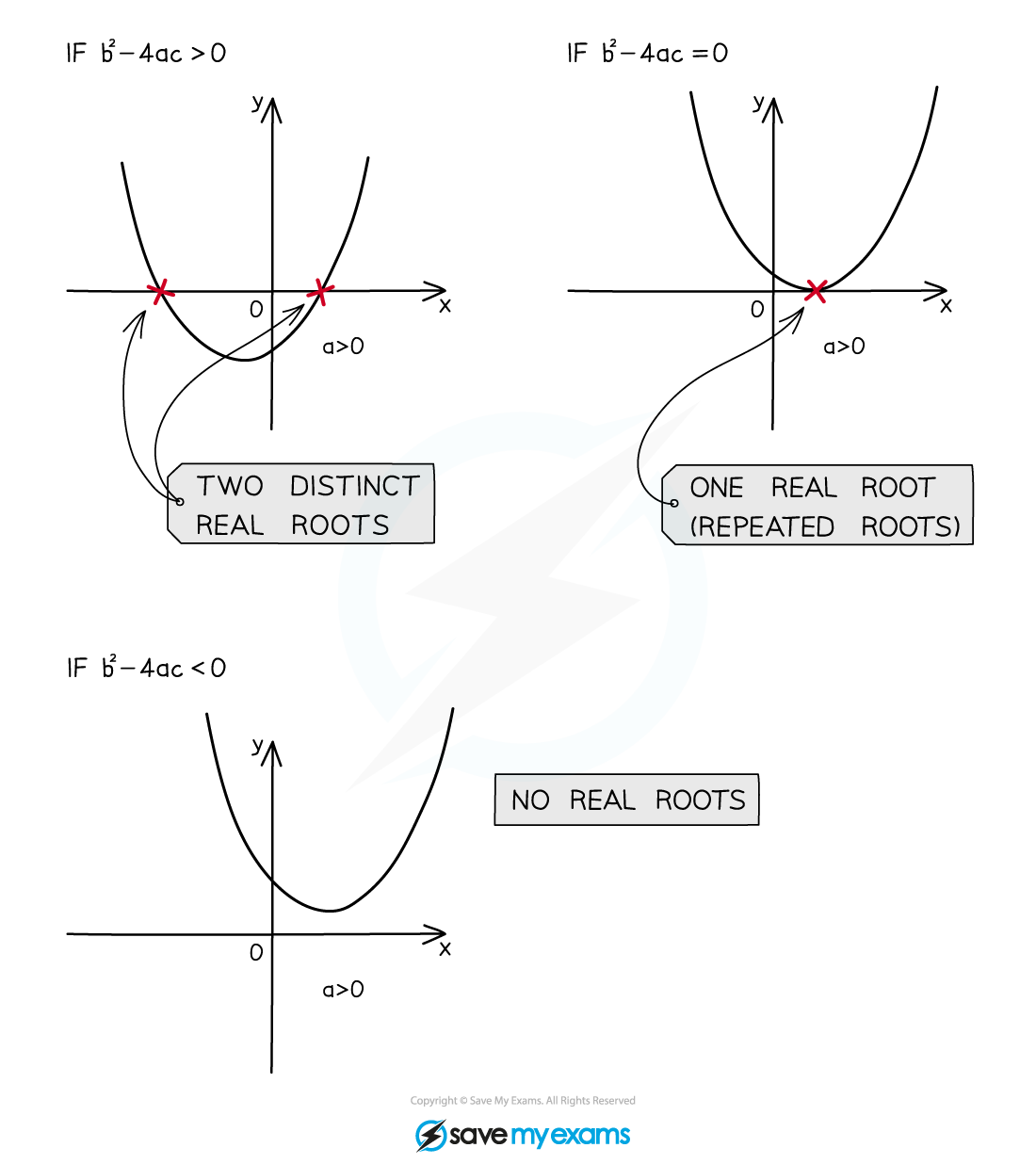
If Δ > 0 then and are two distinct values
-
The equation has unequal real roots
- i.e. there are two distinct real solutions
-
The graph of crosses the x-axis twice
-
-
If then and are both zero
-
The equation has equal real roots
- i.e. it has one repeated real solution
-
The graph of touches the x-axis at exactly one point
- This means that the x-axis is a tangent to the graph
-
-
If then and are both undefined
-
The roots of the equation are not real
- i.e. it has no real solutions
-
The graph of never touches the x-axis
- This means that graph is wholly above (or below) the x-axis
-
How do I solve problems using the discriminant?
-
Often at least one of the coefficients of a quadratic will be given as an unknown
- For example the letter * may be used *for the unknown constant
-
You will be given a fact about the quadratic such as:
- The number of real solutions of the equation
- The number of roots (i.e. x-intercepts) of the graph
-
To find the value or range of values of
-
Find an expression for the discriminant
- Use
-
Decide whether , or
- If the question says there are real roots but does not specify how many then use
-
Solve the resulting equation or inequality for
-
Exam Hint
Questions won't always use the word discriminant
It is important to recognise when its use is required
Look for
- a number of roots or solutions being stated
- whether and/or how often the graph of a quadratic function intercepts the -axis
Worked Example A function is given by , where is a constant. The graph of intercepts the -axis at two different points.
a) Show that .
The question says the graph 'intercepts the x-axis at two different points'
This means that the discriminant is greater than zero
Here , , and
Expand the brackets and collect terms
b) Hence find the range of possible values of .
Solve the inequality, beginning by factorising
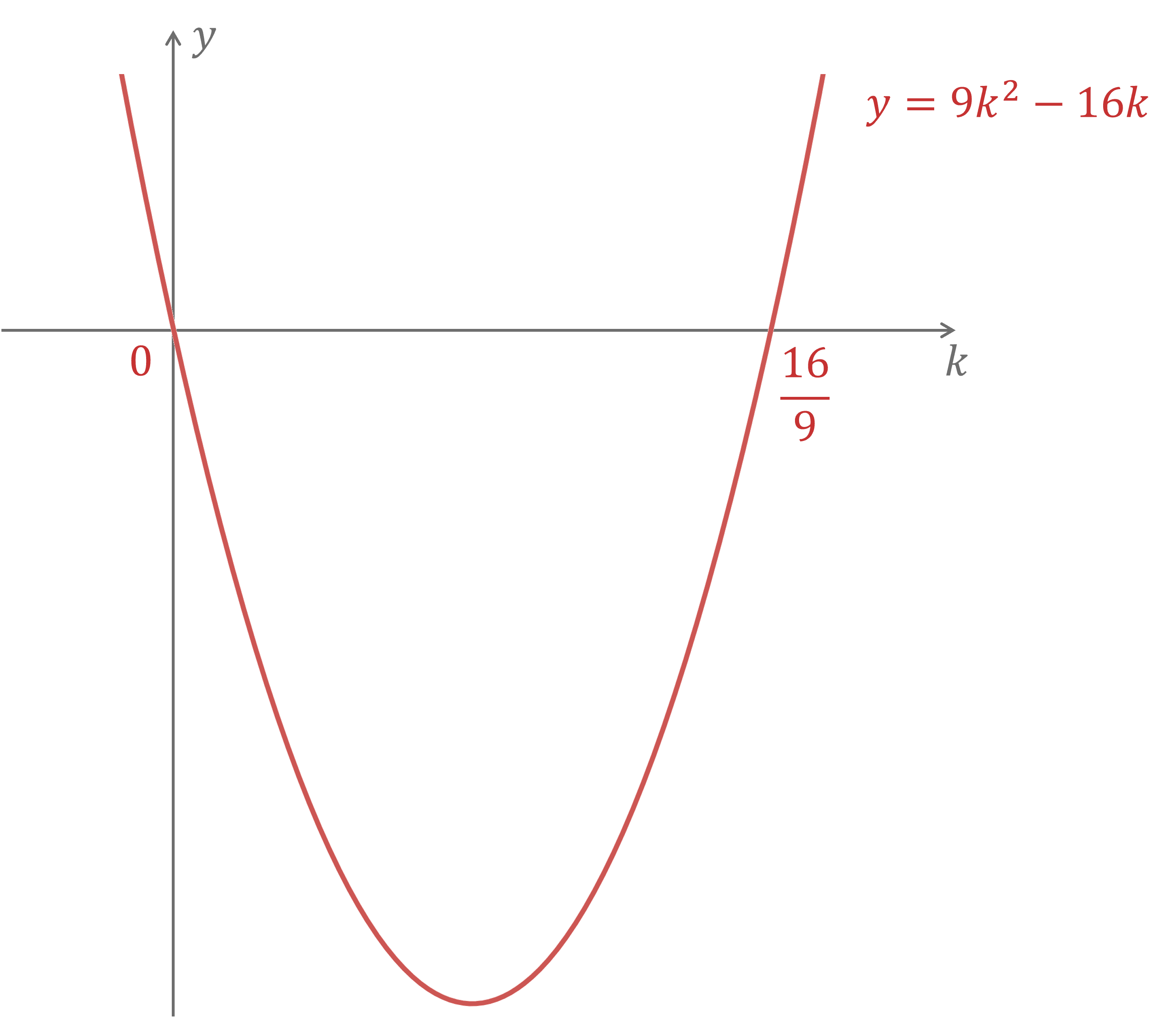
This tells us the graph of intercepts the horizontal axis at and
It can be helpful to sketch a graph here
will be true to the left of 0 and to the right of
Write these down as inequalities
Sum & Product of Roots
Spec point —
2C
How are the roots of a quadratic equation linked to its coefficients?
-
A quadratic equation (where ) has roots and given by
-
- i.e. the solutions found by the quadratic formula (or any other solution method)
-
-
This means the equation can be rewritten in the form
-
Note that
- It is possible that the roots are repeated, i.e. that
-
You can then equate the two forms:
-
Then (because ) you can divide both sides of that by a and expand the brackets:
-
Finally, compare the coefficients
- coefficients:
- Constant terms:
-
-
Therefore for a quadratic equation :
- The sum of the roots is equal to
- The product of the roots is equal to
-
You don't need to prove these results on the exam
-
But you need to be able to use them to answer questions about quadratics
-
They are not on the exam formula sheet
- So you need to remember (or be able to derive) them
-
-
You can use them
-
to find the sum and product of the roots if you know the equation
- Just substitute , and into the formulae
-
or to find the equation if you know the sum and product of the roots
- See the next section
-
How do I find a quadratic equation from information about its roots?
-
You may be given the sum and product of an equation's roots and then asked to find the equation
-
Usually the equation will need to have integer coefficients
- For example "A quadratic equation has roots and , where and . Find a quadratic equation with integer coefficients that has roots and ."
-
-
STEP 1 Start with the formulae linking the roots and coefficients
-
- So
-
- So
-
-
STEP 2 Choose a value for , and find the corresponding values for and
-
Choose a value for that will multiply to make the values for and into integers
- Let
- Then
- And
-
-
STEP 3 Write down the equation using your values for , and
-
Note that the answer is not unique
-
Any multiple of the equation will also have the same roots
- e.g.
-
How do I find a quadratic equation with related roots?
-
You may be asked to find a quadratic equation whose roots are related to the roots of another quadratic equation
- I.e. whose roots are expressed in terms of the roots of the first equation
-
You will often need algebraic tricks to write other expressions with and in terms of and
-
and are the roots of the first quadratic
-
For example:
-
-
Then if you know the values of and from the first quadratic, you can use them to find the sum or product of the new roots
-
For example "A quadratic equation has roots and where and . Form a second quadratic equation with integer coefficients that has roots and ."
-
The sum of the new roots is
- We can use the substitution for from above
- So
-
The product of the new roots is
- So
-
With the sum and product we can form the equation as described in the last section
-
Worked Example The roots of the quadratic equation are and .
Given that and without solving the equation,
(a) show that
Use and to find the sum and product
Express in terms of and
Substitute to find the value
Take the square root, remembering the
Finally, use the fact that
But , therefore
(b) form a quadratic equation, with integer coefficients, which has roots and
Start by finding the sum and product of the new roots
| Sum=(α+β)/(a)+(α - β)/(β) | | _=(β (α+β)+α (α - β))/(α β) | | _=(α ^2+β ^2)/(α β) | | _=((α ^2+2α β+β ^2) - 2α β)/(α β) | | _=((α+β) ^2 - 2α β)/(α β) | | _=((11 / 2) ^2 - 2 (5 / 2))/(5 / 2) | | _=101 / 10 | | _ _ _ | _ _ _ | Product=(α+β)/(a) x (α - β)/(β) | | _=((α+β)(α - β))/(α β) | | _=((11 / 2)(9 / 2))/(5 / 2) | | _=99 / 10 | |Now use and
Select so and will have integer values
And finally use those coefficients to write the new equation
Was this revision note helpful?
Build on this topic