Logarithmic Functions (Edexcel IGCSE Further Maths)
Introduction to Logarithms
Spec point —
1A
What are logarithms?
-
A logarithm is the inverse of an exponent
-
If then
log_ a (b)=x, where- This is the essential definition of a logarithm
- The number is called the base of the logarithm
-
-
Try to get used to ‘reading’ logarithm statements to yourself
- means “ is the power that you raise to, to get "
- So means “3 is the power that you raise 5 to, to get 125”
-
Two important special cases are:
-
- Where is the mathematical constant 2.718…
- This is called the natural logarithm and will have its own button on your calculator
-
log x=log_ 10 (x)- Logarithms of base 10 are frequently used
- They are often abbreviated simply as
-
Why use logarithms?
-
Logarithms allow us to solve equations where the exponent is the unknown value
-
We can solve some of these by inspection
- For example, for the equation we know that * *must be
-
But logarithms allow us to solve more complicated problems
- For example, the equation does not have an obvious answer
- Instead we can rewrite the equation as a logarithm
-
- and use our calculator to find the decimal value of
Exam Hint
- Make sure you are completely familiar with your calculator's logarithm functions
Worked Example Solve the following equations:
i) , Use the definition of a logarithm to rewrite this as an exponential equation
Remember, this equation means " is the power that you raise 3 to, to get 27"
This can be solved by inspection
ii) , giving your answer to 3 s.f.
Use the definition of a logarithm to rewrite this as a logarithm equation
We want the logarithm that means " is the power that you raise 2 to, to get 21.4"
Use your calculator to find the value of that logarithm
Round to 3 significant figures
* *(3 s.f.)
Logarithmic Functions & Graphs
Spec point —
4A
What is a logarithmic function?
-
A logarithmic function is of the form
- In this course the base for a logarithmic function will always be an integer greater than one
-
Its domain is the set of all positive real numbers
- You can't take a log of zero or a negative number
-
Its range is the set of all real numbers
-
and are inverse functions
log_ a (a^x)=xand
What are the key features of logarithmic graphs?
-
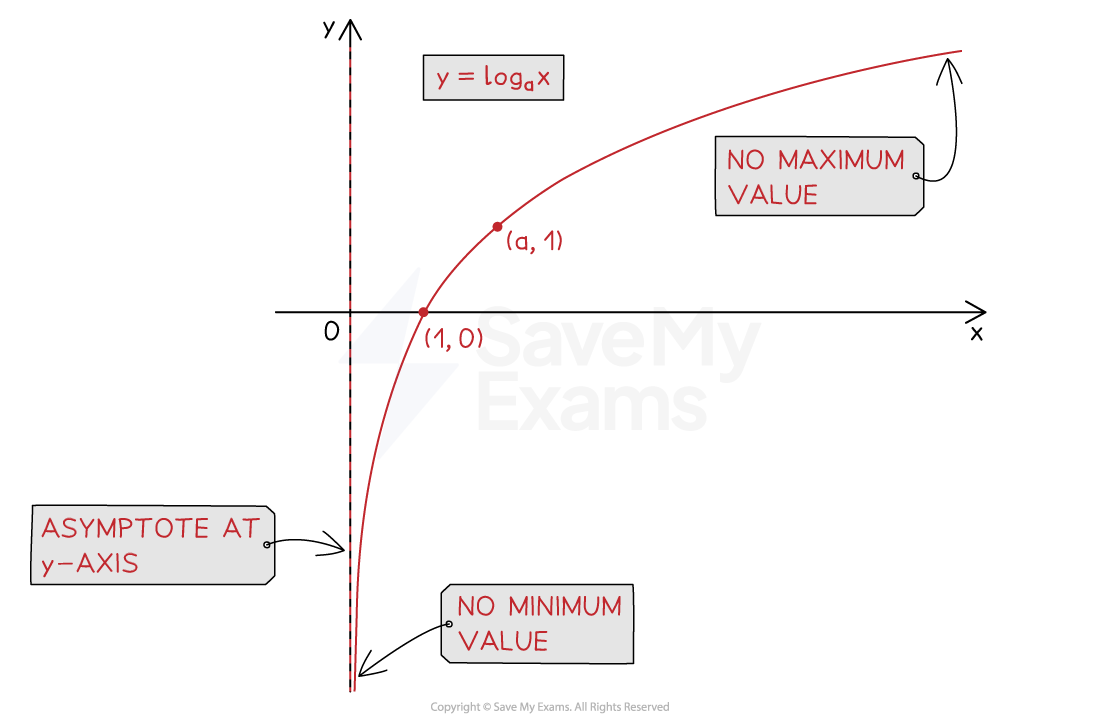
The graph of
- does not have a-intercept
- has a vertical asymptote at the y-axis:
- has one-intercept at (1, 0)
- passes through the point (a, 1)
- does not have any minimum or maximum points
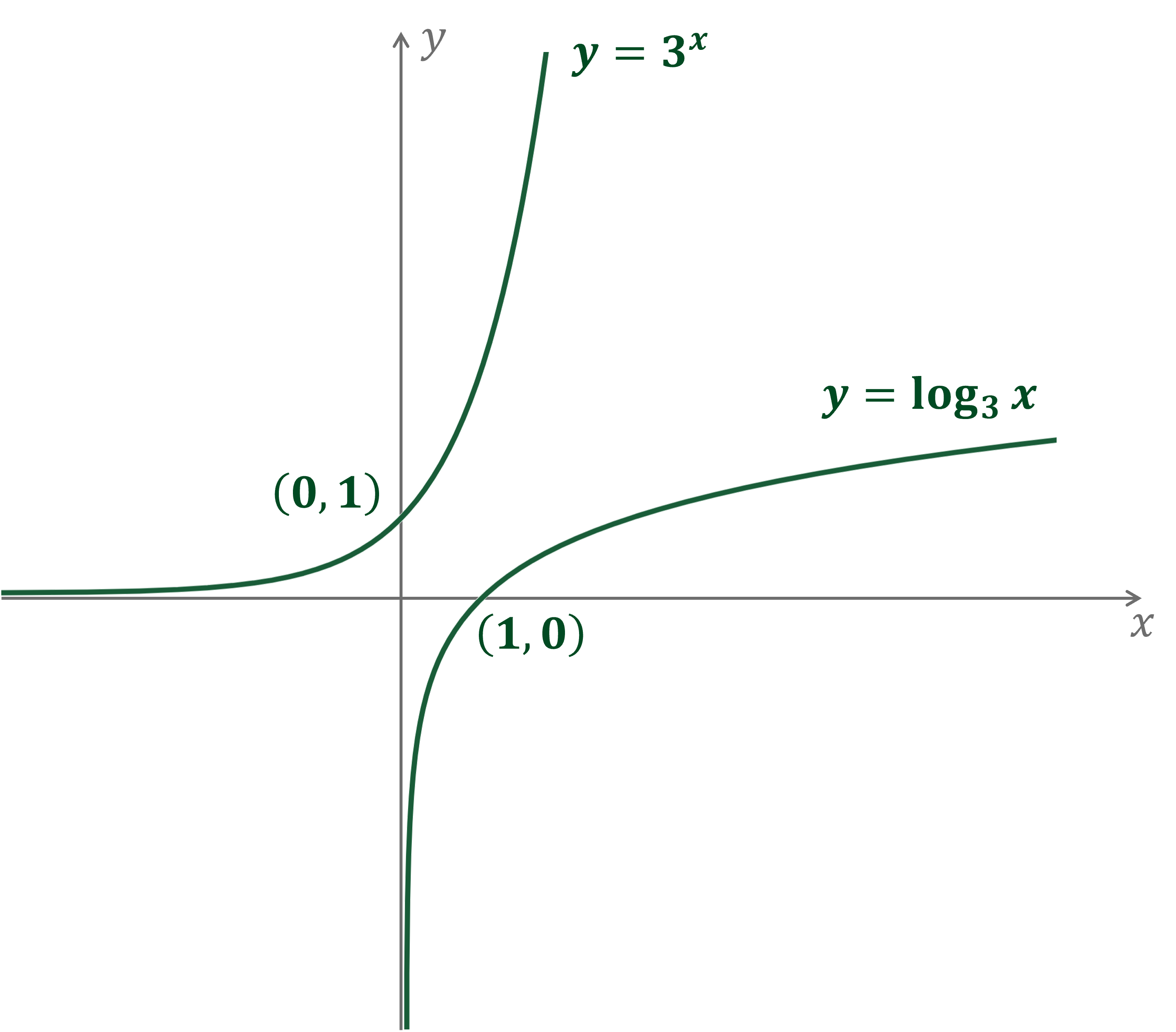
Worked Example On the same set of axes, sketch the graphs of and . Be sure to label any axis intercepts.
will have the typical logarithmic graph shape The -axis is an asymptote, and the -intercept is
(1 comma 0)will have the typical exponential graph shape The -axis is an asymptote, and the -intercept is
(0 comma 1)and are inverse functions Therefore their graphs will be reflections of each other in the line
Was this revision note helpful?