-
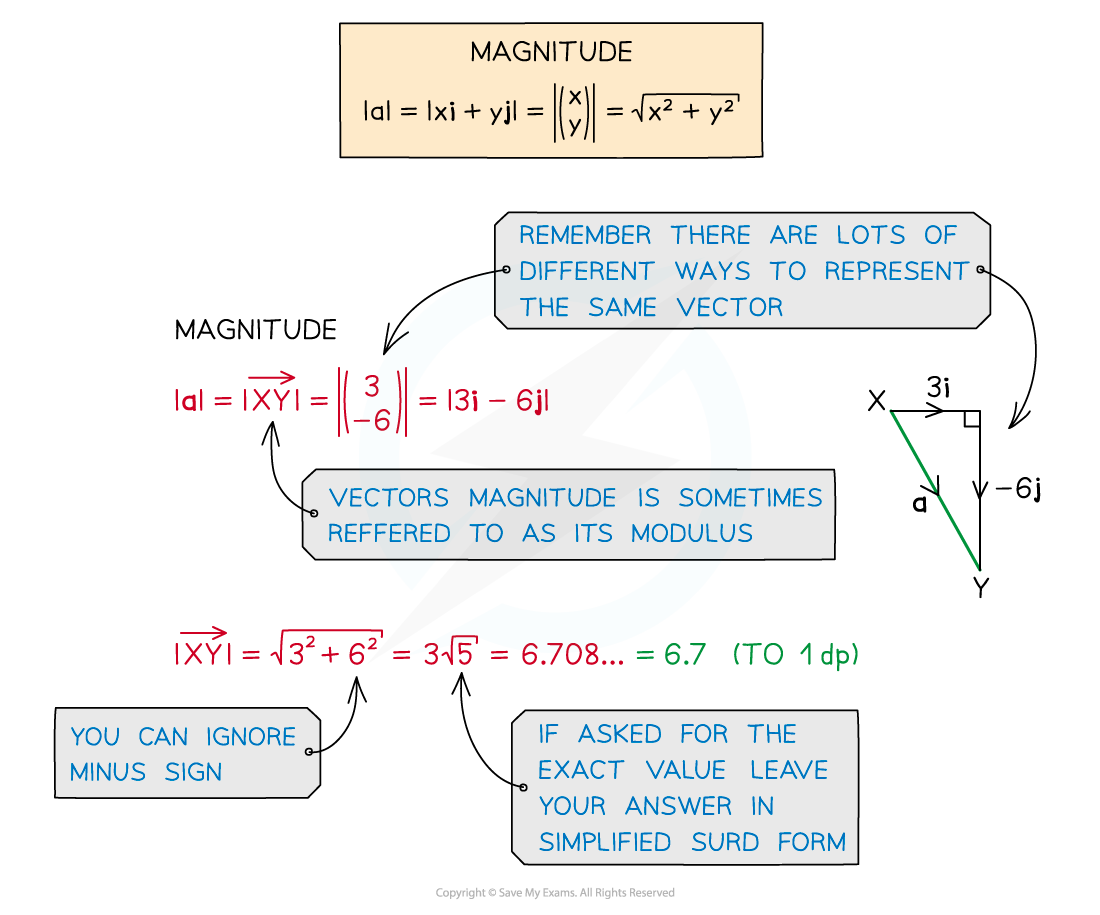
The magnitude of a vector is its length(distance)
- It is also called the modulus
-
The magnitude of AB→ is written AB
- The magnitude of a is written |a|
-
In component form, the magnitude is the hypotenuse of a right-angled triangle
-
Use Pythagoras' theorem to find it
-
The magnitude of a=ξ+yj is
- ∣a∣=x2+y2
- where a=(xy)
-
The magnitude of a sum of vectors is not equal to the sum of the magnitudes
-
∣a±b∣eq∣a∣±∣b∣
- Work out a + b (or a - b) first, then find its magnitude
-
You may need to form an equation
-
For example, |a| = 5 where a = 4i + *xj
- 42+x2=5
- This solves to give x=±3
-
You can use coordinate geometry to find magnitudes of displacement vectors from A to B
-
From the position vectors of A and B you know their coordinates
- If a=OA=x1i+y1j=(x1y1), then point A has coordinates (x1,y1)
- If b=OB=x2i+y2j=(x2y2), then point B has coordinates (x2,y2)
-
The distance between two points is given by d=(x1−x2)2+(y1−y2)2
- So AB=(x1−x2)2+(y1−y2)2
-
For example, if points A and B have position vectors 5i+3j and 3i−6j respectively
- then AB=(5−3)2+(3−(−6))2=85=9.22(3s.f.)
-
Alternatively, you could find AB by
-
first using AB→=−OA→+OB→ to find AB→ in vector form
- and then calculating its magnitude directly
-
See the Worked Example below
Worked Example
O, Aand B are fixed points, where OA→=2i+mj and OB→=−i+4j.
Given that ∣AB∣=32 and m>5, find the value of m.
Use AB→=AO→+OB→=−OA→+OB→
Simplify and collect components
AB=−2i−mj−i+4j=−3i+(4−m)j=−(2i+mj)+(−i+4j)
Use ∣xi+yj∣=x2+y2* *
AB=(−3)2+(4−m)2
Expand and simplify inside the square root
You cannot just take the square root of the individual terms!
AB=25−8m+m2=9+16−8m+m2
Substitute in AB=32 from the question
Square both sides and form a quadratic in m
32(32)218=25−8m+m20=m2−8m+7=25−8m+m2=25−8m+m2
Factorise and solve
0=(m−1)(m−7)m=1,m=7
You are given that m>5 in the question
This means m=7 is the only valid answer
m=7
-
A unit vector is a vector of length 1
-
Any vector, a, can be made a unit vector by dividing it by its magnitude,∣a∣a
-
This will result in a vector of length 1
- It still points in the same direction as a
-
For example, to make 3i – 4j a unit vector
-
find its magnitude, 32+(−4)2=25=5
-
divide by its magnitude
- 5(3i−4j)=53i−54j
- Each component is divided by the magnitude
Worked Example
The position vector of a point,* A, relative to the origin, *O, is given by OA→=−7i+j
Find a unit vector in the direction of OA→, giving your answer in exact form.
To find a unit vector, divide the vector by its magnitude
Find and simplify the magnitude, ∣OA∣, using x2+y2
∣OA∣=49+1=50=25×2=52=(−7)2+12
Divide each component in OA→ by 52
∣OA∣OA=−527i+521j
Final answer: The unit vector is−527i+521j
−507i+501jwould be accepted
Decimals would not be accepted
Rationalised denominators would be accepted,−1072i+102j