Completing the Square (Edexcel IGCSE Further Maths)
Spec point —
2A
Completing the Square
How can I rewrite the first two terms of a quadratic expression as the difference of two squares?
- Look at the quadratic expression * *
- The first two terms can be written as the difference of two squares using the following rule
is the same as (x+p)²−p² where is half of
-
Check this is true by expanding the right-hand side
-
Is the same as
(x+1)²−1²?- Yes:
(x+1)(x−1)−1²=x²+2x+1−1=x²+2x
- Yes:
-
-
This works for negative values of too
- can be written as
(x−10)²−(−10)²which is(x−10)²−100 - A negative does not change the sign at the end
- can be written as
How do I complete the square?
-
Completing the square is a way to rewrite a quadratic expression in a form containing a squared bracket
-
To complete the square on
- Use the rule above to replace the first two terms, , with
(x+5)²−5² - add 9:
(x+5)²−5²+9 - simplify the numbers:
(x+5)²−25+9 - answer:
(x+5)²−16
- Use the rule above to replace the first two terms, , with
How do I complete the square when there is a coefficient in front of the x2 term?
-
You first need to takeout as a factor of the and terms only
-
- Use square-shaped brackets here to avoid confusion with round brackets later
-
For example,
-
-
Then complete the square on the bit inside the square brackets:
-
This gives
- where p is half of
-
-
-
Finally multiply this expression by the outside the square brackets and add the
-
a (x+p)²−a p²+c -
This looks far more complicated than it is in practice!
- Usually you are asked to give your final answer in the form
a (x+p)²+q - Here
- Usually you are asked to give your final answer in the form
-
-
-
For quadratics like , do the above with
How do I find the turning point by completing the square?
-
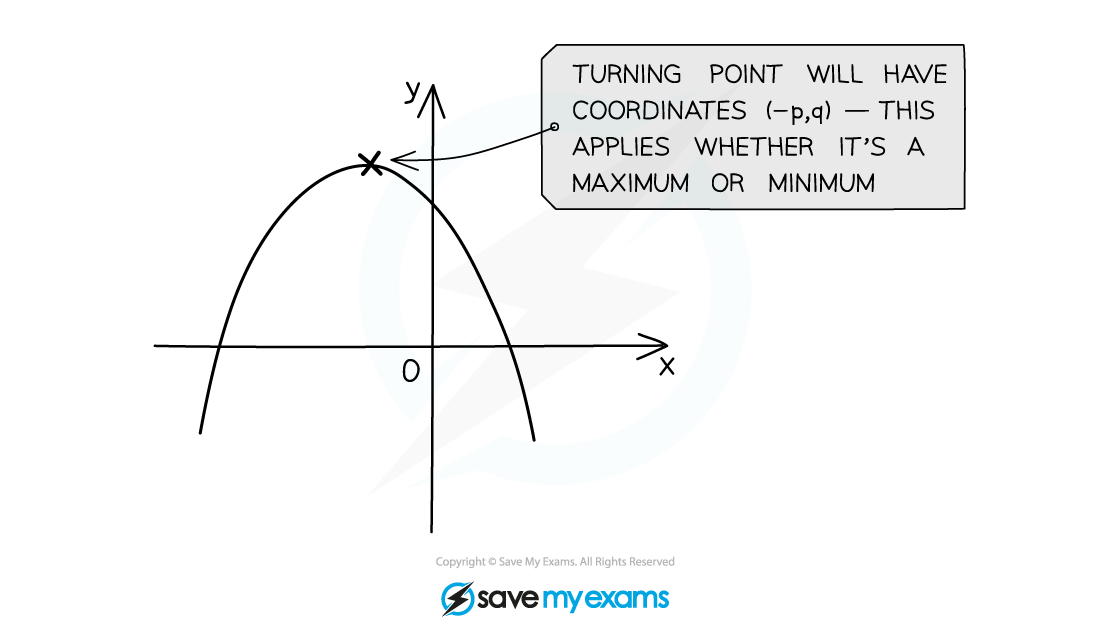
Completing the square helps us find the turning point on a quadratic graph
-
If
y=(x+p)²+qthen the turning point is at(−p comma q)- Notice the negative sign in the -coordinate
- This links to transformations of graphs (translating by to the left and * *up)
-
If
y=a (x+p)²+qthen the turning point is still at(−p comma q)- It's a minimum point if
- It's a maximum point if
-
-
It can also help you create the equation of a quadratic when given the turning point
-
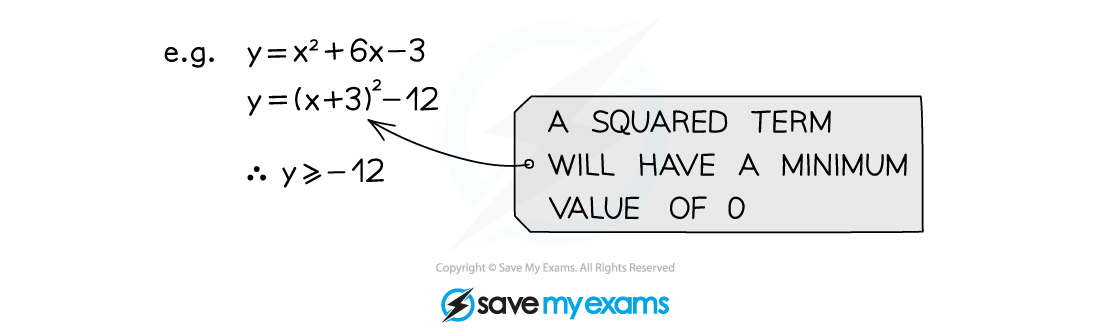
It can also be used to prove and/or show results using the fact that any "squared term", i.e. the bracket (x ± p)2 , will always be greater than or equal to 0
- You cannot square a number and get a negative value
Exam Hint
- Expand your answer to check that you have completed the square correctly.
Worked Example (a) By completing the square, find the coordinates of the turning point on the graph of .
Find half of (call this )
Write in the form
(x+p)²−p²* *
is the same as
(x+3)²−3²
*
Put this result into the equation of the curve
y=(x+3)²−3²−11
Simplify the numbers
y=(x+3)²−20
Use the fact that the turning point of
y=(x+p)²+qis at(−p comma q)Here and
Final answer: Turning point at
(b) Write in the form
a (x+p)²+qFactorise out of the first two terms only Use square-shaped brackets
Complete the square on the inside the brackets (write in the form
(x+p)²−p²where is half of )
Simplify the numbers inside the brackets
(−2)²is
Multiply all the terms inside the square-shaped brackets by
−3 (x−2)²+12+24
Simplify the numbers
−3 (x−2)²+36
This is now in the form
a (x+p)²+qwhere , and
Was this revision note helpful?
Build on this topic