Vector Basics (Edexcel IGCSE Further Maths)
Vector Notation
Spec point —
5A
What is a vector?
-
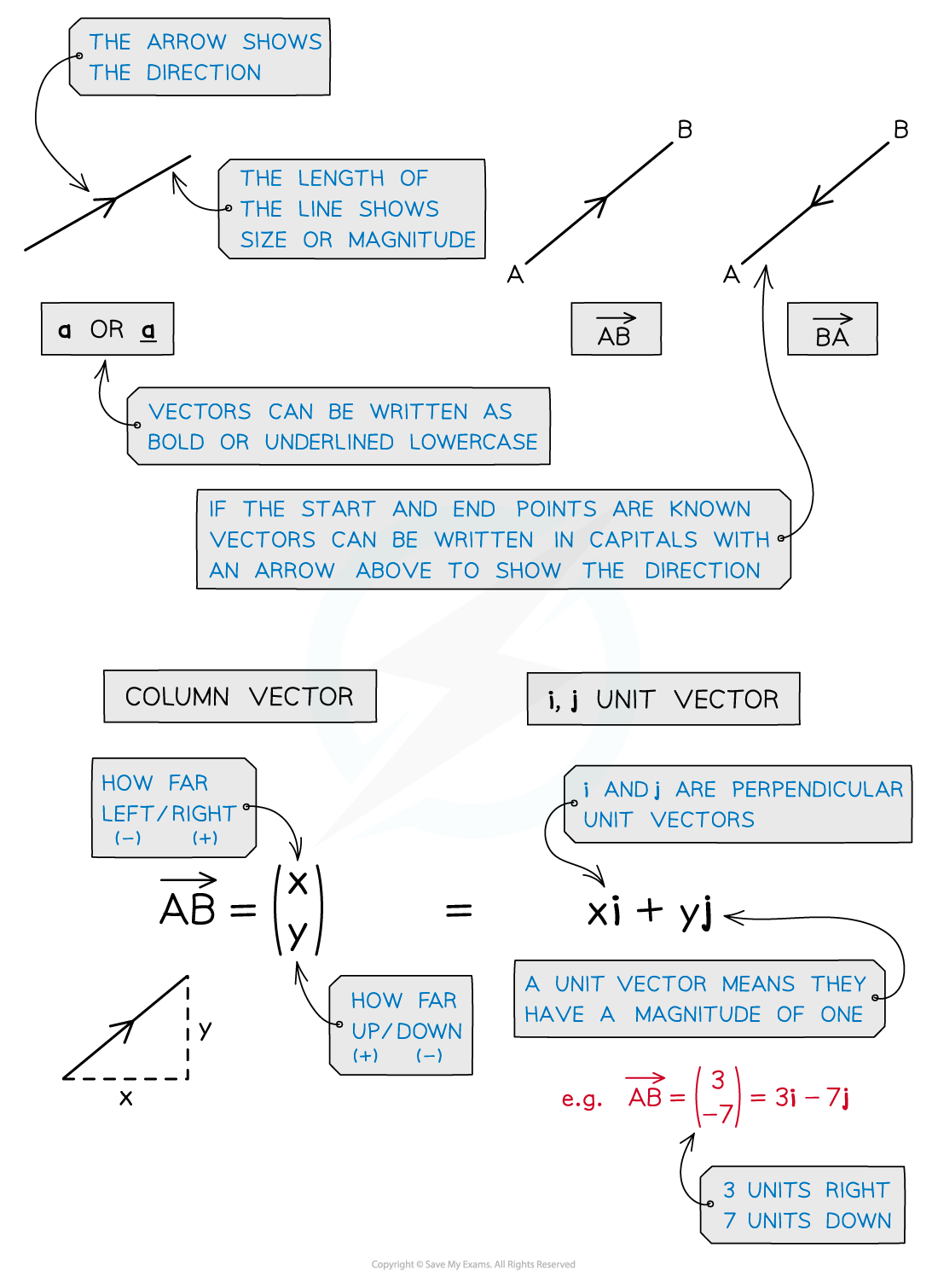
Vectors represent a movement of a certain distance (magnitude) in a given direction
-
In one dimension, the sign of a number represents its direction
-
For example, two objects with velocities 7 m/s and ‑7 m/s are travelling:
- at the **same speed **(magnitude)
- but in opposite directions
-
-
In** two dimensions**, vectors consist of x- and *y-components
- This shows movement parallel to the x and y-axes
- Components can be positive or negative
What is a scalar?
-
A scalar is an ordinary number that does not represent movement
- A scalar is not a vector
-
Scalars can still be negative
-
For example
- temperature is a scalar (it's -2°C today)
- but change in temperature is a vector (it's +3°C from yesterday)
-
How do I write vectors?
-
If you know the two components of a vector, you can write it as
-
either a column vector
- is 3 right and 2 up
-
or in i and j notation
-
-
If you do not know the components, use a lower-case letter to represent the entire vector
-
Exams use bold letters
- a, b, ...
-
You should write underlined letters
- a, b, ...
-
-
If points (A , B, ...) are given, means the vector from A to B
- The order matters
Exam Hint
- Diagrams can help. If there isn’t one, try sketching one!
Adding & Subtracting Vectors
Spec point —
7A
How do I add vectors?
-
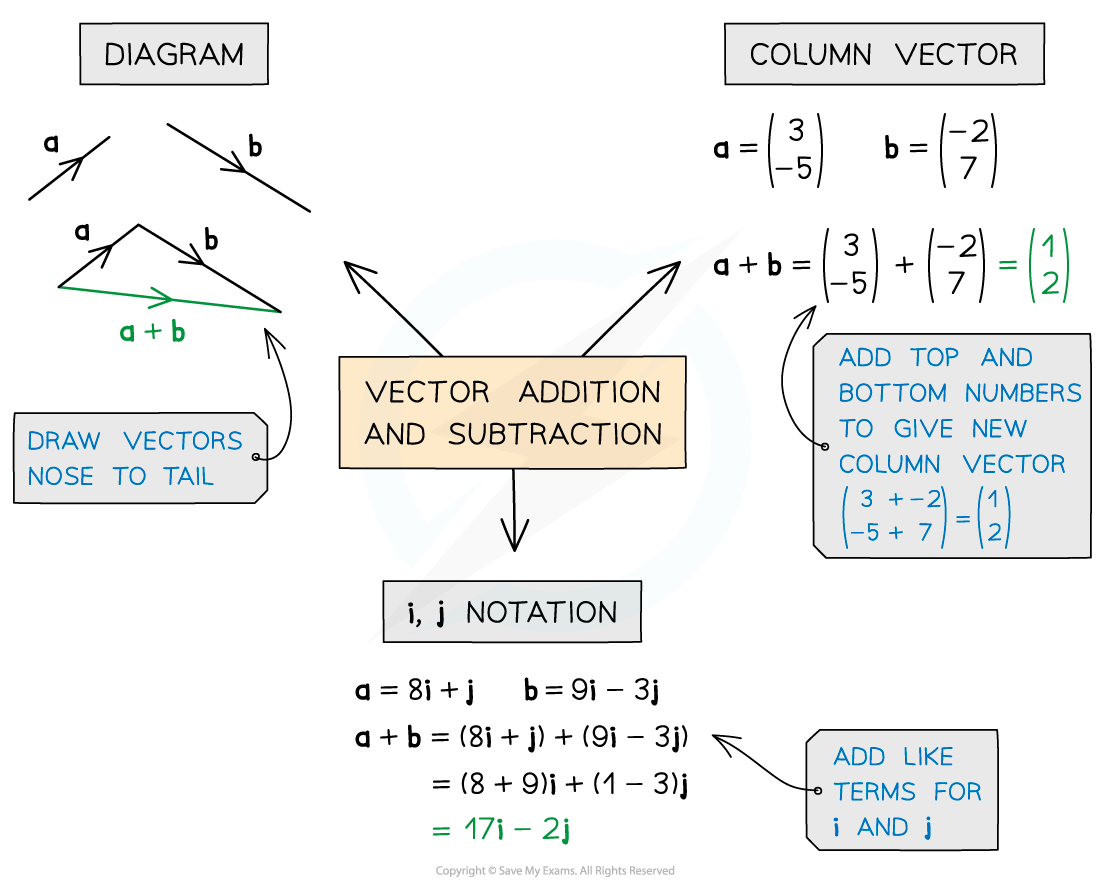
To add vectors you add their components
-
For column vectors, add the tops together and bottoms together
-
-
In i and j notation, add i and j parts separately
- (2i + j) + (i + 4j) = (3i + 5j)
-
Visually, the vector a+ b is the shortest route
- from the start of a
- to the end of b
How do I subtract vectors?
-
To subtract vectors you subtract their components
-
In i and j notation, subtract i and j parts separately
-
Be careful with brackets and negatives
- (2i + j) - (i + 4j) = (i - 3j)
-
-
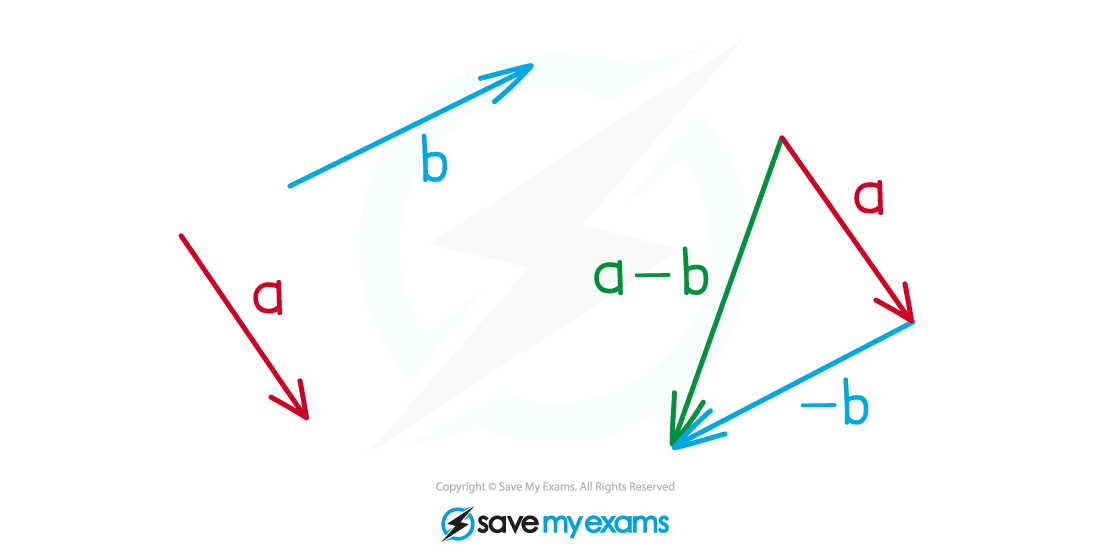
Visually, the vector a- b is the shortest route
- from the start of a
- to the end of -b
How do I add and subtract vectors on diagrams?
-
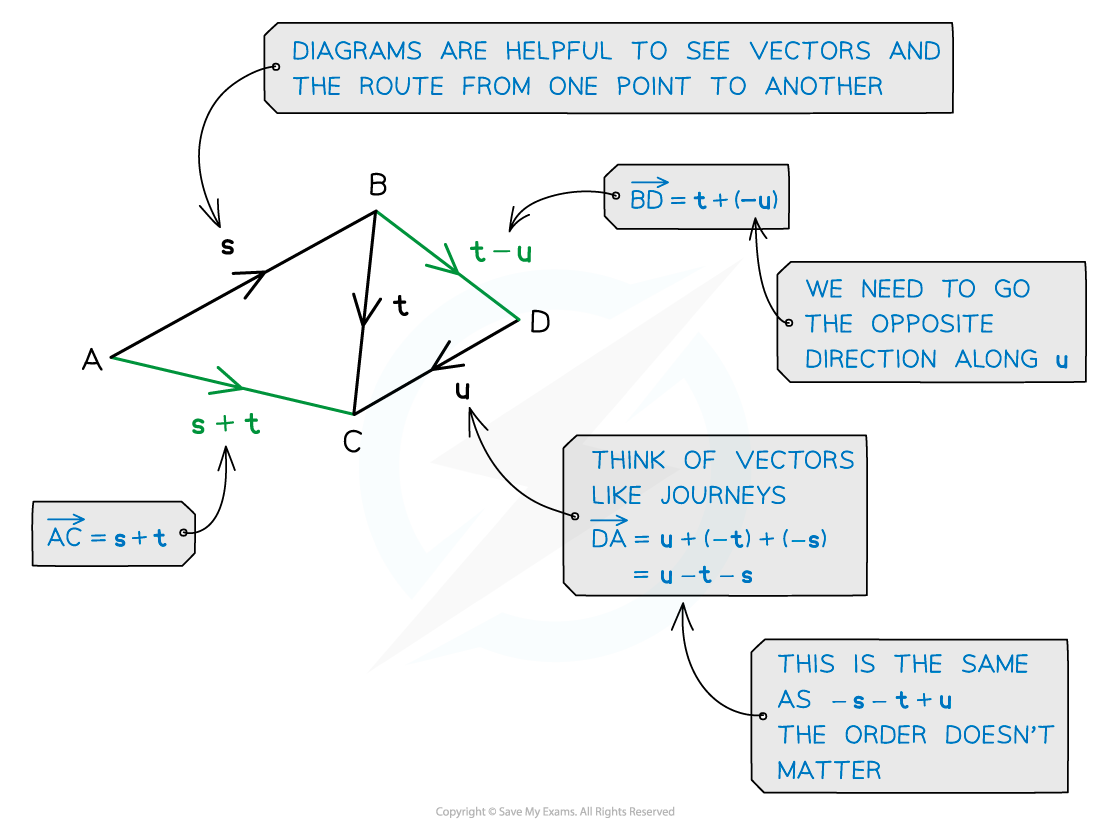
Think of travelling along vectors as a journey
-
a+ b means follow a, then follow b
- This is the same as b + a
- They both end up at the same place
-
-
The diagram below shows vectors s, t and u
-
To get from A to C do s then t
- s + t
-
-
If you have to travel the wrong direction along a vector, add the negative of that vector
-
To get from B to D do t then the reverse of u
- t + (-u)
- This simplifies to t - u
-
-
A vector plus its negative gives the zero vector, 0
-
a + (-a) = 0
- The zero is bold (or underlined)
-
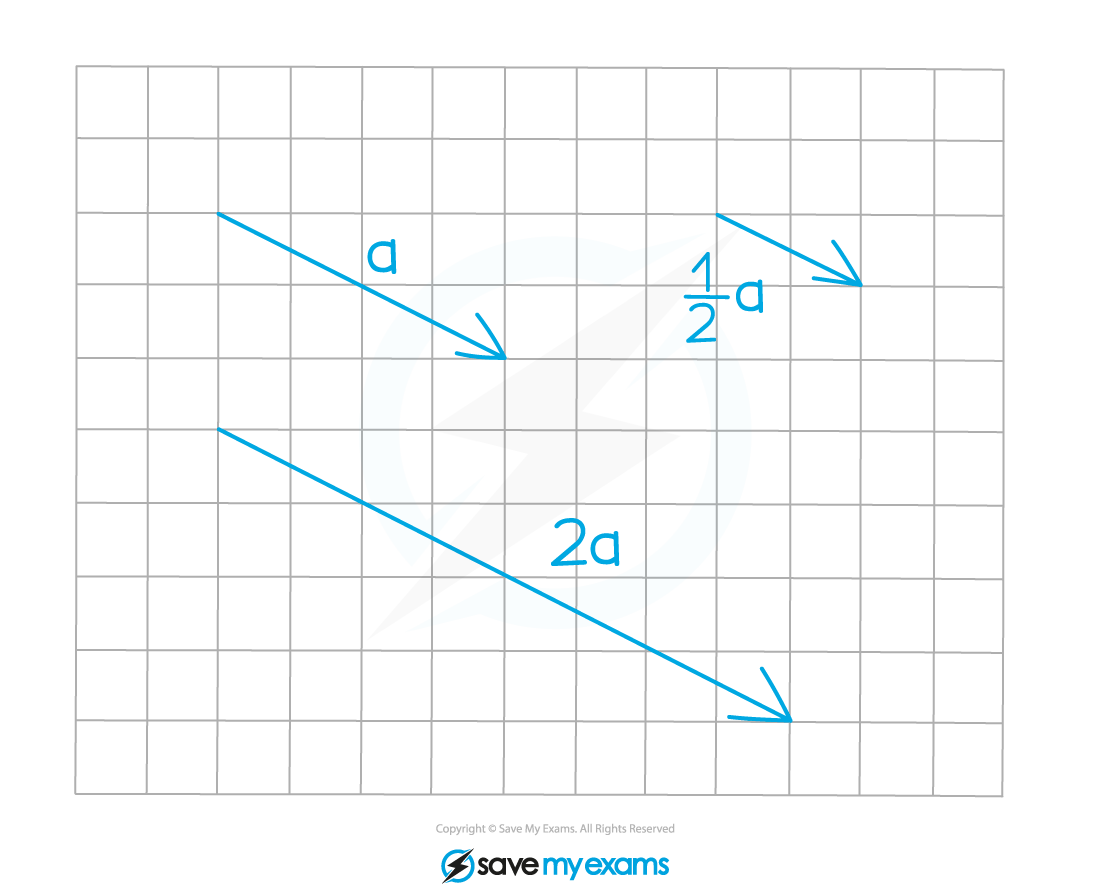
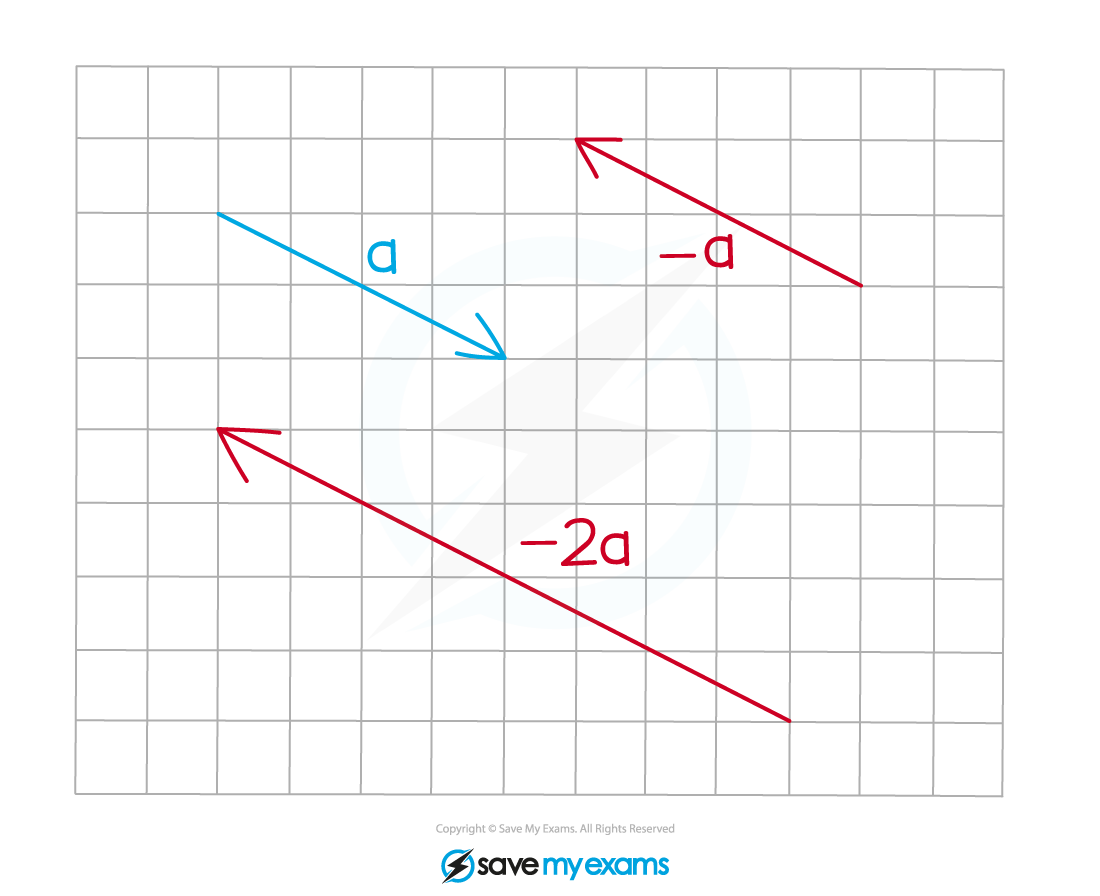
How do I multiply a vector by a scalar?
-
The vector a multiplied by a scalar (constant number) *k ****is *ka
- *ka is parallel to a
- k is the scale factor of enlargement
- A negative k reverses the direction
-
Multiply all components by the scalar constant
-
For example
- 2(4i + 5j) = 8i + 10j
-
Exam Hint
In the exam, questions with lots of parts usually build on each other.
- Check if any previous results give shortcuts!
Worked Example Two vectors are given by a = 4i + 2j and b = *pi – **j **where p is an unknown constant.
If a + 2b = –6i, find the value of p.
Substitute the vectors into the left-hand side
*(4i + 2j) + 2(pi *– j)
Expand the brackets
4i + 2j + 2pi* – 2j
Add the vectors by adding the components The 2j and -2j cancel
*(4 + 2p)i
This must equal the right-hand side of –6**i Write down an equation in p to balance both sides
*4 + 2**p *= –6
*Solve it to find *p
2p = –10
Final answer: p = –5
Was this revision note helpful?
Build on this topic