Equations of a Straight Line (Edexcel IGCSE Further Maths)
Spec point —
8D
Equations of a Straight Line
How do I find the gradient of a straight line?
- Find two points that the line passes through with coordinates (x1, y1) and (x2, y2)
- The gradient m between these two points is calculated by
-
This is sometimes known as rise over run
-
The gradient of a straight line measures its slope
- A line with gradient 1 will go up 1 unit for every unit it goes to the right
- A line with gradient -2 will go down two units for every unit it goes to the right
What are the equations of a straight line?
-
- This is sometimes called gradient-intercept form
- It clearly shows the gradient m and the y-intercept (0, c)
-
- This is sometimes called the point-gradient form
- It clearly shows the gradient m and a point on the line (x1, y1)
-
-
This is sometimes called the general form
-
You can quickly get the x-intercept, y-intercept and gradient
- is not the *y-*intercept in this form of the line equation!
-
You can also rearrange the equation into gradient-intercept form
-
How do I find an equation of a straight line?
-
You will need the gradient
- If you are given two points then first find the gradient
-
It is easiest to start with the point-gradient form
-
then rearrange into whatever form is required
- multiplying both sides by any denominators will get rid of fractions
-
-
Always check your answer
- Substitute the coordinates of points on the line into the equation
- Make sure the equation is satisfied with those coordinates
Exam Hint
Make sure you state equations of straight lines in the form required
Usually or
Check whether coefficients need to be integers
- This is often the case for
Worked Example The line passes through the points and .
Find the equation of , giving your answer in the form where and are integers to be found.
First find the gradient of the line using 'rise over run'
*Substitute the gradient and the coordinates of one of the points into *
Multiply both sides of the equation by 2 to get rid of the fraction
Rearrange into the required form
Parallel Lines
Spec point —
8E
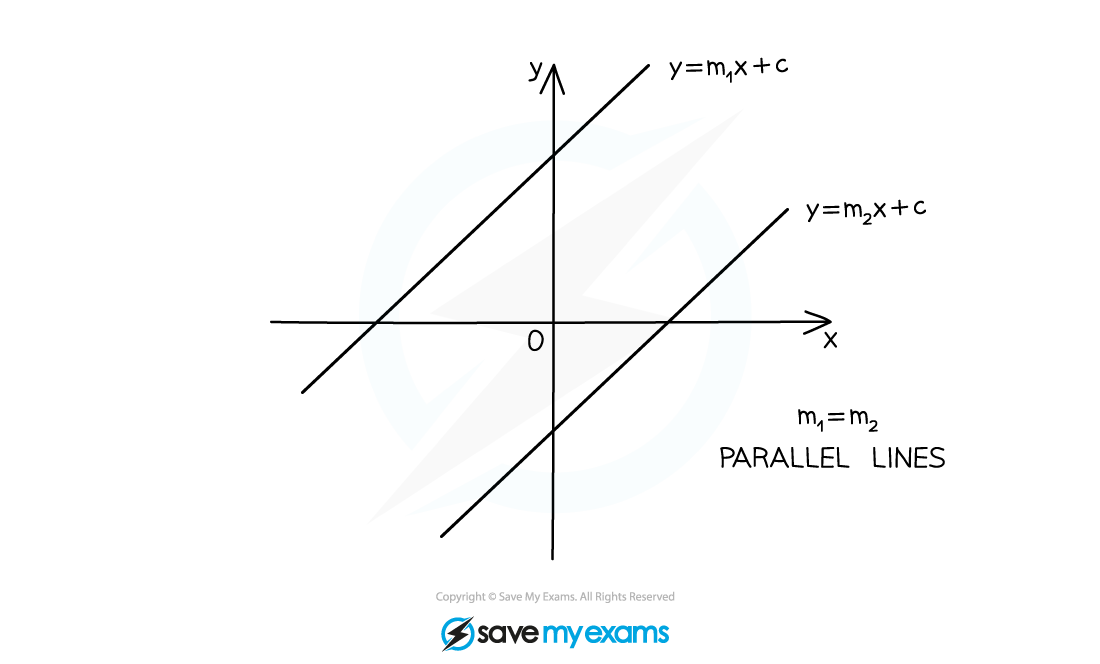
How are the equations of parallel lines connected?
-
Parallel lines are always equidistant meaning they never intersect
-
Parallel lines have the same gradient
-
If the gradient of line is and the gradient of line is then
- If then and are parallel
- If and are parallel, then
-
-
To determine if two lines are parallel:
- Rearrange into the form
- Compare the gradients (i.e. the coefficients of )
- If they are equal then the lines are parallel
Worked Example The line passes through the point and is parallel to the line with equation .
Find the equation of , giving your answer in the form .
First find the gradient of the given line from its equation
So the gradient of line is
Insert that gradient and the coordinates of the point into
Rearrange into the form required
Perpendicular Lines
Spec point —
8E
How are the equations of perpendicular lines connected?
-
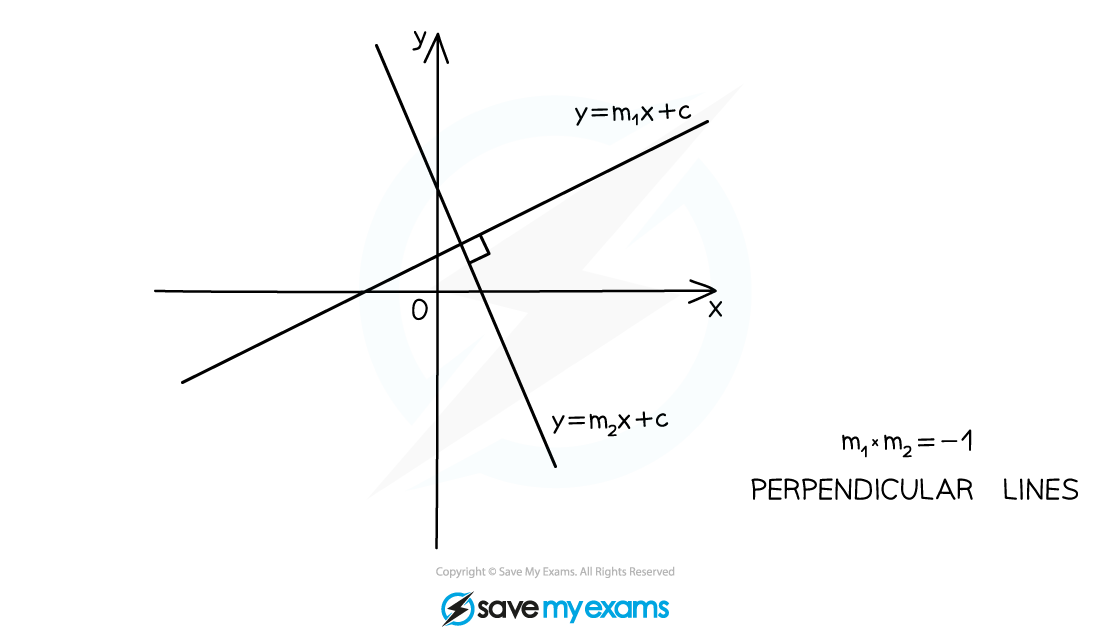
Perpendicular lines intersect at right angles
-
The gradients of two perpendicular lines are negative reciprocals
-
This means the product of their gradients is equal to
- e.g. and
-
If the gradient of line is and the gradient of line is then...
- If then and are perpendicular
- If and are perpendicular, then
-
-
To determine if two lines are perpendicular:
- Rearrange into the form
- Compare the gradients (i.e. the coefficients of)
- If their product is then the lines are perpendicular
-
Be careful with horizontal and vertical lines
- and are perpendicular where p and q are constants
Worked Example The line is given by the equation .
The line is given by the equation .
Determine whether and are perpendicular. Give a reason for your answer.
Rearrange the equation into form
So the gradient of is
The gradient of is (don't be fooled by the order of the terms in the equation!) Find the product of the two gradients
The product of the gradients is equal to , so the lines are perpendicular
Final answer: The product of the gradients of the two lines is equal to, soandare perpendicular
Was this revision note helpful?