Stationary Points & Turning Points (Edexcel IGCSE Further Maths)
Spec point —
9D
Stationary Points & Turning Points
What is the difference between a stationary point and a turning point?
-
A stationary point is a point at which the derivative of a function is equal to zero
- The tangent to the curve of the function is horizontal (gradient = 0)
-
A turning point is a point at which
-
the derivative of a function is equal to zero
-
AND the derivative changes sign (from negative to positive, or positive to negative)
- i.e. the curve changes from ‘going upwards’ to ‘going downwards’ (or vice versa)
-
Turning points will either be (local) minimum or (local) maximum points
-
-
All turning points are also stationary points
- But not all stationary points are turning points
How do I find stationary points and turning points?
-
For the function , stationary points can be found using the following process
-
STEP 1 Find the derivative,
-
STEP 2 Solve the equation
-
The solution(s) are the -coordinate(s) of any stationary points
- Remember, 'stationary points' includes turning points
-
-
STEP 3 Find the corresponding -coordinates (if necessary)
- Substitute each-coordinate(s) into
- If the question only asks for the -coordinates, you can skip this step!
-
More work is needed to find if a stationary point is a turning point
- i.e. if it is a (local) maximum or (local) minimum
- See the following note
Testing for Local Minimum & Maximum Points
Spec point —
9D
What are local minimum and maximum points?
-
Local minimum and maximum points are two types of stationary point
-
The derivative at stationary points equals zero
- i.e.
-
But not all points with a zero derivative are maximum or minimum points
-
-
A local minimum point,
- will have the lowest value of in the local vicinity of the value
- But may reach a lower value further away
-
A local maximum point,
- will have the highest value of in the local vicinity of the value
- But may reach a higher value further away
-
A global maximum (or global minimum) point
-
has the highest (or lowest) value of for all values of in the domain of
- A global maximum (or minimum) may not be a local maximum (or minimum)
- and vice versa
-
Not all functions have a global maximum (or minimum)
- e.g. some functions tend to infinity as tends to infinity
- or as approaches some other value (vertical asymptotes)
-
How can I use the derivative to identify local minimum & maximum points?
-
The nature of a stationary point can be determined using the derivative
-
For the function …
-
STEP 1 Find and solve
- The solutions are the the -coordinates of any stationary points
-
STEP 2 Find the sign of the derivative just either side of each stationary point
-
i.e. evaluate and for small
- Choose a convenient value for
- Just make sure you don't 'jump over' any other stationary points!
-
-
At a local minimum point
- the derivative changes from negative to positive
-
At a local maximum point
- the derivative changes from positive to negative
-
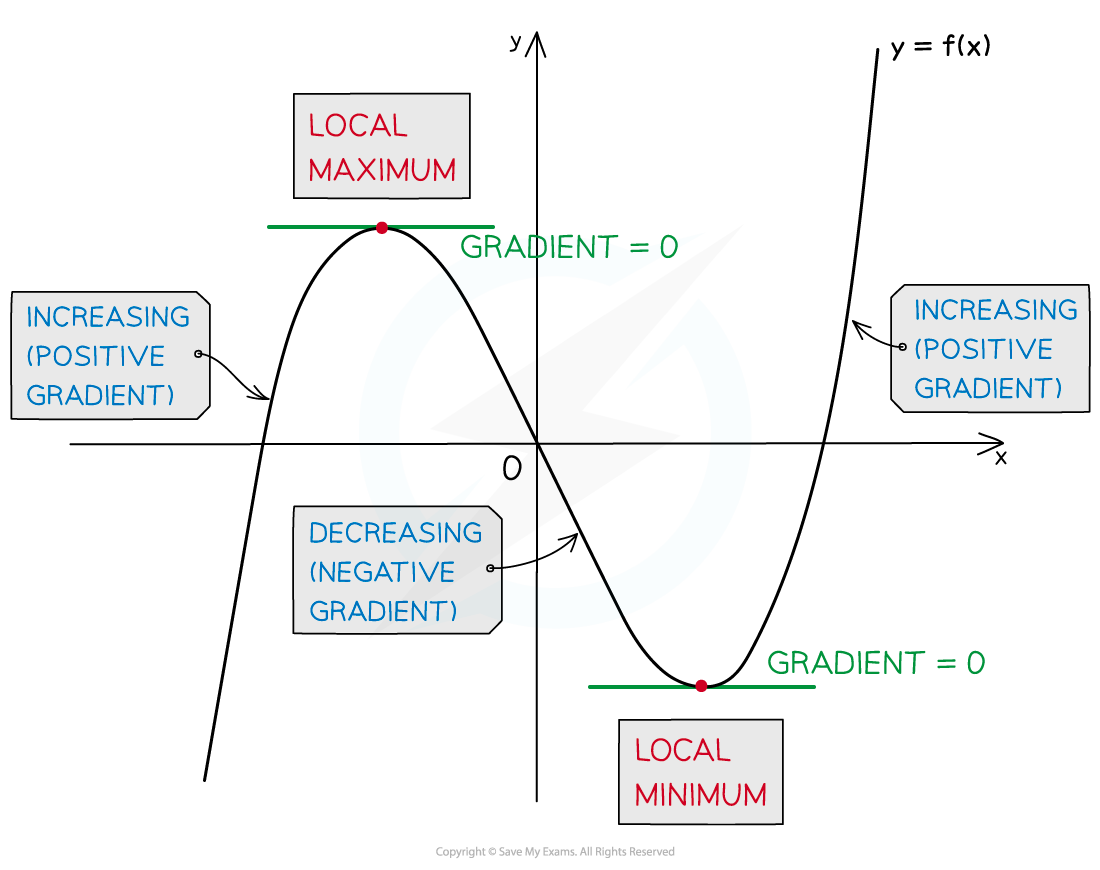
-
If the derivative does not change sign at the point
- (i.e. if it is positive on both sides or negative on both sides)
- then the point is not a local minimum or a local maximum
- But it is still a stationary point if there
What is the second derivative?
-
It is possible to differentiate a function more than once
-
If you differentiate , you find its (first) derivative
- e.g. the (first) derivative of is
-
Then you can differentiate the derivative again to find the second derivative
- e.g. the derivative of is
- so the second derivative of is
-
-
The second derivative can be used to test the nature of a stationary point
How can I use the second derivative to identify local minimum & maximum points?
-
STEP 1 Find and solve
- The solutions are the the -coordinates of any stationary points
-
STEP 2 Find the second derivative
- Do this by differentiating from Step 1
-
STEP 3 Find the value of at each of the stationary points
- i.e., by substituting the -coordinate of each point into
-
If
- then the stationary point is a local minimum
-
If
- then the stationary point is a local maximum
-
If
- then the test does not tell you anything
- the stationary point may be a local maximum, a local minimum, or neither
- In this case, use the first derivative test instead
Exam Hint
Don't just assume that a zero derivative corresponds to a maximum or minimum point
- Especially if a question asks you to justify that a point is a maximum or minimum
The second derivative test is usually much quicker for identifying maximum and minimum points
- But it is good to understand how to use the first derivative test as well
Your calculator may be able to show graphs of functions
- You can use this to check your work
Worked Example Find the coordinates and determine the nature of any stationary points on the graph of , where is the function defined by .
Start by finding
Solve to find the -coordinates of any stationary points
Substitute into to find the corresponding -coordinates
So the stationary points are and
Method 1: using the second derivative to test the points
Differentiate to find the second derivative
Now substitute in the -coordinates of the two stationary points This will give the value of the second derivative at those points
That is less than zero, so is a local maximum point
That is greater than zero, so is a local minimum point
Method 2: using the first derivative to test the points
Test the values of at either side of the stationary points (Note that, where applicable, is a very convenient test value!)
At the derivative changes from positive to negative, so that is a local maximum point
At the derivative changes from negative to positive, so that is a local minimum point
Note that for this function both stationary points are also turning points
Final answer: is a local maximum point
Final answer: is a local minimum point
Was this revision note helpful?
Build on this topic