Using Financial Documents (Edexcel IGCSE Business)
How financial documents are used
Spec point —
3.5.3· The use of financial documents: • assess the performance of the business • inform decision making.
How financial documents are used
- Stakeholders use financial documents to assess business performance and inform decision-making
How stakeholders use financial documents
| Stakeholder | Use of financial documents |
|---|---|
| Managers | - Financial documents help managers track performance and identify areas for improvement - This helps them make informed decisions to achieve business objectives |
| Employees | - Employees use financial accounts to assess the stability of their employer - This helps them determine their job security or support salary negotiations |
| Owners | - Owners and shareholders can assess the profitability and growth potential of a business - This helps them determine its ability to provide them with returns on their investment |
| Suppliers | - Suppliers will want to assess the financial stability of key customers - Financial documents can show whether customers can pay what they owe on time |
| Banks and other lenders | - Financial statements can help to determine whether a business is creditworthy - Lenders can assess the risk of lending money to the business and set appropriate credit terms |
- Owners and managers use the quantitative data in financial documents to make a range of informed decisions
Decisions using financial documents
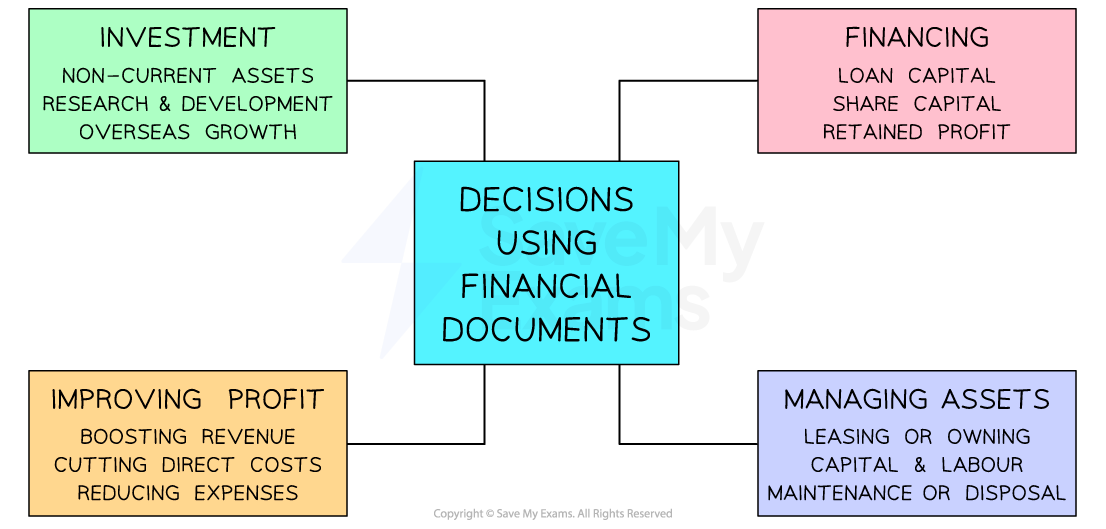
Managers and owners use financial documents to inform decisions about investments, financing, improving profit and managing assets
Investments
- The statement of comprehensive income can show whether a business can afford to purchase new non-current assets such as machinery, property or vehicles
- The impact of spending on research and development or overseas growth on costs and revenues can be determined
Financing
- The impact on the statement of financial position of taking out loans or other credit can be determined
- The statement of financial position also identifies the value of share capital and retained profit
Improving profit
- Ratio analysis can identify the impact of different types of cost on the businesses ability to generate profit
- The impact of increased prices on sales revenue can be identified in the statement of comprehensive income
Managing assets
- The impact of leasing assets rather than owning them can be seen in both key financial documents
- Investment in non-current assets can be compared to investment in human resources to determine whether capital-intensive or labour-intensive production is most suitable
- Deciding whether to continue to maintain equipment or dispose of it can be determined by considering costs and revenues in the financial documents
Exam Hint In the exam you may be asked to explain how a stakeholder uses a particular financial statement, such as a cash flow forecast or a statement of financial position. A good way to structure your 3-mark response is to consider, first, what the particular document shows. This can then be used to develop a strong response.
Example
Managers use cash flow forecasts to understand the predicted cash inflows and cash outflows over a period of time [1]. This allows them to plan for cash shortfalls [1] by making arrangements for short-term finance, such as overdrafts, to ensure they are able to meet their financial obligations [1].
Was this revision note helpful?
Build on this topic