Liquidity (Edexcel IGCSE Business)
The importance of liquidity
Spec point —
3.5.1· Calculating and analysing accounting ratios
-
Liquidity is defined as the ability of a business to pay back its short-term debts, e.g. its suppliers
-
A businesses that cannot pay its debts is considered insolvent
- If a business cannot pay its suppliers, raw materials or components may not be delivered and production will be delayed
- If it cannot repay an overdraft, banking facilities may be withdrawn, and its credit rating will suffer
- Creditors may force it to stop trading and sell its assets so that the debts owed to them are repaid
-
Stakeholders interested in liquidity include
- Suppliers want to be reassured that a business is likely to be able to pay for them
- Financial providers such as banks want evidence that a business is likely to be able to repay loans or overdrafts
- Customers want to be sure that a supplier will be able to produce and deliver goods it orders
Liquidity ratios
Spec point —
3.5.1· Calculating and analysing accounting ratios: • current ratio • acid test ratio.
Liquidity ratios
-
The liquidity of a business can be measured using two ratios
- Current ratio
- Acid test ratio
The current ratio
-
The current ratio is a quick way to measure liquidity
- The outcome is expressed as a ratio
- All types of current asset are included in calculating this ratio
- The result indicates how many £s(or other currency units) of current assets are available to cover each £1 (or other currency unit) of short-term debt
- It is calculated using the formula
Worked Example Packer Sports Ltd has current assets of $15,545, current liabilities of $5,060 and an inventory figure of $8,250.
Calculate Packer Sports Ltd.’s current ratio.
[2]
Step 1: Substitute the values into the equation
\ 15 , 545 \div $ 5 , 060
= 3.07$ [1 mark]
Step 2: Express the outcome as a ratio
[1 mark]
In this example, Packer Sports Ltd has $3.07 of current assets to cover each $1 of short-term debt**
The acid test ratio
-
The acid test ratio is a precise and realistic way to measure liquidity, especially for businesses that hold large amounts of inventory
-
It is expressed as a ratio
-
It is also known as the liquid capital ratio
-
The least liquid form of current assets (inventory) is deducted so the acid test ratio provides a more realistic measure of the businesses ability to meet short-term debts quickly
- It often takes time to sell inventory so it is excluded
-
The Acid Test is calculated using the formula
-
Worked Example Packer Sports Ltd has current assets of $15,545, current liabilities of $5,060 and an inventory figure of $8,250.
Calculate Packer Sports Ltd’s acid test ratio.
[3]
Step 1: Subtract inventory from current assets
\ 15 , 545 - $ 8 , 250
= $ 7 , 295$ [1 mark]
Step 1: Substitute the values into the equation
$\text{Acid} \text{test} \text{ratio} = \frac{ \text{Current} \text{assets} - Inventory}{Current liabilities}
= \frac{ $ 7 , 295}{$ 5 , 060}
= 1.44$ [1 mark]
Step 2: Express the outcome as a ratio
[1 mark]
In this example, Packer Sports Ltd has $1.44 of the most liquid current assets to cover each $1 of short-term debt
Analysing liquidity
Spec point —
3.5.2· Liquidity: • the concept and importance of liquidity • comparisons with previous years and/or with other business organisations.
Analysing liquidity
Comparing liquidity
Businesses compare and monitor liquidity over time
-
A business may be able to identify a pattern of periods of good and poor liquidity
-
For some businesses poor liquidity can be seasonal
- E.g. Low sales often follow major public holidays such as Christmas
-
Steps can be taken to improve the liquidity position at these times
- E.g. Short-term finance such as overdrafts can be arranged
-
The impact on liquidity of spending decisions can be determined
- Budgets that ensure a healthy liquidity position can be set
- Capital expenditure could be delayed to avoid liquidity problems
Comparing liquidity between different businesses is problematic
-
Some businesses can survive on very low ratios
-
Businesses that have a high level of inventory turnover and sell for cash can have very low liquidity ratios
- In 2023 Tesco Plc, the UK's largest supermarket, had a current ratio was just 0.71:1
-
Businesses that sell small volumes of expensive products, often on credit, require much higher liquidity ratios
- In 2023 LVMH Group, owner of brands including Louis Vuitton and Acqua di Parma, had a current ration of 4.34:1
-
Improving liquidity
- A business will often need to take quick, decisive steps to improve their liquidity
Ways to improve liquidity
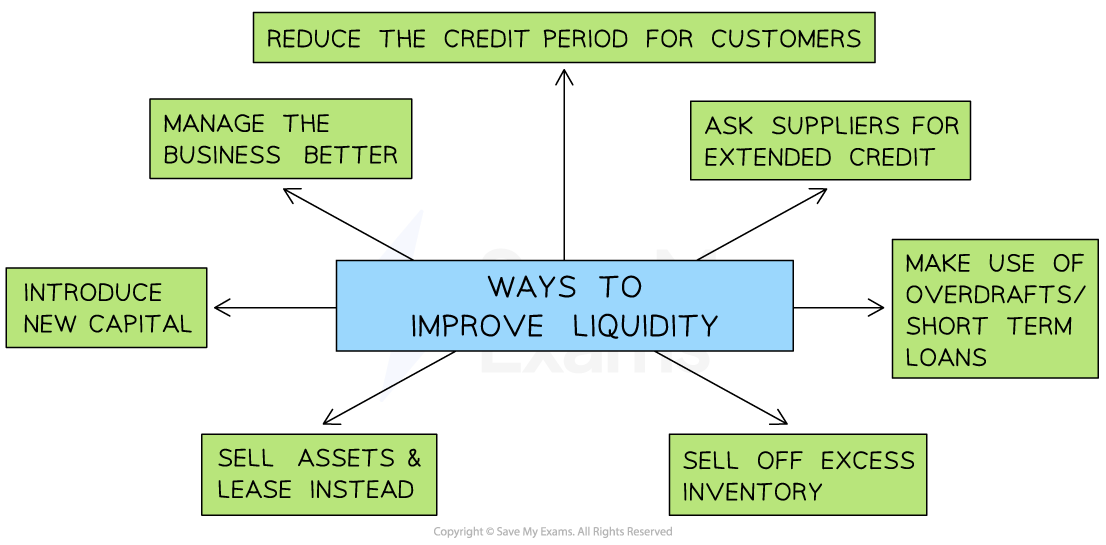
*Liquidity can be improved in a number of ways *
Methods to improve liquidity
| Method | Explanation |
|---|---|
| Manage the business better | - Use cash flow forecasts to identify potential cash flow issues before they arise and take appropriate action - Budget effectively and consider adopting zero budgeting to carefully control spending - Set clear financial objectives and look for ways to reduce costs and increase income wherever possible |
| Reduce the credit period offered to customers | - Collecting money owed from customers more quickly will **increase the level of current assets **in the business - Customers may move to competing businesses that offer better credit terms |
| Ask suppliers for an extended repayment period, e.g an extension from 60 to 90 days | - Current liabilities will not be reduced - The business can use cash it would have paid to suppliers for other purposes - Suppliers may be unwilling to extend credit terms |
| **Make use of overdraft facilities or short-term loans | - Current liabilities will** increase** - The business can spend more money than it has in its bank account - Banks may be reluctant to lend to businesses with cash-flow problems |
| Sell off excess inventory | - Less liquid current assets will be reduced and** converted into more liquid forms of current asset **(e.g. cash) - Storage and security costs may also be reduced - Inventory may need to be sold at a low price to attract sales |
| ** Sell assets and lease fixed assets instead **(e.g. sale & leaseback) | - Both current assets and current liabilities will increase - The business will continue to have the use of assets but must make regular payments to the leasing company |
| ** Introduce new capital and reduce **drawings out of the business | - Current assets will be increased - New capital may be** introduced by the owner or from additional investors - This may result in the dilution of control of the business |
Exam Hint In the exam, you could be asked to compare two ways to improve liquidity and make a recommendation. You may consider factors such as how quickly cash is needed, how much cash is needed, and how the methods may affect the business's ability to continue to operate effectively.
For example, selling assets may raise a large amount of finance, but it is unlikely to be a quick solution, and the business may be unable to operate effectively without key equipment or buildings.
Was this revision note helpful?
Build on this topic