Government Impacts on Business (Edexcel IGCSE Business)
The provision of infrastructure
Spec point —
1.6.2· How governments can affect business activity: • infrastructure provision • legislation • trade policy - membership of trading blocs, tariffs.
The provision of infrastructure
- A key role of government is to ensure that important infrastructure is constructed, maintained and upgraded when required
Infrastructure funded by government
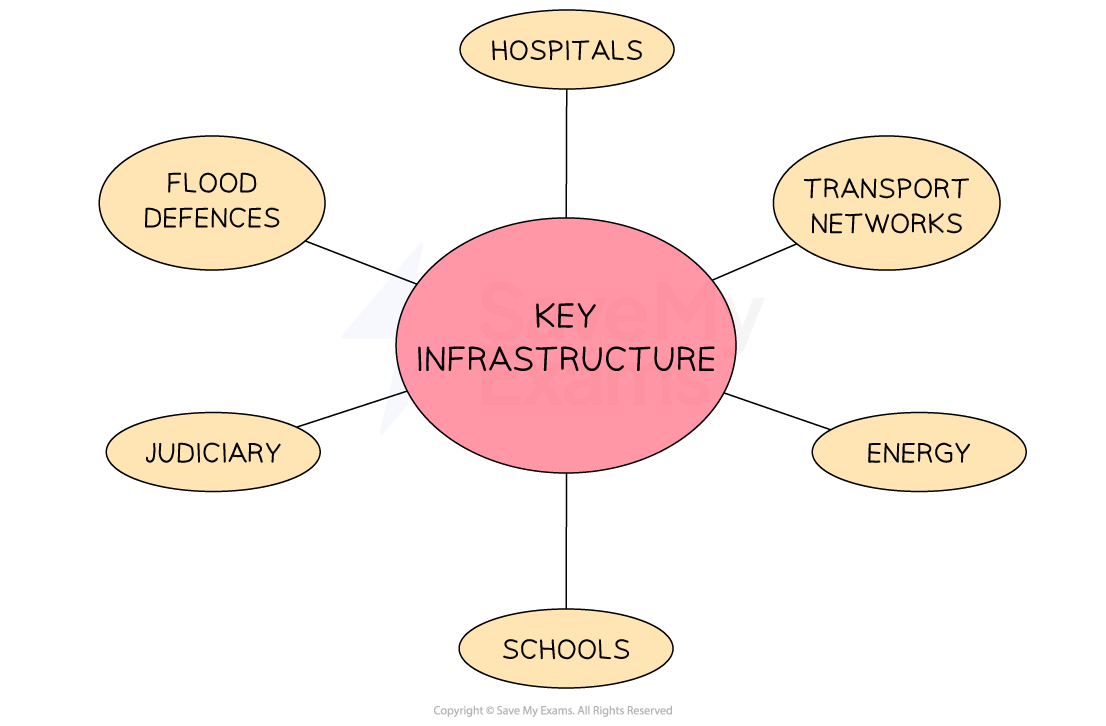
Government funding ensures that key infrastructure, including transport networks, health and education facilities and energy grids, operate effectively
- Businesses benefit from the provision of key infrastructure in a number of ways
Government contracts
-
Some businesses are paid to carry out construction and maintenance of infrastructure on the government's behalf
- In the UK, companies such as Mitie maintain public sector buildings, including hospitals and schools
Higher consumer spending
-
Government spending generates income in an economy.
- Increased incomes from employment can increase consumer spending, which leads to more demand for goods and services
Greater efficiency and productivity
-
Improved networks can improve business performance
- Better transport networks can improve logistics
- Reliable energy networks and disaster protection, such as flood defenses, allow for business continuity
- Faster communications networks can make online operations more efficient
- Effective education and health systems improve the skills and wellbeing of workers, making them more productive
Legislation
Spec point —
1.6.2· How governments can affect business activity: • infrastructure provision • legislation • trade policy - membership of trading blocs, tariffs.
Legislation
-
Legislation refers to the laws and regulations created by governments
- Businesses must operate within these so as to avoid fines or legal action
-
A strong legal framework in the country in which a business is located provides stability for businesses to plan and invest
Key areas of legislation affecting business
| Area of law | Explanation | Examples |
|---|---|---|
| Consumer protection | - Unfair selling practices are not allowed, such as - False claims about product capabilities - Selling goods that are unfit for purpose or dangerous - Selling short measures of goods | - Businesses must follow India's Consumer Protection Act, which defines eight fundamental rights for consumers, including the right to safety, the right to be informed and the right to seek redress |
| Equal opportunities | - Prevent workers from being treated less favourably as a result of protected characteristics, including - Gender and sexual orientation - Race - Disability - Age | - The Egyptian Labour Code prohibits wage discrimination on the basis of religion, gender, race, language, disability, social class, or political affiliation and guarantees equal pay for equal work. |
| Health and safety | - Protect the public, including workers, from harm as a result of business negligence, such as - Injury and stress caused by poor working conditions - Failure to provide protective equipment | - Vietnam's first law covering workplace health and safety was introduced in 2015 - Employers must reduce hazards and risks, improve working conditions, take care of employee’s health and prevent workplace accidents and diseases |
| Competition policy | - Uncompetitive practices such as - Removing or reducing trade barriers to encourage market competition - Preventing mergers or takeovers that could reduce choice for consumers | - Norway's Competition Act bans unlawful cooperation between firms, abuse by a business of a dominant market position and controls mergers and takeovers |
| Environmental protection | - Reduce negative environmental impacts of business activity, including - Air pollution - Water pollution - Waste reduction - Use of harmful chemicals | - Since 1998, Brazil's Environmental Crimes Act set out the definition of environmental crime and has played a key role in reducing deforestation in the Amazon |
Trade policy
Spec point —
1.6.2· How governments can affect business activity: • infrastructure provision • legislation • trade policy - membership of trading blocs, tariffs.
Trade policy
-
Government trade policy determines their approach to the import and export of products across borders
- Importing involves bringing goods or services into a country from overseas
- Exporting is where a business sells its products abroad
-
Governments can use trade barriers to restrict the level of trade between countries for several reasons
- Protect new industries from overseas competition
- E.g. The UK government heavily subsidises the solar panel industry
- Achieve a healthy balance of payments
- Trade barriers applied by the US on products from China since 2017 have focused on reducing the country's trade deficit
- Protect jobs in industries that are major employers
- E.g. The UK government provided subsidies of more than $500 million to Tata Steel, a major employer in South Wales
- Retaliation for trade barriers applied by other countries
- China has applied retaliatory tariffs of up to 25% on US-produced goods such as soybeans
- Prevent dumping of cheap goods from overseas
- In 2017, India applied tariffs on imports of Bangladeshi jute that was priced to undercut domestic producers
- Pressure a foreign power to change policies
- Many western governments have applied sanctions on Russia since 2022 in response to its foreign policy
Tariffs
-
A tariff is a tax placed on imported goods from other countries
- E.g. Tennis rackets imported into the UK from China have a tariff of 4.7%
-
A tariff increases the price of imported goods which helps to shift demand for that product/service from foreign businesses to domestic businesses
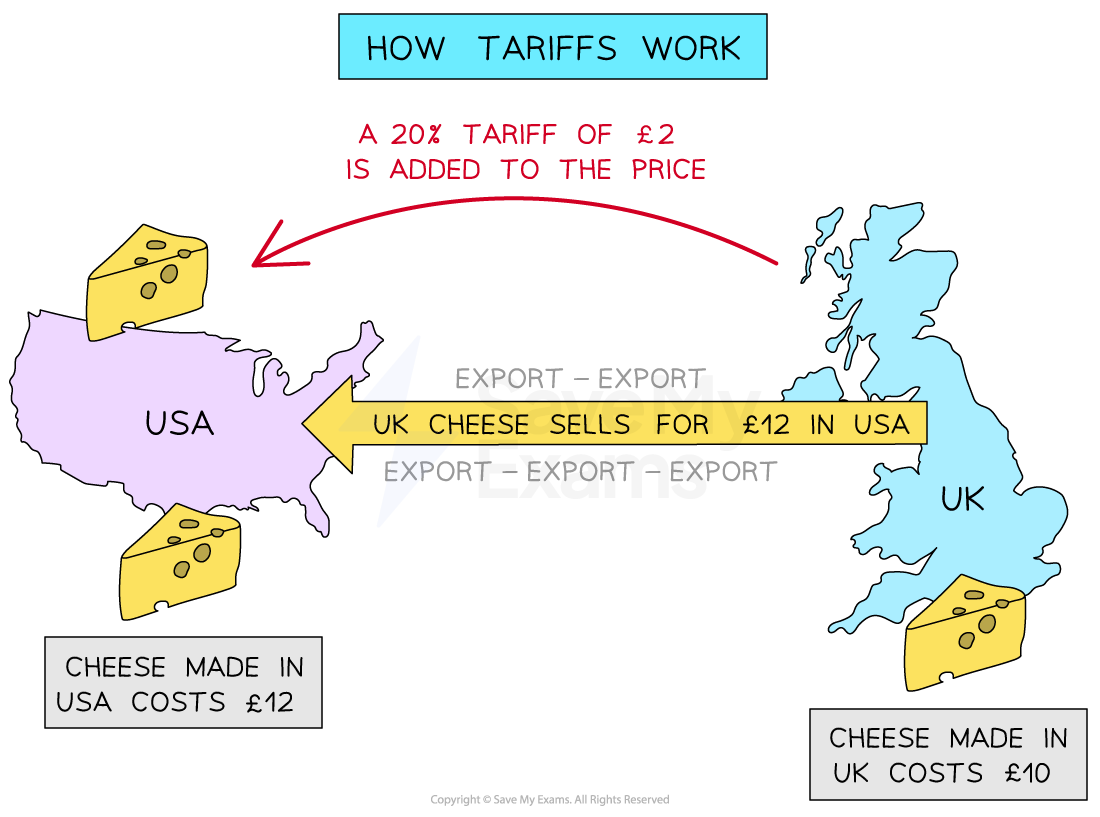
When the USA places a tariff on imported cheese from Britain, the price of British cheese in the USA rises
- American customers are more likely now to purchase American cheese as the tariff has made British cheese equally expensive
Evaluation of tariffs
-
The benefits of tariffs include
- Protection for infant industries so they can eventually become more competitive globally
- An increase in government tax revenue
- Reduced dumping by foreign businesses as they cannot sell below the market price
-
The disadvantages of tariffs include
- Increased cost of imported raw materials, which may affect businesses who use these goods for production, leading to higher prices for consumers
- Less competition for domestic firms who may become more inefficient and produce poor quality products for their customers
- Reduced consumer choice as imports are now more expensive and some customers will be unable to afford them
Trade blocs
-
A trade bloc is a group of countries that agree to reduce or remove trade barriers between themselves, while maintaining individual or common trade policies towards non-members
- The extent of integration depends on the type of trade bloc (e.g. free trade area, customs union, or common market).
-
Membership of a trade bloc, such as the EU or ASEAN, usually includes barrier-free trade between member countries
-
Most EU countries share a common currency, the Euro
-
ASEAN members are cooperating to harmonise laws and regulations relating to product safety, labelling and ingredients
- This enables products manufactured in any of the countries within the trade bloc to be suitable for sale in all of the other countries
-
-
Governments can cooperate with other countries outside of trade blocs to ease business transactions
-
A free trade agreement allows goods and services to be sold across borders as easily as domestic firms trade with each other
- E.g. Norway's free trade agreement with the EU allows its goods to be exported with ease to its member countries
-
Exam Hint You could be asked to calculate the impact of a tariff on the selling price of product. This will usually involve working out a percentage. Don't forget to add this percentage to the original product price.
Was this revision note helpful?
Build on this topic