Government Objectives (Edexcel IGCSE Business)
Government Economic Objectives
Spec point —
1.6.1
-
Most governments pursue similar objectives for their national economies
- They use a mix of government spending and taxation in order to achieve these objectives
-
The government has many policy options available that can be used to meet the targets of their macroeconomic objectives
- Any policy action taken is likely to have a direct impact on business
Government economic objectives
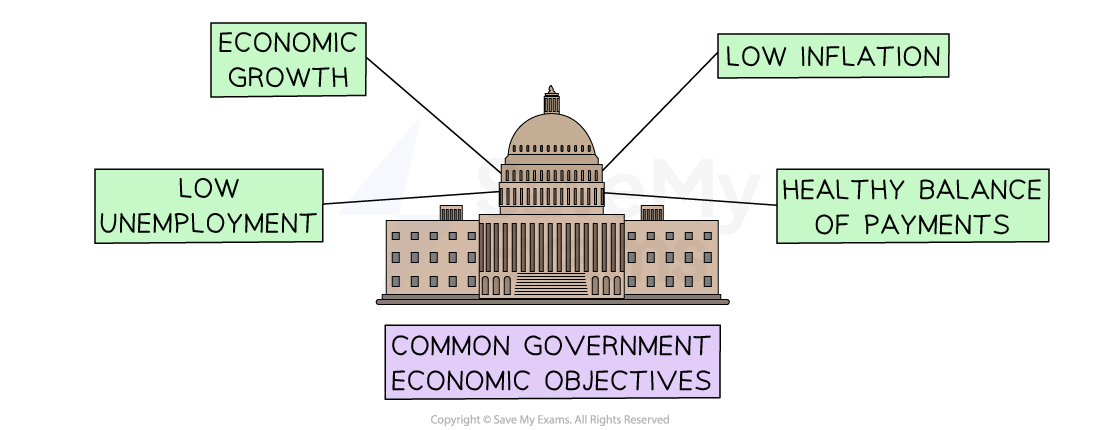
Governments typically look to achieve economic growth, low inflation, low unemployment and a positive balance of payments
Positive economic growth
-
Positive economic growth is the increase in the amount of goods and services produced per head of population over a period of time
-
The standard of living of the population is likely to increase with GDP growth
- As output is rising, more workers are needed, and high levels of employment are achieved
- Households can afford to buy more goods and services as most people become richer
- Business owners expand their business as people have more money to spend on their products and revenue rises
Low levels of inflation
- Inflation refers to a general increase in prices and fall in the purchasing value of money over time
- Both the UK and US governments set their Central Bank an inflation target of 2%
- Central Banks have a range of tools they can use to achieve this target, such as base rates and quantitative easing
Low levels of unemployment
- Unemployment refers to the number of people without a job who are actively seeking and available for work
- Low unemployment increases national output, improves workers’ living standards and reduces government spending on welfare benefits
A healthy balance of payments
-
The balance of payments is the relationship between the value of imports and exports over a period of time
- A balance of payments deficit occurs when the money spent on imports is higher than the money received from exports
- A balance of payments surplus occurs when the money received from exports is higher than the money spent on imports
-
If a country has an ongoing deficit, it means there is possibly less support for domestic business (imports preferred)
- The country's residents may need to borrow more money to fund these imports
-
Maintaining a healthy balance of payments helps to avoid some of these issues
Examples of government actions aimed at meeting macroeconomic objectives
| Example | Explanation | Impact on business |
|---|---|---|
| The government raises the interest rate in order to reduce the level of inflation | - Higher interest rates mean that businesses and people will borrow less money as they will have to pay back more | - Demand for goods typically purchased using credit is likely to decline, causing revenue to fall |
| The government places a tariff on imports in order to reduce foreign purchases | - Tariffs increase the price of imported goods compared to those that are domestically-produced | - Increased demand for businesses that sell domestically-produced goods is increasing revenue - Higher costs for businesses that import goods from overseas, which they may choose to pass on to customers |
| The government allows fewer low-skilled workers to enter the country and be available for employment | - Low-skilled jobs are filled by the domestic workforce, reducing both the level of unemployment and government spending on welfare benefits | - Businesses may have to offer higher wages to compete with rivals and attract enough workers - Staff shortages may encourage some businesses to move towards capital-intensive production methods |
Exam Hint In the exam you may be asked to explain how a change in government objectives might affect businesses. Remember, explain questions do not require a contextualised response.
Was this revision note helpful?
Build on this topic