Above & Below the line Promotion (Edexcel IGCSE Business)
Above-the-line promotion
Spec point —
4.3.4· above the line techniques
-
Above-the-Line Promotion promotion refers to advertising activities that are aimed at reaching a wide audience through traditional mass media channels to create awareness about a product, service, or brand.
- These channels typically include television, radio, newspapers, magazines and outdoor advertising such as billboards
Characteristics of above-the-line promotion
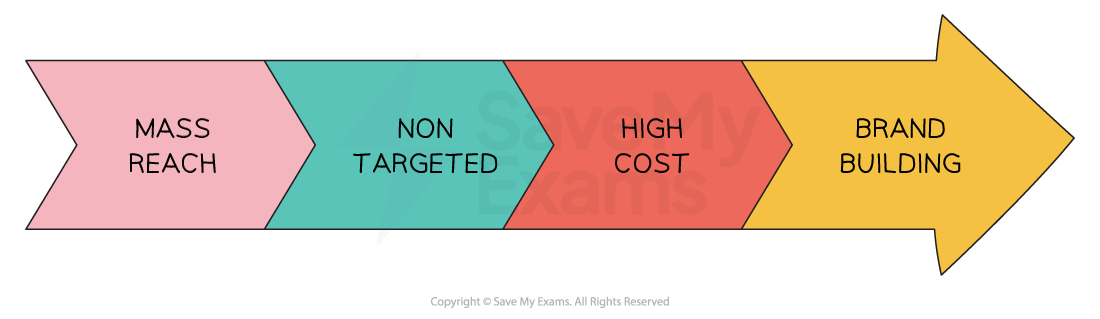
Above-the-line promotion aims to reach the masses and build brand awareness
- Mass reach: Above-the-line promotion aims to reach a large number of people often through broadcasting media and is designed to create brand awareness and **generate interest **among a wide audience
- Non-targeted: It is generally** not tailored to a specific customer segment** and aims to capture the attention of as many people as possible
- High cost: Traditional above-the-line promotion methods require significant budgets due to the costs associated with advertising on television, radio or print media
- Brand building: Above-the-line promotion plays a crucial role in brand building by establishing brand recognition and familiarity among consumers
Types of above-the-line promotion
- Above-the-line promotion can be classified as being informative, persuasive or reassuring
- Examples include advertising on TV, in cinemas, in the print media or online
Types of above-the-line promotion
| Classification | Explanation | Examples |
|---|---|---|
| Informative | - Informative advertising focuses on providing factual information about a product, service or brand - It educates and informs consumers about the features, benefits and value of a product, enabling them to make well-informed purchasing decisions | - When releasing a new drug, pharmaceutical companies such as Bayer may decide to make a television advert that provides information on the medication's proven benefits |
| Persuasive | - Persuasive advertising is designed to influence consumers' attitudes and behaviours towards products or services - It aims to convince customers that a particular product or service is desirable, necessary or superior to alternatives in the market | - Package holiday companies such as Eurocamp which aim their services at families,* *emphasise excellent weather and use images of children having fun in posters displayed on billboards |
| Reassuring | - Reassuring advertising aims to remind existing customers that they made the right decision when choosing a particular product over those of rivals - It encourages customers to remain loyal and continue to purchase the product and others within the range | - Coca Cola reassures its customers through the use of television advertising that promote a 'feel-good' response |
Advantages of above-the-line promotion
-
Wide reach
- Businesses can reach large audiences because mass media channels (e.g. TV, radio, newspapers) provide high visibility.
-
Brand building
- Effective for creating a strong brand image, enhancing brand recognition, and establishing credibility and trust with consumers.
-
Impactful messaging
- Marketing messages can be communicated in an engaging way using sound, images, and graphics, making them more memorable and persuasive.
Disadvantages of above-the-line promotion
-
High cost
- Can be expensive to run, particularly for small businesses with limited marketing budgets.
-
Lack of targeting
- Aimed at wide audiences, so may not effectively reach specific market segments or the intended customer base.
-
Declining effectiveness
- Traditional media consumption is decreasing due to the rise of digital platforms, and consumers can easily ignore or filter out advertisements.
Below-the-line Promotion
Spec point —
4.3.4· below the line promotion techniques
- Below-the-line promotion includes marketing communications over which a business has direct control and which do not make use of mass media
Evaluation of below-the-line promotion
| Method | Explanation | Advantages | Disadvantages |
|---|---|---|---|
| Direct marketing | - This involves communicating directly with customers through email, text message, social media or post - E.g. Takeaway restaurants distribute menus to households in the local community | - Businesses can target specific audiences and personalise the message to individual customers - Direct marketing is measurable, which enables businesses to track their results and adjust strategy accordingly | - It can be intrusive, as customers may perceive it as spam - It can also be costly, especially if businesses do not have an established customer database or need to purchase leads |
| Sales promotions | - Techniques that encourage the purchase of a product or service by offering temporary incentives or discounts - Examples include free samples, buy one get one free (bogof), discount coupons, loyalty cards, point of sale materials and rebates (customers have to mail in to receive money back) | - Sales can receive a quick boost - Sales promotions help clear out stock or promote a new product - They can encourage impulse purchases - They can be targeted to specific segments of customers | - It can be expensive especially if promotions include heavy discounting - They are likely to attract deal-seeking customers who may not be loyal to the brand - Demand for full-priced products may fall |
| Personal selling | - Where a salesperson interacts with customers one-on-one, either in person or through digital communication channels - E.g. Luxury skincare products are often sold by brand representatives at concession stands in department stores | - Businesses build relationships with their customers and understand their specific needs - It enables businesses to provide personalised advice and guidance to customers | - It can be expensive due to the cost of hiring and training sales staff - It may have limited impact as it is difficult to scale to large audiences |
| Merchandising | - The use of point-of-sale materials, product displays and store layout | - Merchandising is particularly effective in encouraging impulse purchases | - It can be 'lost' amongst other visual promotions such as special offers |
| Exhibitions and trade fairs | - Attending specialist exhibitions or trade fairs allows businesses to meet customers face-to-face at a stand or exhibit - Detailed discussions can be held and products demonstrated | - High-profile events can attract media attention which could provide positive brand exposure - Specific target markets attend particular exhibitions - E.g. The annual London Toy Fair attracts toy and game enthusiasts and retailers | - Stands at popular events can be very expensive and require representatives with excellent interpersonal skills |
Exam Hint In the exam you may be asked to justify a suitable method of promotion. Look carefully at the question:
What is the promotional activity expected to achieve?
- Increase market share?
- Higher sales?
- Improve brand recognition?
Make sure you refer back to this aim throughout your answer.
Was this revision note helpful?
Build on this topic