The Importance of Marketing (Edexcel IGCSE Business)
An introduction to marketing
Spec point —
4.2.1· Importance of marketing
-
A market is any place where buyers and sellers can meet to conclude a transaction, e.g. amazon.co.uk or a shopping mall
-
The aim of marketing is to help identify, anticipate and satisfy consumer needs and wants profitably
- Needs are considered to be essential, e.g. shelter or food
- Wants are desires which are non-essential, even if consumers consider them to be essential e.g Nike trainers
Why marketing is important
Spec point —
4.2.1· Importance of marketing: • satisfying customer needs • building customer relationships • keeping customer loyalty
Why marketing is important
Identifying and understanding customer needs
-
Marketing helps a business identify and understand the needs and wants of its customers
-
It involves finding out about the
- Variety and quality of goods and services that customers want
- Prices they are willing to pay
- Promotional techniques that may persuade them to make repeated purchases
- Convenience factors, including where and how they want to purchase products
- After-sales services they anticipate
-
-
Businesses that successfully identify and then satisfy customer needs
- Compete more effectively than rival businesses
- Keep up to date with changing tastes and preferences
- Attract positive word-of-mouth recommendations and build the brand
Benefits of identifying and understanding customer needs
| Need | Explanation | Benefits to the Business |
|---|---|---|
| Price | - The amount of money a customer is willing to pay for a product - Customers often have a budget and want to find the best value for their money | - Understanding this helps the business set competitive prices and offer appealing promotions to their target market |
| Quality | - Quality refers to the standard of excellence that a customer expects from a product - Customers want reliable, durable products that **meet their expectations and **good quality after-sales service | - Understanding this helps businesses create products that meet the desired standards, which can lead to** customer loyalty** and positive word-of-mouth advertising |
| Choice | - Customers have a wide range of preferences and want the choice of a variety of products - Varied features, such as sizes, colours and styles, are required by different customers | - Understanding this helps businesses offer a range of product options that cater to different preferences - This increases customer satisfaction as customers purchase products that meet their specific needs |
| Convenience | - Customers value convenience because they want products that are easy to access and use - This includes factors such as location, online ordering, fast delivery and a variety of ways to pay for products | - Understanding this helps businesses to create a customer experience that is both efficient and enjoyable - Providing a convenient shopping experience builds customer loyalty and increases repeat sales |
Keeping customer loyalty
- Customer loyalty is when existing customers buy products from the same business over and over again
- Customer loyalty leads to repeat purchases and a rise in market share.
- It is much cheaper for a business to try to keep existing customers(for example, with loyalty cards) than trying to gain new customers, as this can involve expensive advertising campaigns
Building customer relationships
-
Building customer relationships involves communicating with customers to encourage them to become loyal to the business and its products
-
Good relationships are maintained by
-
Developing close ties with customers and finding out if products/services are continuing to meet their needs
- E.g. Using surveys to discover if preferences are changing
-
Using technology to gather important information about customers
-
-
Having strong relationships with customers means a business can respond appropriately when expectations of what they want from a good or service change
Market orientation versus product orientation
Spec point —
4.2.1· Importance of marketing: • market orientation and product orientation"
Market orientation versus product orientation
-
Market orientation focuses on the needs of consumers and uses this information to design products that meet customer needs
-
Consumers are at the centre of marketing decisions
-
Products which respond to consumer needs are developed
-
The result of market orientation is that the firm will benefit from increased demand, increased profits, and a valued brand image as its products become more desirable
- E.g. Universities often develop new courses based on the feedback they receive from students and employers
-
Tools of market orientation
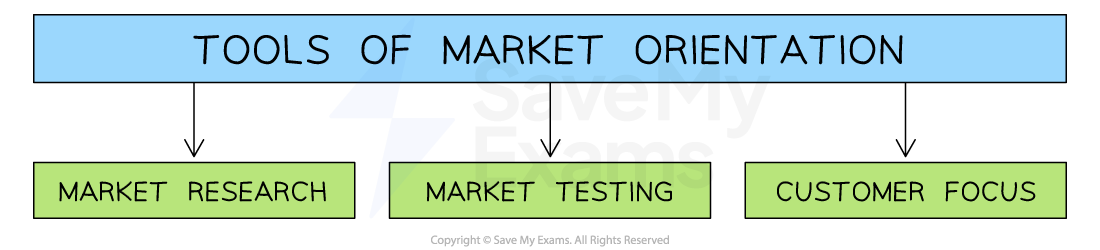
Market orientation aims to develop products to meet consumer needs identified during the market research process
-
Product orientation focuses on the characteristics of the product rather than the needs of the consumer
-
The emphasis is on creating a product first and then finding a market
-
The business has a belief that the product is superior i.e. it will sell itself
- E.g. Gillette's razors can be classed as a product oriented business as the business focuses on the quality of its products and regular innovations aim to increase sales
-
One problem with being too product orientated is that over time a business moves further and further away from what the market is looking for, thus increasing the risk of business failure
-
Tools of product orientation
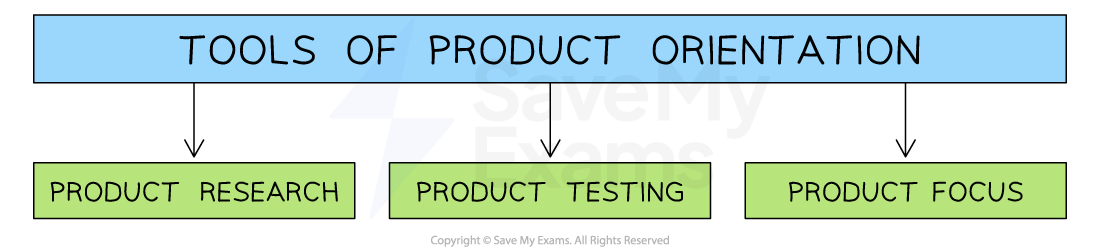
*A product orientation is used by inventors who research, test and produce a product well before market research has taken place *
Niche markets and mass markets
Spec point —
4.2.1· Importance of marketing: • niche and mass marketing.
Niche markets and mass markets
Niche markets
-
In niche markets, products are aimed at a subset of the larger market e.g. gluten free bread and cakes
- Niche marketing occurs when businesses identify and satisfy the demands of a small group of consumers within the wider market
- Production usually happens on a small scale
-
Profitable niche markets rarely remain small for long; their potential attracts competition, which increases sales volumes
- The market for energy drinks is a good example of this - originally targeted at sports-enthusiasts, it is now one of the largest soft drinks segments in the world
Mass markets
-
In mass markets, products are aimed at broad market segments e.g Kellogg's Corn Flakes is an example of a breakfast cereal aimed at the mass market
- Market segments are groups of consumers who share similar characteristics e.g. age, lifestyle, etc.
- Mass marketing occurs when businesses sell their products to most of the available market
- Production usually happens on a large scale
Characteristics of niche and mass markets
| Niche markets | Mass markets |
|---|---|
| - Products are specialised and unique as they are aimed at narrow market segments - High average costs due to small scale production - They do not benefit from economies of scale - High prices make products less affordable and lead to lower sales volumes - High prices can allow businesses to earn higher profit margin - Louis Vuitton is an example of a fashion company that aims its products at a niche market | - Products are less unique as they are aimed at broad market segments - Low average costs due large scale production economies of scale - Low prices lead to greater affordability and higher sales volumes - Low prices lead to lower profit margins - Primark is an example of a clothing company that focuses its product on the mass market |
Market Share & Market Growth
Spec point —
4.2.1· Importance of marketing: • market share and analysis
Market share and market growth
Market share
-
Market share is the percentage of the total market revenue that a single business or brand has
- e.g. Tesco had a 27% share of the UK grocery market in 2022
-
Market share can be calculated using the formula
- An increase in market share can indicate that a business has made effective use of marketing strategies to increase sales and gain customers from competitors
Worked Example In 2022 the UK coffee shop/cafe market was worth £4.6bn. Sales of Starbucks Coffee were £328m in 2022.
Using the data calculate, to 2 decimal places, the market share of Starbucks Coffee in the coffee shop/café market. You are advised to show your workings.
[2]
Step 1: Divide Starbucks' sales by the market size
****$= \frac{ \pounds 328 \mathrm{m} }{\pounds 4.6 bn}
= 0.0713$[1 mark]
Step 2: Multiply the outcome by 100 and express as a percentage
$= 0.0713 \times 100
= 7.13 %$[1 mark]
Exam Hint By showing your working-out, even if you do not get the right answer you will still be able to gain some marks.
Market growth
-
Market growth is the increase in the overall size, value or volume of a market over a period of time, usually expressed as a percentage
-
Market growth provides an incentive for businesses looking to expand, increase sales and generate higher revenue
- Businesses are often attracted to the potential of growing markets - and they can become increasingly competitive quite rapidly
-
Market growth is calculated using the formula
- If the growth rate is positive, the market is getting bigger (expanding)
- If the growth rate is negative, the market is getting smaller (contracting)
Worked Example In 2021 worldwide sales of plug-in hybrid vehicles was 1.94 million units. By 2022 sales had increased to 2.84 million units.
Calculate the rate of market growth in the plug-in hybrid vehicles market.
[2]
Step 1 - Deduct 2021's sales from 2022's sales
Step 2 - Divide the outcome by 2021's sales
[1 mark]
Step 3 - Multiply the outcome by 100 to find the percentage growth rate
[1 mark]
Exam Hint Unless otherwise stated, always give your answer to two decimal places.
Was this revision note helpful?
Build on this topic