Transpiration (Edexcel IGCSE Biology)
Spec point —
3.6B· understand that transpiration is the evaporation of water from the surface of a plant
Transpiration
- Transpiration is defined as
The evaporation of water vapour from the surface of a plant
-
Transpiration is useful for plants, having several functions :
- Drawing water up to the leaves from the roots
- Keeping the leaves cool as heat energy is lost from the leaves when water evaporates
- Transporting mineral ions(eg. nitrates)
- Preventing wilting by providing water to keep cells turgid
- Providing water for photosynthesis
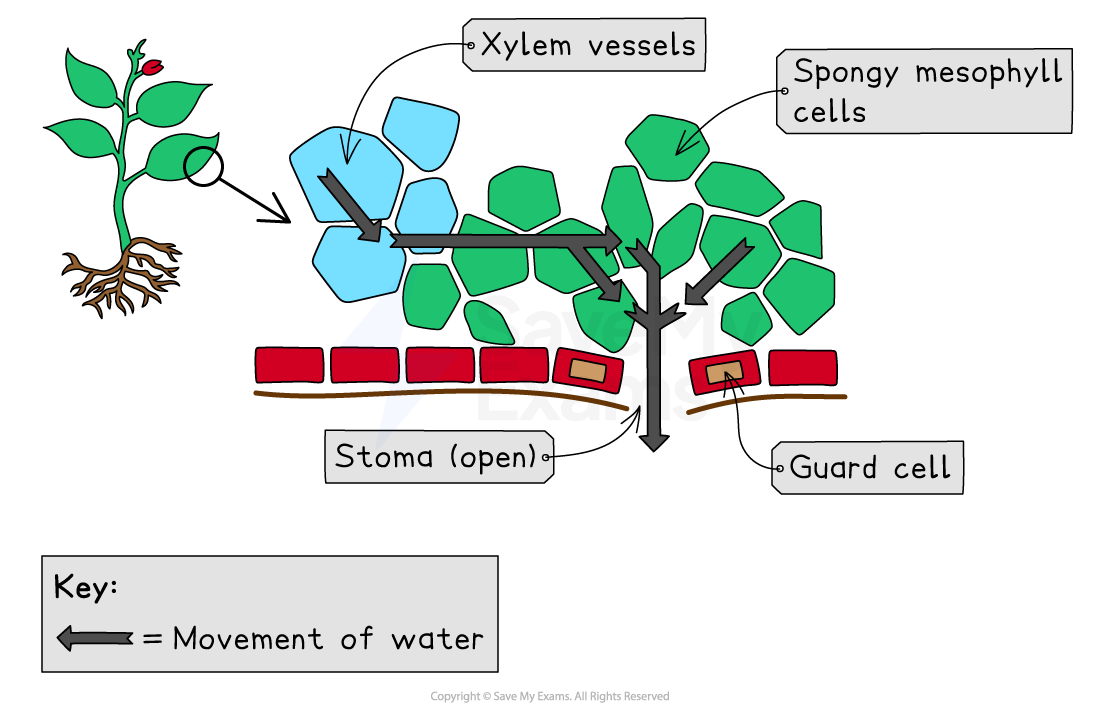
Transpiration mainly occurs on the underside of leaves through tiny pores called stomata (one pore is referred to as a stoma)
Factors Affecting Transpiration
Spec point —
3.7B· understand how the rate of transpiration is affected by changes in humidity, wind speed, temperature and light intensity
-
There are several environmental conditions which have an impact on the rate of transpiration:
- Air movement
- Humidity
- Temperature
- Light intensity
Factors affecting transpiration rate table
- The table summarises the effects of these four factors on the rates of transpiration
| Factor | Relationship to transpiration rate | Explanation |
|---|---|---|
| Air movement | As wind speed increases, the transpiration rate increases | When it is windy, water molecules that have diffused out of the stomata are quickly blown away from the leaf. This creates a concentration gradient and more water vapour diffuses out of the leaf. |
| Temperature | As temperature increases, the transpiration rate increases | As temperature increases, the kinetic energy of water molecules increases. Water molecules with increased kinetic energy move around faster and more likely to diffuse out of the stomata. |
| Humidity | As humidity increases, the transpiration rate decreases | When it is humid, there is an increase in water molecules outside of the leaf. This affects the diffusion concentration gradient. As a result, there is a decrease in the rate of diffusion of water vapour out of the leaf. |
| Light intensity | As light intensity increases, the transpiration rate increases | Light intensity affects stomatal opening - the higher the light intensity the greater the number of stomata that are open, which increases the diffusion of water vapour out of the leaf. |
Exam Hint You could be given a question about a transpiration experiment in your exam where some of the factors listed in the table above are being investigated.
The table above explains how the factors influence transpiration when they're increased (eg. an increase in humidity results in a decrease in transpiration rate...) but you should also know the effects of each of them decreasing, which would be the opposite (eg. in less windy/still conditions, transpiration rate decreases as less of a diffusion gradient would exist between the leaf and the air).
Was this revision note helpful?
Build on this topic