Mutation: Advanced (Edexcel IGCSE Biology)
Changes in DNA can Affect the Phenotype
Spec point —
3.35B· understand how a change in DNA can affect the phenotype by altering the sequence of amino acids in a protein
-
A change in DNA can affect the phenotype of an individual by **altering the sequence of amino acids **in a protein
-
There are three main ways that the** sequence of DNA can be changed**(which will alter the sequence of amino acids in the protein)
- Insertion of a new base into the DNA sequence
- Deletion of a base within the DNA sequence
- Substitution of a base within the DNA sequence
Insertions
-
A new base is randomly inserted into the DNA sequence
-
An insertion mutation changes the amino acid that would have been coded for by the group of three bases in which the mutation occurs
- Remember – every group of three bases (codon) in a DNA sequence codes for an amino acid
-
An insertion mutation also has a knock-on effect by changing the groups of three bases further on in the DNA sequence
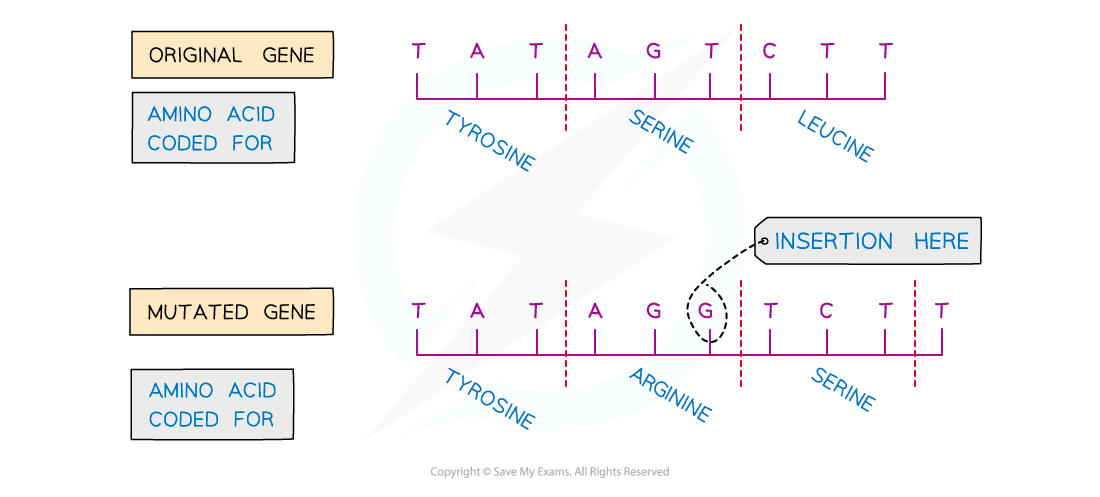
An example of an insertion mutation
Deletions
- A base is randomly deleted from the DNA sequence
- Like an insertion mutation, a deletion mutation changes the amino acid that would have been coded for by the group of three bases in which the mutation occurs
- Like an insertion mutation, a deletion mutation also has a knock-on effect by changing the groups of three bases further on in the DNA sequence
Substitutions
- A base in the DNA sequence is randomly swapped for a different base
- Unlike an insertion or deletion mutation, a substitution mutation will only change the amino acid for the group of three bases in which the mutation occurs; it will not have a knock-on effect
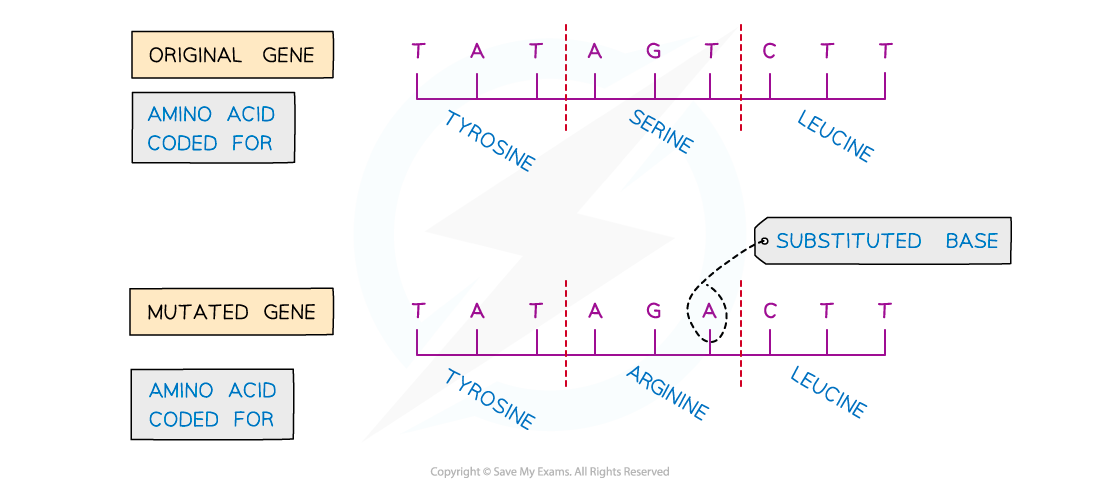
An example of a substitution mutation
The Effects of Mutations
Spec point —
3.36B· understand how most genetic mutations have no effect on the phenotype, some have a small effect and rarely do they have a significant effect
-
Most genetic mutations do not alter the protein, or only alter it slightly, so that its function is unaffected
- Therefore, most mutations have no effect on the phenotype
-
Some genetic mutations can slightly alter the shape of a protein, causing a minor effect on the phenotype
-
Rarely do mutations have a significant effect on the phenotype
- If a mutation produces a protein with a different shape, this may affect its function (affecting the phenotype)
- For example, if the active site of an enzyme changes shape, the substrate may no longer bind, preventing enzyme-substrate complexes from forming
-
Occasionally, mutations create new alleles, resulting in new phenotypes
-
If the new phenotype provides a survival or reproductive advantage, it can be passed on to future generations
- For example, if a mutation changes a bird’s feather colour, If the new colour makes it more attractive to mates, the mutation is more likely to be passed on
-
Mutations can also be harmful, causing significant health problems
- For example: sickle cell anaemia, caused by a mutation in the gene coding for haemoglobin
The Causes of Mutations
Spec point —
3.37B· understand that the incidence of mutations can be increased by exposure to ionising radiation (for example, gamma rays, x-rays and ultraviolet rays) and some chemical mutagens (for example, chemicals in tobacco)
-
Mutations happen spontaneously and continuously but their frequency can be increased by exposure to the following:
- Gamma rays, x-rays and ultraviolet rays - all types of ionising radiation which can damage bonds and cause changes in base sequences
- Chemical mutagens - for example, chemicals such as tar in tobacco
-
Increased rates of mutation can cause cells to become cancerous, which is why the above are linked to increased incidence of different types of cancer
Was this revision note helpful?
Build on this topic