11 markeasy
In a mathematical argument, how are three consecutive integers usually denoted algebraically?
38 questions · 136 marks · ≈ 2 hours
In a mathematical argument, how are three consecutive integers usually denoted algebraically?
(i) In a mathematical argument, how is an even number usually denoted?
(ii) Similarly, how is an odd number usually denoted?
Prove that the sum of two odd numbers is even.
Explain why for all real values of .
Prove that the product of two even numbers is a multiple of 4.
Use a counter-example to show that .
Prove by exhausting all possible factors that 11 is a prime number.
Prove that for all real values of .
Show that 0.6 can be written in the from , where and are integers.
What does this tell you about the type of number 0.6 is?
Prove that the sum of any three consecutive integers is a multiple of 3.
Prove that for all values of .
Prove that the square of an even number is a multiple of 4.
The set of numbers S is defined as all positive integers less than 5.
Prove by exhaustion that the cube of all values in S are less than 100.
Use a counter-example to prove that the difference between any two square numbers is not always odd.
Express 18 as a product of its prime factors.
Write down all prime numbers between 1 and 13.
By dividing 13 by each of the prime numbers found in part (b), prove that 13 is a prime number.
Factorise .
Hence show that .
Given that n is even, write down whether are odd or even.
Hence deduce whether is odd or even. Justify your answer.
By writing it as a fraction in its lowest terms, show that 0.35 is a rational number.
Two rational numbers, and are such that and where are integers with no common factors and .
Find an expression for .
Deduce whether or not the product is rational or irrational.
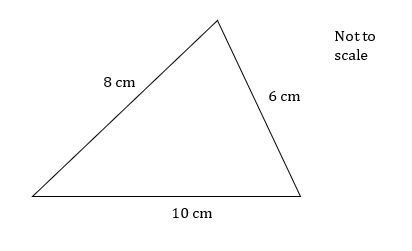
Prove that a triangle with side lengths of 8 cm, 6 cm and 10 cm must contain a right-angle. You may use the diagram below to help.
A standard chess board has 64, 1x1- sized squares. It also has 1, 8x8 - sized square.
How many 2x2 - sized squares are there on a standard chess board?
Write down the number of 3x3 - sized and 4x4 - sized squares there are on a standard chess board.
Hence show that there are 204 squares in total on a standard chess board.
Prove that the sum of any three consecutive even numbers is a multiple of 6.
Prove that for all values of , where .
Prove that the square of an odd number is always odd.
The set of numbers S is defined as all positive integers greater than 5 and less than 10.
Prove by exhaustion that the square of all values in S differ from a multiple of 5 by 1.
Use a counter-example to prove that not all integers of the form , where is an integer, are prime.
By considering all possible prime factors of 17, prove it is a prime number.
Fully factorise .
Prove that, if is odd, is odd and that if is even, is even.
Two rational numbers, a and b are such that and , where are integers with no common factors and .
Find expressions for and .
Deduce whether or not and are rational or irrational.
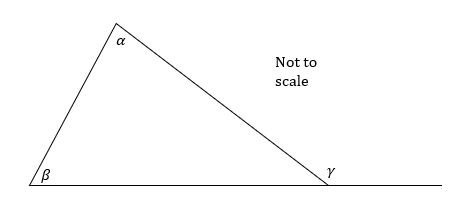
Prove that the exterior angle in any triangle is equal to the sum of the two opposite interior angles. You may use the diagram below to help
Prove that the sum of any three consecutive even numbers is always a multiple of 2, but not always a multiple of 4.
Prove that for all values of ,* *where .
Prove that the (positive) difference between an integer and its cube is the product of three consecutive integers.
The elements, , of a set of numbers, S, are defined .
Prove that every element of S can be written in the form where .
Give an example to show when the following statement is both true and false.
The square of a positive integer is always greater than doubling it.
Prove that 23 is a prime number.
Briefly explain why only prime factors need to be tested for, in order to prove a number is prime.
Prove that, if is negative, is positive.
Prove that the sum of two rational numbers is rational.
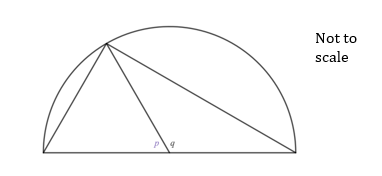
Prove the angle at the circumference in a semi-circle is a right angle.
You may use the diagram below to help.
A standard chess board has 64 1x1 - sized squares. It also has 1 8x8 - sized square.
Prove that there are 204 squares on a standard chess board.