Linear Simultaneous Equations using Substitution (Edexcel IAL Maths)
Exam board Pearson Edexcel · IALUpdated 2026-07-02
Linear Simultaneous Equations - Substitution
Spec point —
1.6
Linear simultaneous equations using substitution
What are linear simultaneous equations?
- When you have more than one equation in more than one unknown, then you are dealing with simultaneous equations
- An equation is linear if none of the unknowns in it is raised to a power other than one
- Solving a pair of simultaneous equations means finding pairs of values that make both equations true at the same time
- A linear equation in two unknowns will produce a straight line if you graph it... linear = line
- A pair of simultaneous equations will produce lines that will cross each other (if there is a solution!)
How do I use substitution to solve linear simultaneous equations?
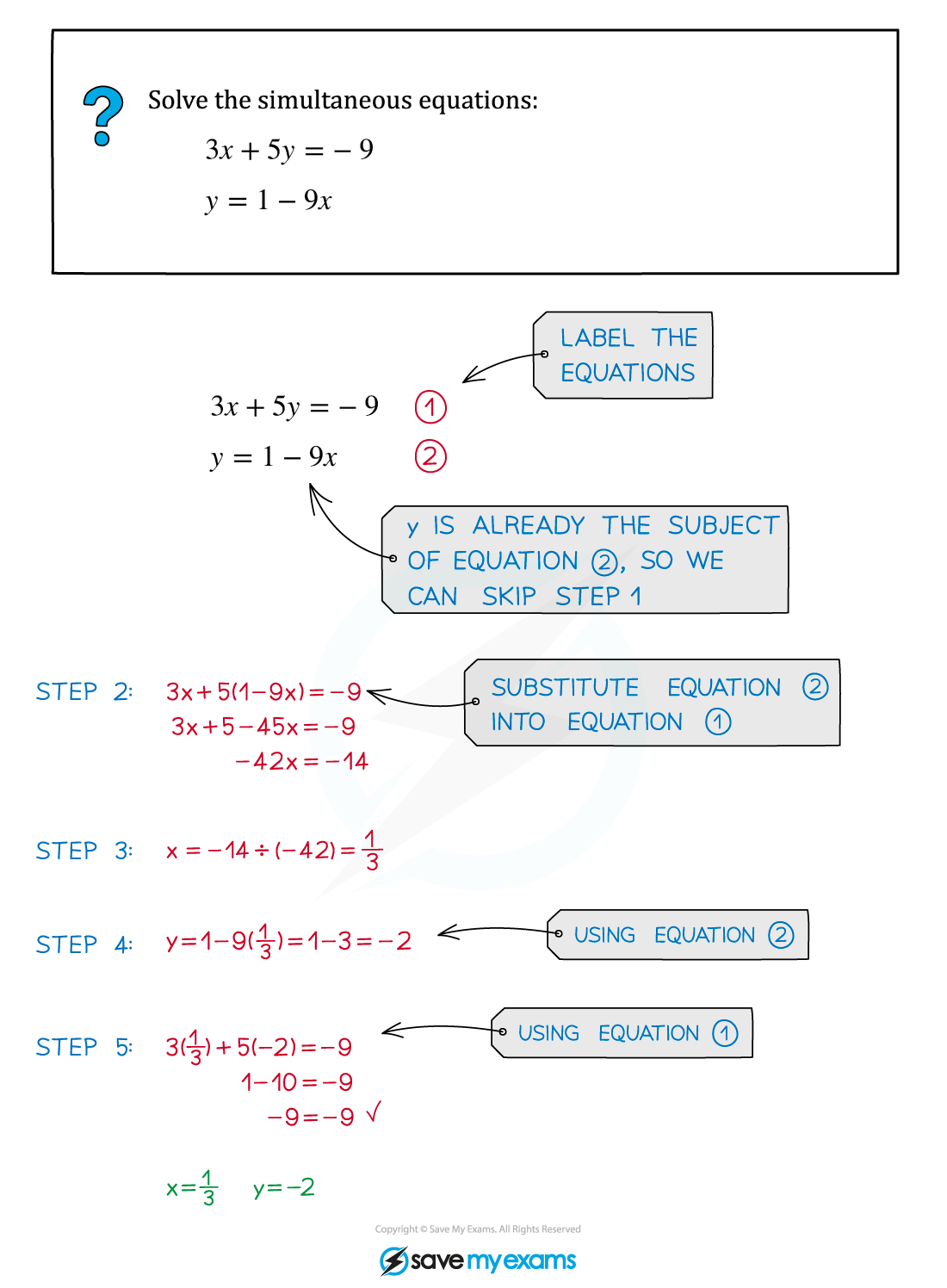
Step 1: Rearrange one of the equations to make one of the unknowns the subject (if one of the equations is already in this form you can skip to Step 2)
Step 2: Substitute the expression found in Step 1 into the equation not used in Step 1
Step 3: Solve the new equation from Step 2 to find the value of one of the unknowns
Step 4: Substitute the value from Step 3 into the rearranged equation from Step 1 to find the value of the other unknown
Step 5: Check your solution by substituting the values for the two unknowns into the original equation you didn't rearrange in Step 1
Exam Hint
- Although elimination will always work to solve simultaneous linear equations, sometimes substitution can be easier and quicker.
- Knowing both methods can help you a lot in the exam (plus you will need substitution to solve quadratic simultaneous equations).
Worked Example
Was this revision note helpful?
Build on this topic