Enthalpy of Solution - Key Terms (Edexcel IAL Chemistry)
Spec point —
12.16
Enthalpy of Solution - Key Terms
Enthalpy of solution
-
The standard enthalpy change of solution (ΔsolH) **is the enthalpy change when 1 mole of an ionic substance dissolves in sufficient water to form an infinitely dilute solution
-
The symbol**(aq) is used to show that the solid is dissolved in sufficient water
- For example, the enthalpy changes of solution for potassium chloride are described by the following equations:
KCl (s) + aq → KCl (aq)
OR
KCl (s) + aq → K+ (aq) + Cl- (aq)
- ΔsolHꝋcan be exothermic(negative) or endothermic(positive)
Enthalpy of hydration
-
The standard enthalpy change of hydration (ΔhydH) is the enthalpy change when 1 mole of a specified gaseous ion dissolves in sufficient water to form an infinitely dilute solution
- For example, the enthalpy change of hydration for magnesium ions is described by the following equation:
Mg2+(g) + aq → Mg2+(aq)
-
Hydration enthalpies are the measure of the energy that is released when there is an attraction formed between the ions and water molecules
- Hydration enthalpies are exothermic
-
When an ionic solid dissolves in water, positive and negative ions are formed
-
Water is a polar molecule with a δ- oxygen (O) atom and δ+ hydrogen (H) atoms which will form ion-dipole attractions with the ions present in the solution
-
The oxygen atom in water will be attracted to the positive ions and the hydrogen atoms will be attracted to the negative ions
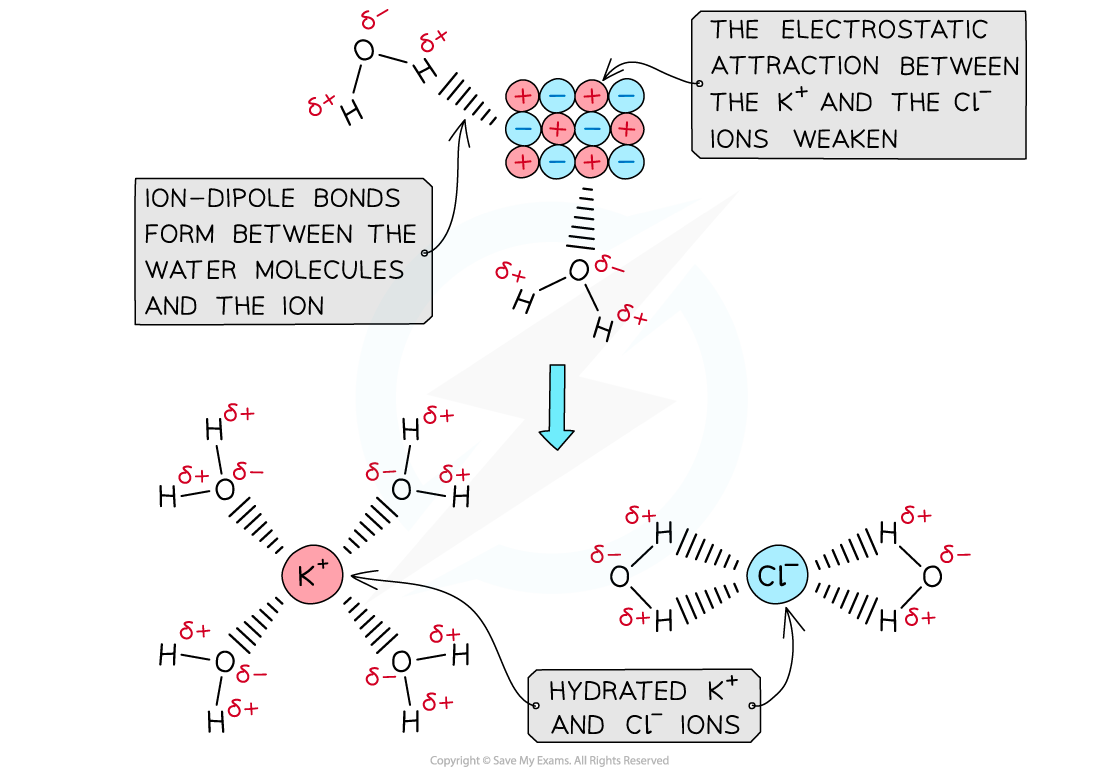
The polar water molecules will form ion-dipole bonds with the ions in solution causing the ions to become hydrated
Was this revision note helpful?
Build on this topic