Enthalpy of Solution - Calculations (Edexcel IAL Chemistry)
Spec point —
12.17
Enthalpy of Solution - Calculations
-
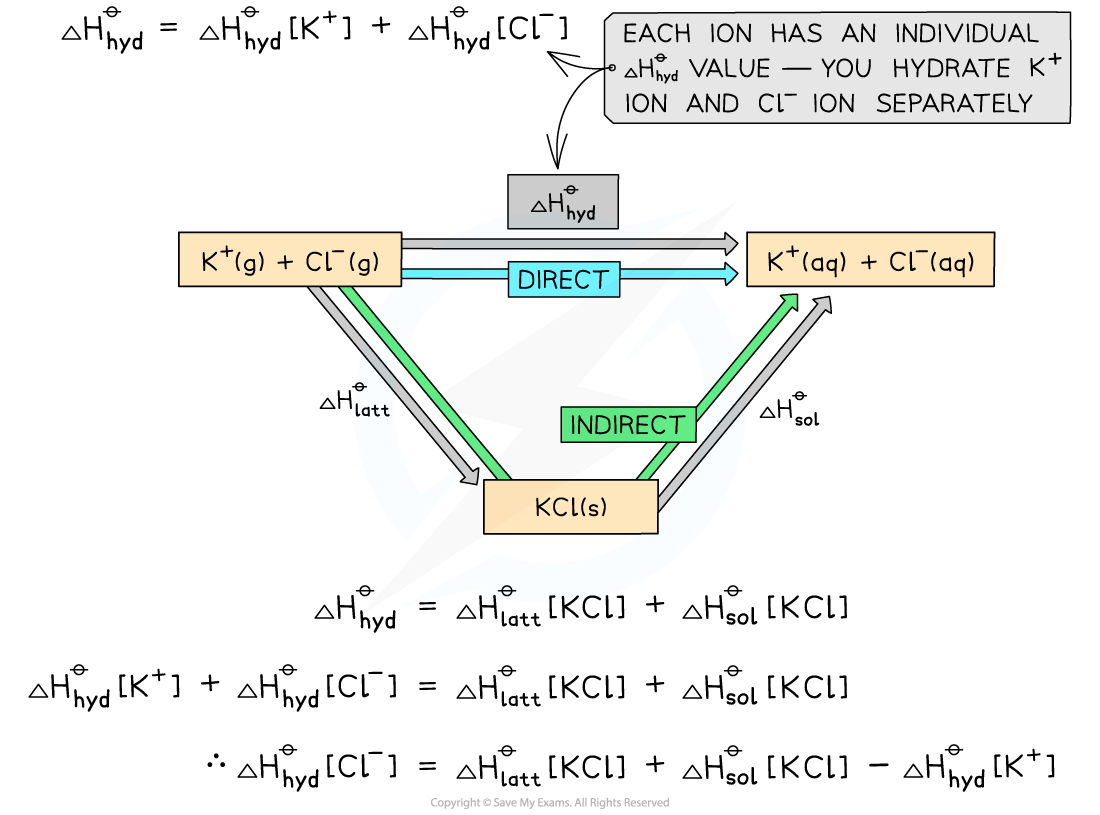
Questions in this topic typically ask you to calculate the hydration enthalpy of one of the ions, given the lattice enthalpy, enthalpy of solution and hydration enthalpy of the other ion.
-
This can be done by constructing an appropriate energy cycle and using Hess's Law to find the unknown energy value
-
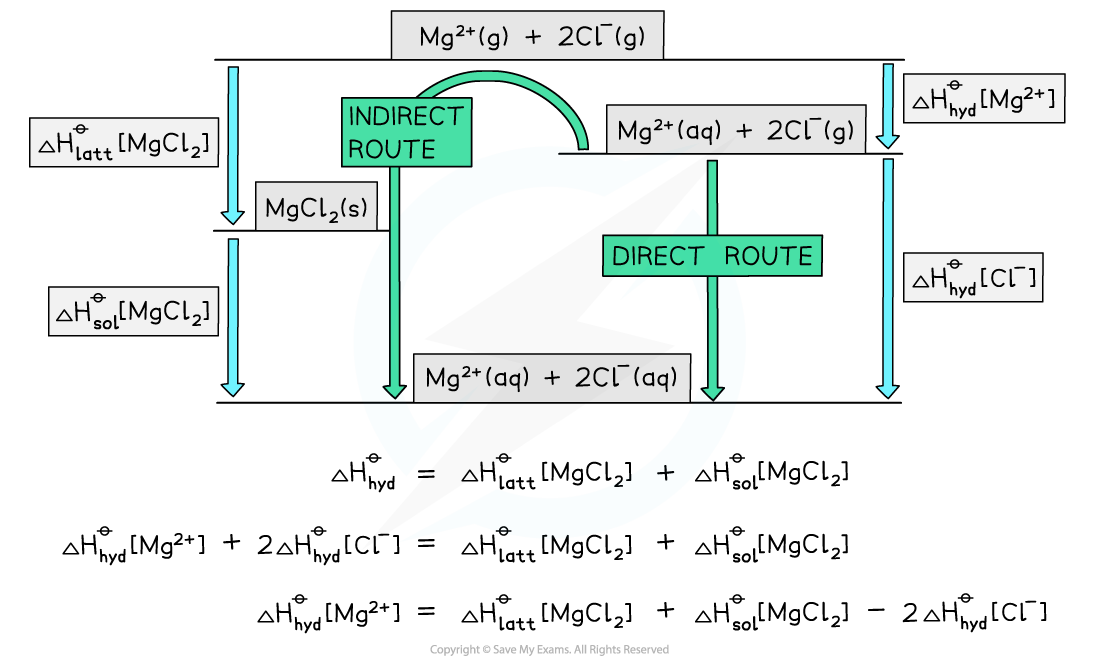
The energy cycle above shows that there are two routes to go from the gaseous ions to the ions in an aqueous solution:
-
Route 1: going from gaseous ions → ionic solid → ions in aqueous solution (this is the indirect route)
- Route 2: going from gaseous ions → ions in aqueous solution (this is the direct route)
-
-
According to Hess’s law, the enthalpy change for both routes is the same, such that:
ΔhydHꝋ = ΔlattHꝋ+ ΔsolHꝋ
-
Each ion will have its own enthalpy change of hydration, ΔHhydꝋ, which will need to be taken into account during calculations
- The total ΔhydHꝋis found by adding the ΔhydHꝋvalues of both anions and cations together
Worked Example Constructing an energy cycle for KCl
Calculate the enthalpy of hydration of the chloride ion given the following data:
ΔlattHꝋ [KCl] = -711 kJ mol-1
ΔsolHꝋ [KCl] = +26 kJ mol-1
ΔhydHꝋ [K+] = -322 kJ mol-1
Answer
Step 1: Draw the energy cycle and make ΔhydH[Cl-] the subject of the formula:
**Step 2: **Substitute the values to find ΔhydH[Cl-]
ΔhydH[Cl**-] = (-711) + (+26) - (-322) = -363 kJ mol-1**
Alternative Diagram
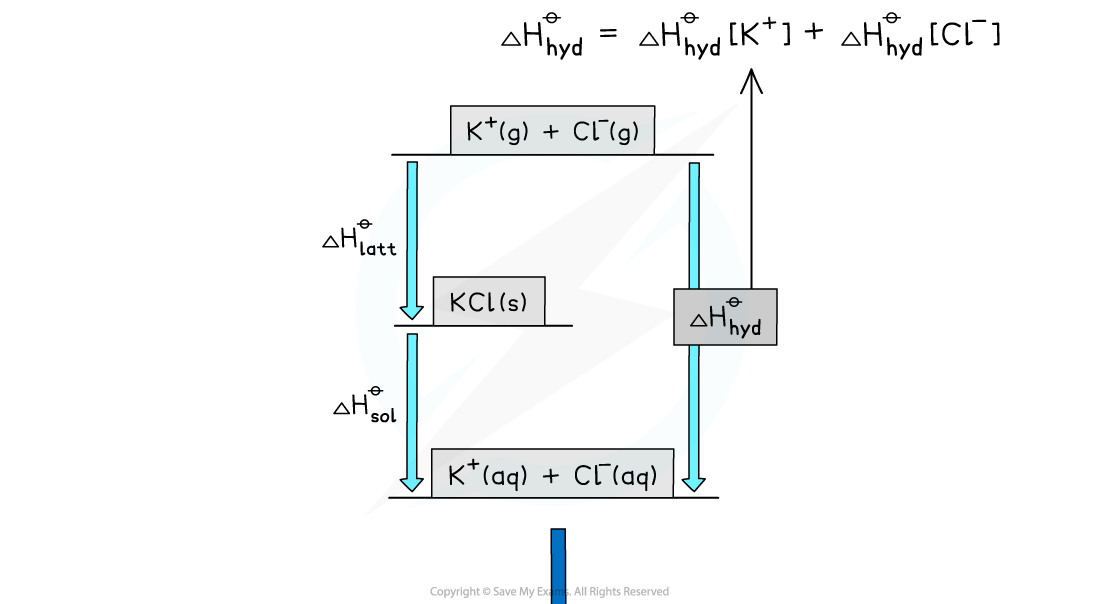
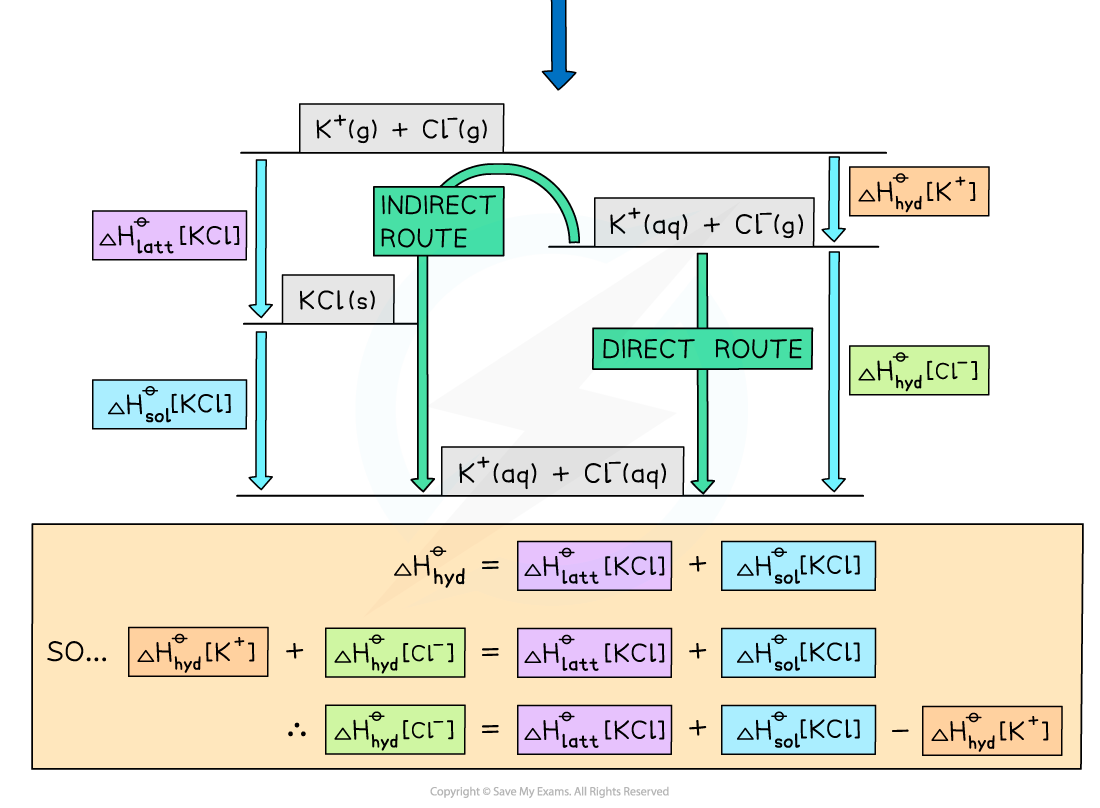
- You can also draw a Born-Haber cycle as an alternative approach to the same problem
Energy level diagram:
Worked Example Constructing an energy cycle and energy level diagram of MgCl2
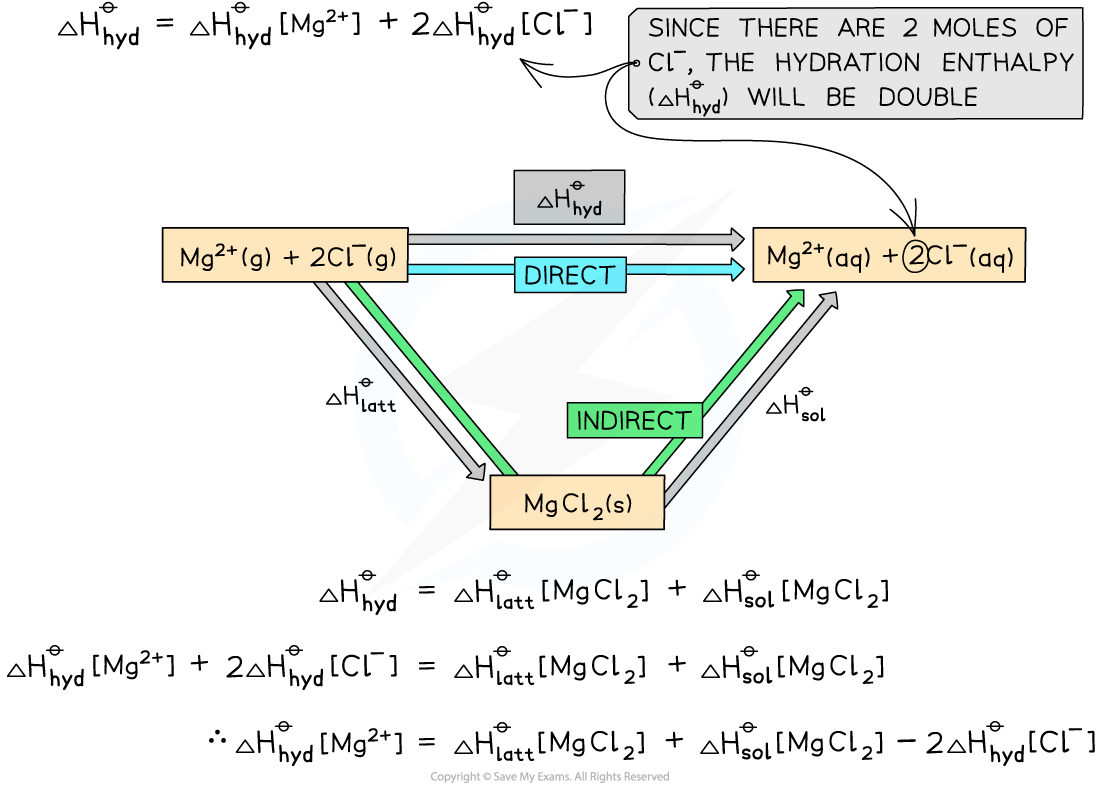
Construct an energy cycle to calculate the ΔhydHꝋof magnesium ions in magnesium chloride, given the following data:
ΔlattH [MgCl2] = -2592 kJ mol-1
ΔsolH [MgCl2] = -55 kJ mol-1
ΔhydH* *[Cl-] = -363 kJ mol-1
Answer
Step 1: Draw an energy cycle:
**Step 2: **Substitute the values to find ΔHhydꝋ [Mg2+]
ΔH**hydꝋ**[Mg 2+] = (-2592) + (-55) - (2 x -363) = -1921 kJ mol -1 **
Alternative route to find ΔhydHꝋ[Mg2+**]
- Here is the same solution using a Born-Haber cycle
Exam Hint It doesn't matter whether you use Hess cycles or Born-Haber style cycles to solve these problems as long as the information is correctly labelled and the direction of the arrows matches the definitions.Exam problems in this topic often show diagrams with missing labels which you have to complete and find unknown values.The key to success in energy cycle calculations is not to panic, but have a careful step-by-step approach, show your workings and use brackets to separate mathematical operations from the enthalpy changes.
Enthalpy of Solution - Predictions
Spec point —
12.19
-
When an ionic compound dissolves in water, there are two changes that need to take place
- The lattice structure needs to be broken down and the ions must become hydrated
-
The breaking down of the lattice structure is endothermic (equivalent to the reverse lattice energy) it also results in an increased number of moles of particles present, therefore entropy will increase
-
The hydration of the ions is an exothermic process but results in water molecules becoming more ordered as they arrange themselves around the cations and anions
-
This increasing in order decreases the entropy of the water
-
Therefore to explain why some ionic compounds are soluble and some are insoluble we must consider both entropy and enthalpy changes involved
-
As we have seen previously
ΔStotal = ΔSsystem+ Δ Ssurroundings
And since
Δ Ssurroundings
The expression can become
Δ Stotal= Δ Ssystem
-
Therefore the solubility of an ionic solid depends upon three factors
- The entropy of the system, ΔSsystem
- The enthalpy change of solution, ΔsolH
- The temperature, in K, of the water, T
If we consider ammonium nitrate, NH4NO3 (s), at 298 K
NH4NO3(s) → NH4+(aq) + NO3-(aq)
- The enthalpy change of solution, ΔsolH = +25.8 kJ mol-1
- The temperature, in K, of the water, T = 298 K
ΔSsystem = S[NH4+ (aq)] + S[NO3- (aq)] - S[NH4NO3 (s)]
= +113.4 + 146.4 - 151.1
= +108.7 J K-1mol-1
=
= -86.6 J K-1mol-1
- Therefore the total entropy is:
ΔStotal = Δ Ssystem+ Δ Ssurroundings
= +108.7 + (-86.6)
= +22.1 J K-1mol-1
- If the entropy change is positive, as it is for dissolving ammonium nitrate in water at 298 K, then this is thermodynamically spontaneous
- The activation energy (Ea) for this reaction is very low, we can conclude that at 298 K, ammonium nitrate is soluble in water
Was this revision note helpful?
Build on this topic