Rates of Reaction - Titrimetric Method (Edexcel IAL Chemistry)
Exam board Pearson Edexcel · IALUpdated 2026-02-19
Core Practical 9a: Titrimetric Methods
Spec point —
11.12
- This practical uses a titrimetric method (a technique involving titration) to determine the order of reaction with respect to iodine in its acid-catalysed reaction with propanone
- Propanone reacts with iodine in the presence of an acid catalyst:
CH3COCH3 (aq) + I2(aq) → CH3COCH2I (aq) + H+(aq) + I- (aq)
Aim
- To determine how the concentration of iodine, [I2], affects the rate of the reaction
Experimental design
-
The concentrations of the other reactants, propanone and H+, do not change
-
A large excess of both propanone and the acid catalyst is used
- This means that their concentrations will remain effectively constant throughout the experiment
Method (sampling and quenching)
- We need to find the concentration of iodine at various points in time, so we use a sampling and titration method
- Mix 25 cm3 of 1.0 mol dm-3 aqueous propanone with 25 cm3 of 1.0 mol dm-3 sulfuric acid in a beaker
- Add 50 cm3 of 0.02 mol dm-3 iodine solution
- Start the timer as soon this is added to the beaker
- At regular intervals, use a pipette to withdraw 10 cm3 portion of the reaction mixture and transfer this to a conical flask
- Quench/ stop the sample reacting further by adding a spatula of sodium hydrogen carbonate
- Titrate the sample against 0.01 mol dm-3 sodium thiosulfate(VI) solution using starch as an indicator
- Starch is used as an indicator is used to determine the concentration of iodine
2S2O32-(aq) + I2(aq) → 2I-(aq) + S4O62- (aq)
- Record the result for each titration in a suitable table
| Time (mins) | Titre (cm3) |
|---|---|
| 0 | |
| 5 | |
| 10 |
Practical tips
-
Have everything ready and set up before beginning the procedure
-
Keep the timer running throughout the practical rather than stopping the clock
-
Record the time when the sodium hydrogencarbonate is added to the samples of reaction mixture
- This is when the reaction actually stopped
- This means that the concentration of iodine can be calculated accurately
Results
- Here is an example set of results
| Time (mins) | Titre (cm3) |
|---|---|
| 2.3 | 39.10 |
| 8.6 | 35.80 |
| 14.7 | 33.15 |
| 21.9 | 29.55 |
| 38.0 | 22.10 |
Analysis and conclusion
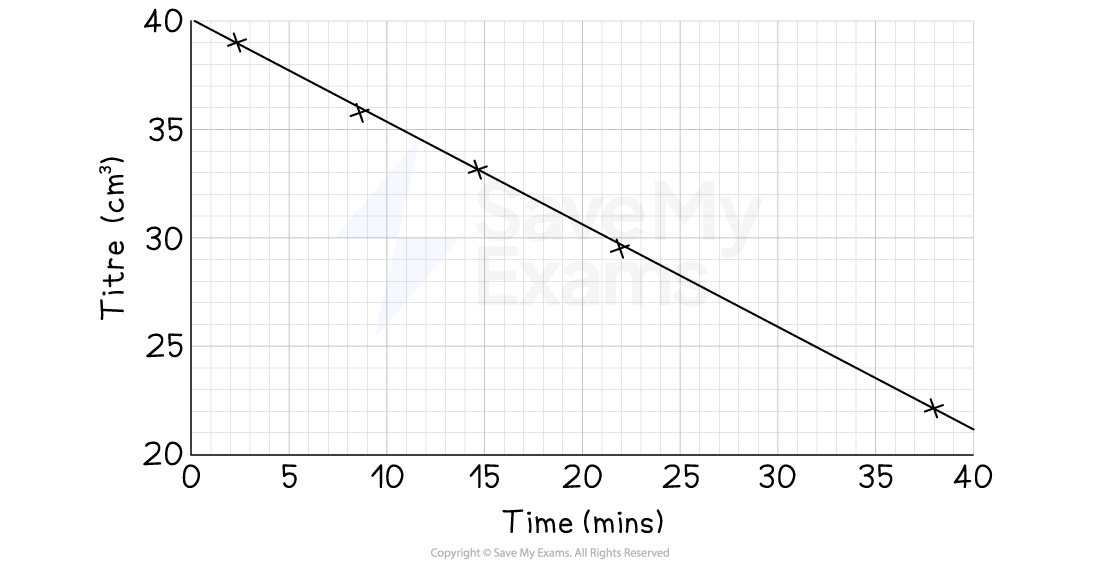
- Plot a graph of titre (y-axis) against time (x-axis)
-
For this reaction, the graph is a straight line with a negative gradient
- A straight, descending line on a concentration-time graph means the rate of reaction is constant.
- This shows that the rate is independent of the concentration of iodine.
- Therefore, the reaction is zero order with respect to iodine
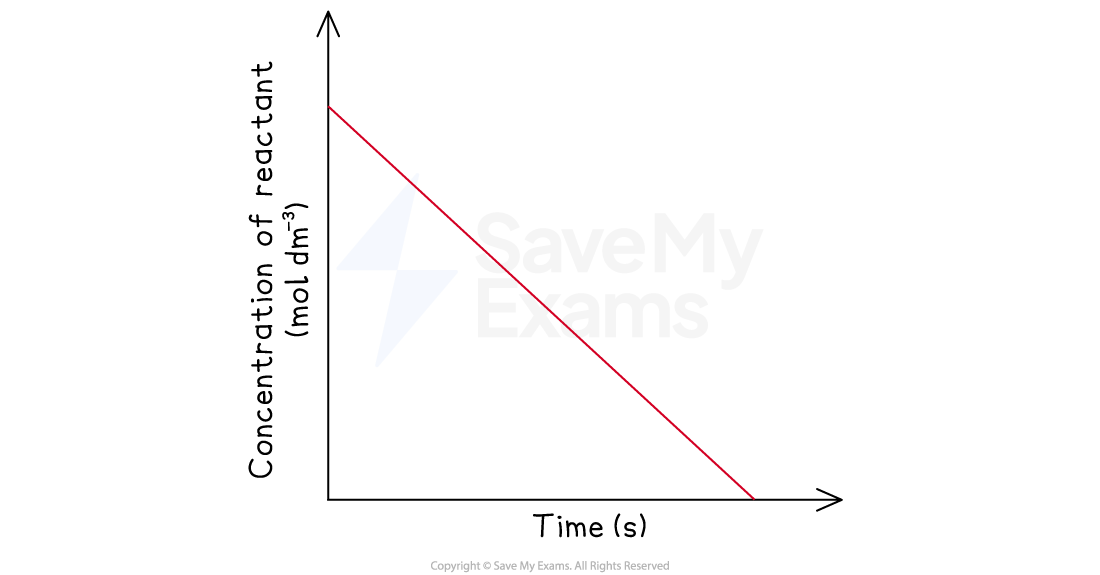
Concentration-time graphs of a zero-order reaction
- The reaction is first order with respect to propanone and H+
- This experiment determines that the reactions is zero order with respect to iodine
- So, the overall rate equation is:
Rate = k[CH3COCH3 (aq)] [H+ (aq)]
- [I2] does not appear in the rate equation because its order is zero
Was this revision note helpful?
Build on this topic