Periodic Trends (Cambridge International IGCSE Science)
The metallic character of elements
-
The metallic character of the elements:
- Decreases as you move across a period on the Periodic Table, from left to right
- Increases as you move down a Group
-
Across a period:
- Atoms become less likely to lose electrons and more likely to gain or share electrons
- So, metallic character decreases
-
Metals occur on the left-hand side of the Periodic Table and non-metals on the right-hand side
-
Between the metals and the non-metals lie the elements which display some properties of both
-
These elements are referred to as metalloids or semi-metals
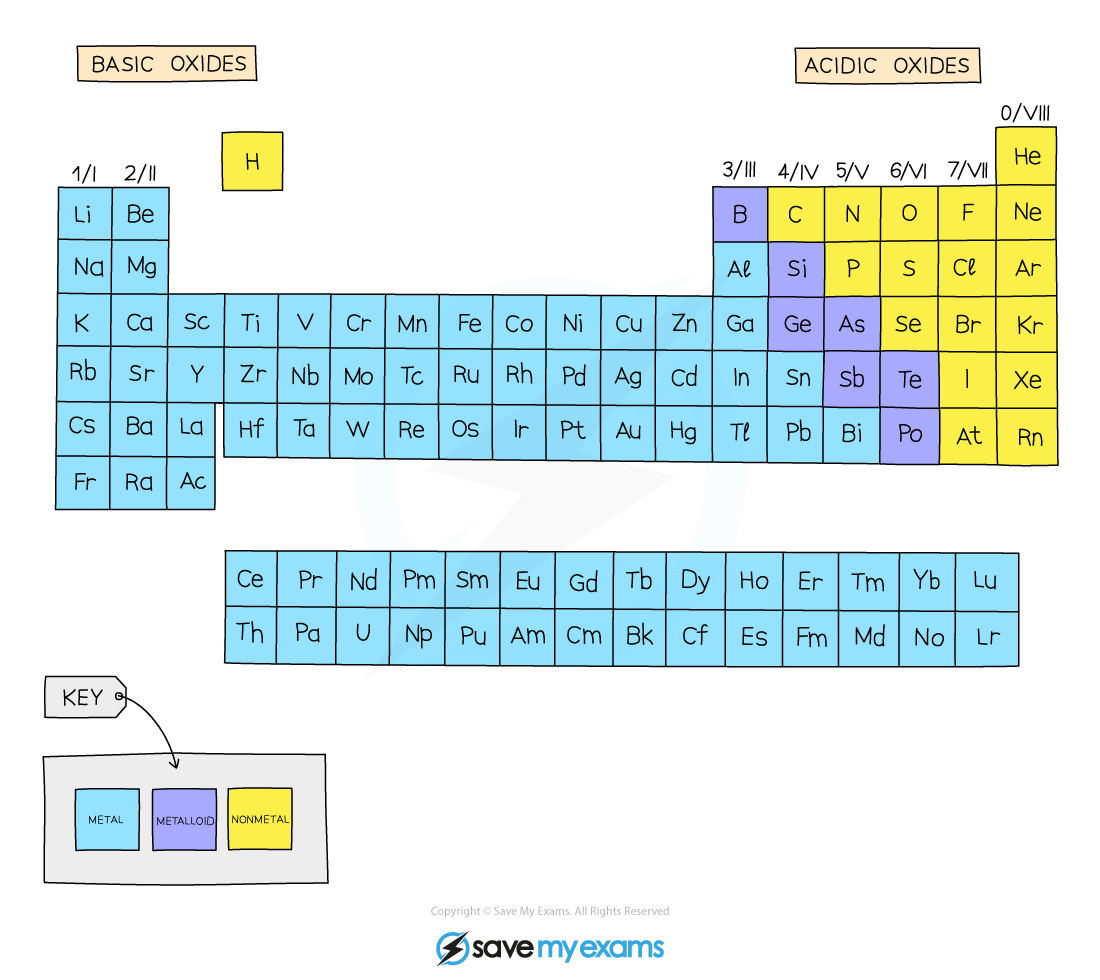
A zig-zag line in this diagram separates the metals on the left, from the non-metals on the right
Properties of metals and non-metals
| Property | Metal | Non-metal |
|---|---|---|
| Bonding | metallic | covalent |
| Electrical conductivity | good conductors | poor conductors |
| Type of oxide | basic oxide | acidic oxides |
| Reaction with acids | many react with acids | do not react with acids |
| Physical characteristics | malleable high melting and boiling point | brittle low melting and boiling point |
Identifying Trends
Extended tier only
- Using given information about elements, we can identify trends in properties
- An example of this could be determining the trend in reactivity of Group I metals
Reaction of lithium with water:
lithium + water → lithium hydroxide + hydrogen
2Li (s) + 2H2O (l) → 2LiOH (aq) + H2 (g)
-
Observations:
- Relatively slow reaction
- Fizzing
- Lithium moves on the surface of the water
Reactions of sodium with water:
sodium + water → sodium hydroxide + hydrogen
2Na (s) + 2H2O (l) → 2NaOH (aq) + H2 (g)
-
Observations:
- More vigorous fizzing
- Moves rapidly on the surface of the water
- Dissolves quickly
Reactions of potassium with water:
potassium + water → potassium hydroxide + hydrogen
2K (s) + 2H2O (l) → 2KOH (aq) + H2 (g)
-
Observations:
- Reacts more vigorously than sodium
- Burns with a lilac flame
- Moves very rapidly on the surface
- Dissolves very quickly
Identifying the trend
-
The trend:
- The observations show that reactivity of the Group I metals increases as you go down the group
-
Using the trend:
- With this information we can predict the trend going further down Group I for the elements rubidium, caesium and francium
-
Predicting properties:
-
Reactivity increases down the group
- Lithium is the least reactive metal at the top of the group
- So, francium will be the most reactive at the bottom of the group
-
This means that rubidium, caesium and francium will react more vigorously with air and water than lithium, sodium and potassium
-
-
Predicted reactions with water:
- Rubidium reacts very violently and may explode
- Caesium reacts extremely violently and can explode
- Francium is extremely reactive, but it is rare and radioactive so it is difficult to confirm predictions
Exam Hint For the extended course you may be asked to identify other trends in chemical or physical properties of Group I metals, given appropriate data.
Firstly, ensure that the metals and associated data are written in either descending or ascending order according to their position in the Group. Then look for general patterns in the data.
Was this revision note helpful?
Build on this topic