Life Cycle of a Star (Cambridge International IGCSE Science)
Exam board Cambridge International · IGCSEUpdated 2025-12-19
Spec point —
P6.2.2
Life cycle of a star
Small mass star
- A small mass star is one which has a similar mass as the Sun
- After the stable star stage, a small mass star finishes its life cycle in the following evolutionary stages:
red giant → planetary nebula + white dwarf
-
Red giant:
- Formed when a small mass star reaches the end of its life
- The outer layers of the star expand and cool
-
Planetary nebula:
- Formed when the outer layers of the star are pushed away
-
White dwarf:
- Formed when the core of the star collapses
- Found at the centre of a planetary nebula
The life cycle of a small mass star
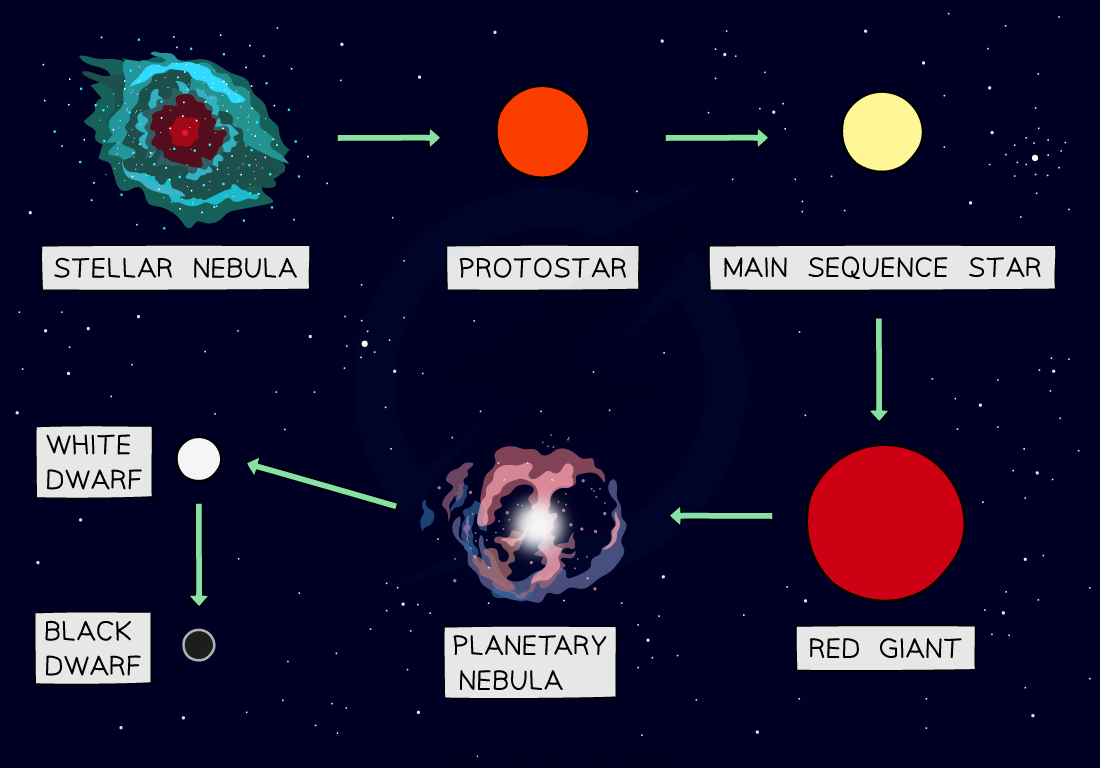
The life cycle of a star that is similar to our Sun
Large mass star
- A large mass star is one with a larger mass than the Sun
- After the stable star stage, a large mass star finishes its life cycle in the following evolutionary stages:
red supergiant → supernova → neutron star
-
Red supergiant:
- Formed when a large (or very large) mass star reaches the end of its life
- The outer layers of the star expand and cool
-
Supernova:
- An exploding red supergiant
-
Neutron star:
- Formed when the core of a large star collapses
- Very dense, but not as much as a black hole
Very large mass star
- A very large mass star is one with a much larger mass than the Sun
- After the stable star stage, a very large mass star finishes its life cycle in the following evolutionary stages:
red supergiant → supernova → black hole
-
Black hole:
- Formed when the core of a very large star collapses
- Extremely dense
The life cycle of a large mass star
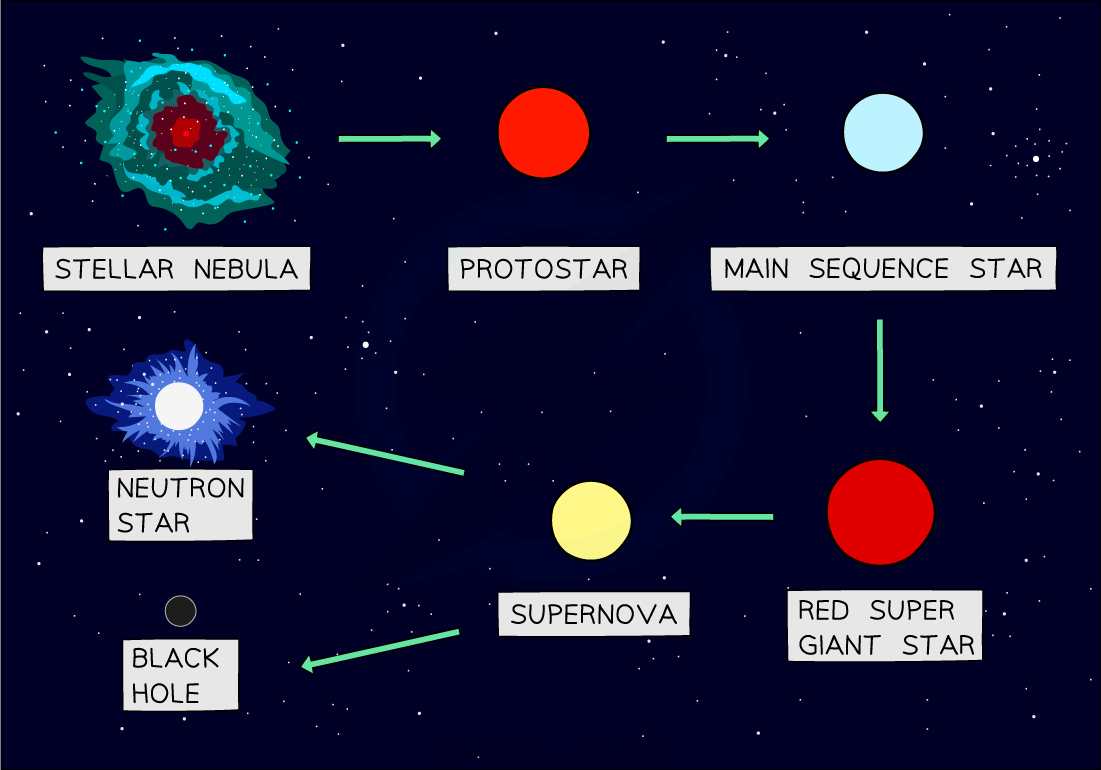
The life cycle of a star much larger than our Sun
Formation of new stars and planets
Extended Tier Only
-
The nebula from a supernova may form new stars with orbiting planets
- The heaviest elements (elements heavier than iron) are formed during a supernova and are ejected into space
- These nebulae may form new planetary systems
A supernova
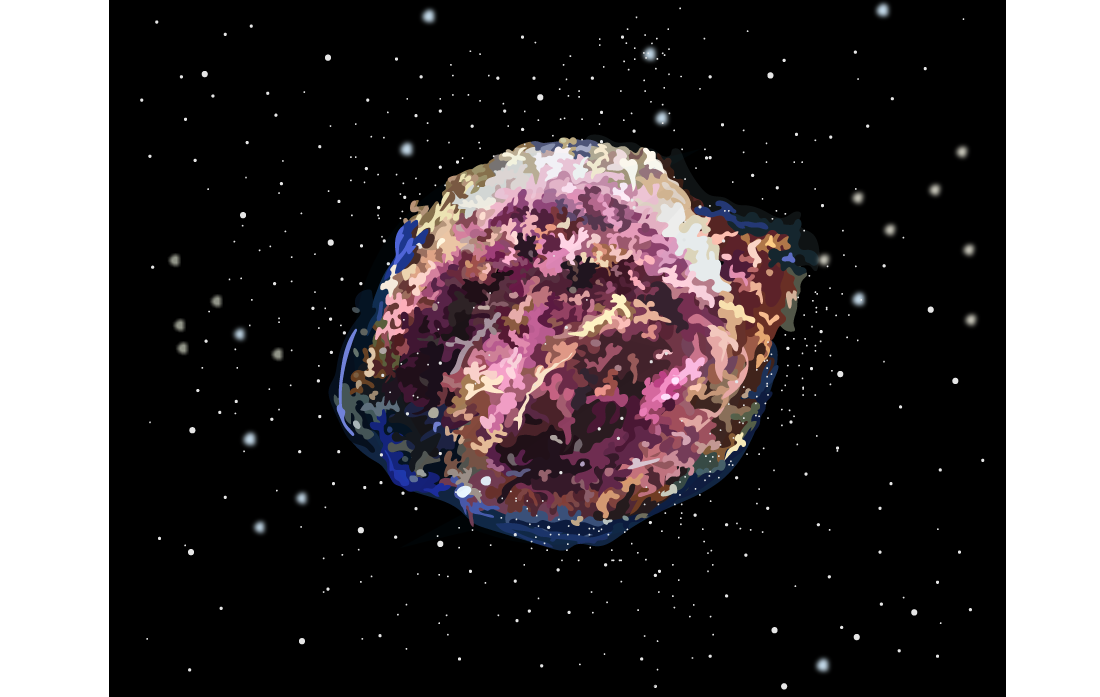
The nebula formed from a supernova may eventually form new stars with orbiting planets
Was this revision note helpful?
Build on this topic