Managing the Impacts of Tectonic Hazards (Cambridge International IGCSE Geography)
Specification link
This page covers section 4.4.1 and 4.4.2 of the CIE IGCSE specification .
- 4.4.1- Primary and secondary responses.
- 4.4.2 - An evaluation of the strategies and techniques used to manage the impacts of earthquakes and volcanic eruptions: monitoring, prediction, protection, planning and technology.
Primary and secondary responses
Spec point — Primary and secondary responses.
-
Types of response to tectonic hazard
-
The responses to any tectonic hazard can be divided into two groups
- Immediate or emergency
- Long term
-
Immediate or emergency responses
-
The immediate or emergency response is the action taken immediately after a hazard event, such as an earthquake
- Rescue teams search for survivors
- Medical assistance for injured people
- Shelter provided for those people made homeless
- Food and water provided
- Recovery and burial of bodies
- Evacuation if needed
- Clearing ash and debris
- Reconnect gas, water and electricity supplies
-
This response has to be coordinated, as many NGOs and government organisations, including the armed forces, may be involved
Long term responses
-
The long-term responses happen over the months and years after the hazard
- Rebuilding homes and other buildings
- Improve building regulations
- Improve drills, evacuation plans and warning systems
- Money given to farmers for seed and new livestock
- Data used to inform future hazard planning
- Government planning improved
- Transport routes rebuilt
Park's hazard response curve
- The stages of hazard response can be seen in Park's hazard response curve
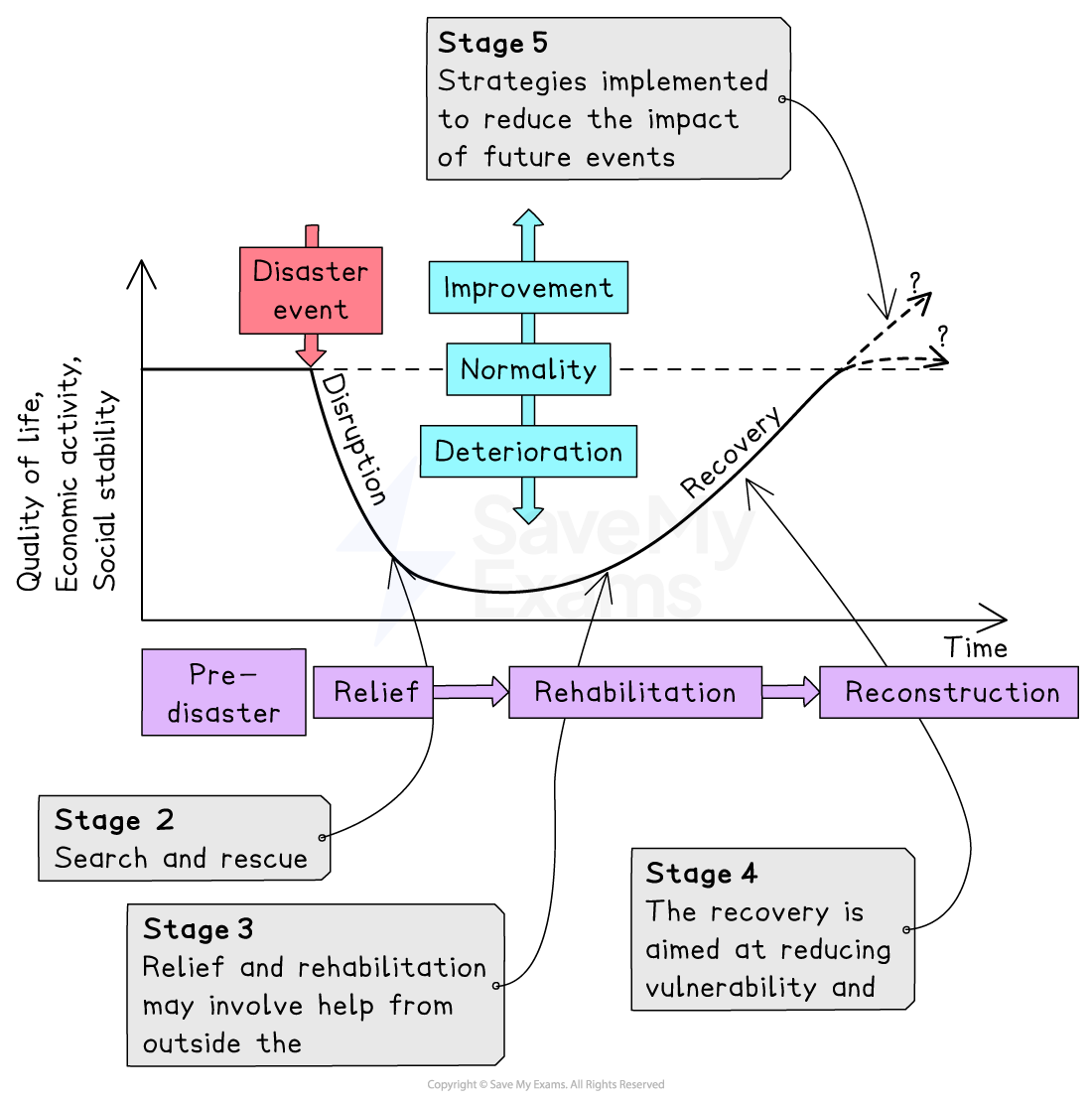
Park's hazard response curve
Exam Hint Remember that although there is an immediate or emergency response in all countries where there is a natural hazard event, the response will be slower and often less well-organised in low-income countries (LICs). This delay often increases deaths and recovery time.
Strategies to manage the impacts of tectonic hazards
Spec point — An evaluation of the strategies and techniques used to manage the impacts of earthquakes and volcanic eruptions: monitoring, prediction, protection, planning and technology.
-
To reduce the risks from tectonic hazards, the five key management strategies and techniques are:
- monitoring
- prediction
- protection
- planning
- technology
Monitoring
-
Active volcanoes are monitored using a range of equipment
- Seismometers record earth movements and can detect the slightest tremor
- Lasers and tiltmeters are used to detect ground deformation; changes in land shape can be a sign of rising magma
- Remote sensing is where satellites are used to detect heat increases within the volcano, another sign of rising magma
- Gas sensors detect increases in gases such as sulphur and radon which increase before an eruption
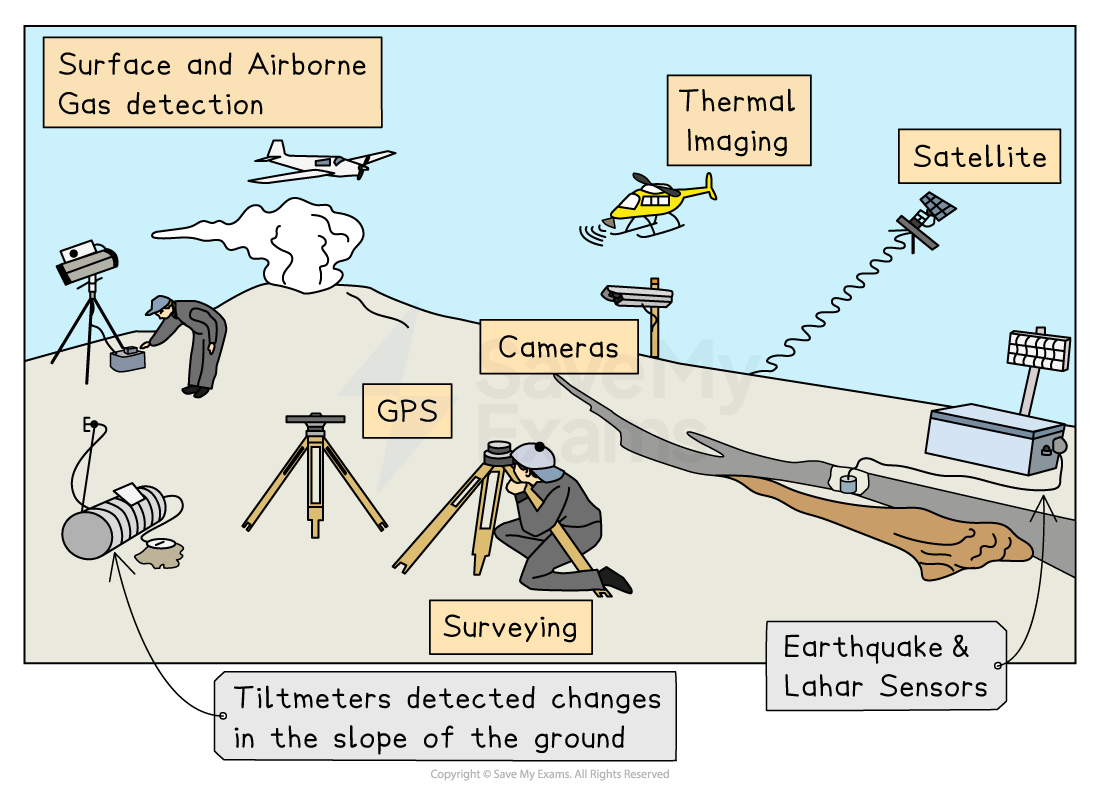
Monitoring volcanic activity
-
Earthquakes
- Seismometers record earth movements and can be used to detect foreshocks
- Gas sensors detect increases in radon gas, which some scientists believe is released before an earthquake
- Groundwater level changes have been recorded before earthquakes
Prediction
-
Volcanoes:
- Monitoring of volcanoes now allows more accurate predictions to be made of when eruptions will happen
- This allows for evacuation and exclusion areas to be put in place
- Accurate timings for eruptions are not possible
-
Earthquakes:
- Impossible to predict the date, time or location because it is a very sudden release of stress that has built up over long periods
Protection
-
Volcanoes:
-
Evacuation and exclusion zones move people out of areas at risk
-
Buildings cannot be protected against lava or pyroclastic flow
-
Strengthening of roofs to support the weight of falling ash
-
Airports can be closed to ensure that planes are not flying through ash clouds
- In June 2025, Bali's international airport was closed due to the eruption of Mount Lewotobi Laki-Laki
-
-
Earthquakes:
-
Building regulations and codes require new buildings to include earthquake-resistant features, including:
- shutters on windows prevent falling glass
- cross-bracing or diagonal bracing of steel frames
- flexible building materials
- foundations sank deep into the bedrock
- frames which sway with the earthquake tremors
- rubber shock absorbers to reduce tremors moving through the building
- reinforce walls/pillars with concrete
- shatterproof/reinforced glass
- fire-resistant materials
- automatic cut-off for gas/electricity
-
In many countries, earthquake drills are regularly carried out
- The drills help people prepare for what to do in an earthquake to protect themselves
-
Educating people about how to prepare homes means they are less likely to be injured by falling objects and furniture
-
Sea walls to protect against tsunami
-
Planning
-
Volcanoes and earthquakes:
- Hazard mapping and risk assessment are used to identify areas which are at greater risk – this means people can be moved or buildings restricted in those areas, particularly essential buildings (hospitals) and transport
- Evacuation plans
- Education about what actions to take, including drills
- Stockpile of emergency supplies
- Training of emergency services
Exam Hint High-income countries (HICs) often have less to change in their long-term planning because their preparation for the hazard is better. However, the costs of any disaster are often greater than in a developing country. This is due to the higher cost of the damaged buildings, roads, and infrastructure.
Technology
-
Hazard mapping and geographical information systems (GIS) can be used to:
- Map the areas where earthquakes are most likely to occur
- Enable planning of where important services and infrastructure should be located – land use zoning
- Identify the correlation between risk and vulnerability
-
Remote sensing of the Earth's surface by satellites such as Sentinel 1 provides data about changes in ground movement
Exam Hint Remember that the level of planning, prediction and monitoring will vary between countries of contrasting wealth. High-income countries (HICs) are better able to prepare for and monitor tectonic hazards.
Was this revision note helpful?
Build on this topic