Hydrological Characteristics (Cambridge International IGCSE Geography)
Specification checklist
This content page covers the following sections of the specification:
- 1.1.1- Characteristics of drainage basins: the watershed, tributary, confluence, source and mouth.
- 1.1.3 - How the drainage basin operates within the water cycle.
- 1.1.4- Processes which operate in a drainage basin: precipitation, interception, infiltration, percolation, overland flow, channel flow, throughflow, groundwater flow, transpiration, evaporation, evapotranspiration.
Features of drainage basins
Spec point — Characteristics of drainage basins: channel, watershed, tributary, confluence, source, mouth.
-
A drainage basin is the area of land drained by a river and its tributaries
- This is also known as the catchment area of the river
-
Drainage basins are open systems
-
This means that as well as stores and transfers, drainage basins have inputs and outputs
- The input is any water entering the system (precipitation)
- Outputs are where water is lost from the drainage basin (evaporation, transpiration and into the sea/lake)
-
When precipitation falls into the drainage basin, it will take different paths
-
The possible paths include:
- Direct channel precipitation, which occurs when the water falls directly into a river
- Overland flow (surface runoff) when the water cannot infiltrate the soil due to the ground being impermeable
- Throughflow when the water flows through the soil
- Groundwater flow when the water flows through the rocks
-
Every drainage basin is unique
-
They have different
- shapes
- sizes
- rock types
- relief
- land use
Drainage basin features
-
All drainage basins have some features in common:
-
The watershed is the boundary between drainage basins
-
A source is the point of the river which is furthest from the mouth; this is the point at which the river begins and is usually an upland lake, spring or glacier
- Gravity then causes water to flow downhill, taking the fastest and easiest path
-
A confluence is the place where two or more streams/rivers meet
-
Tributaries are streams or rivers flowing into larger streams or rivers
-
The mouth of a river is where it enters the sea/ocean or sometimes a lake
-
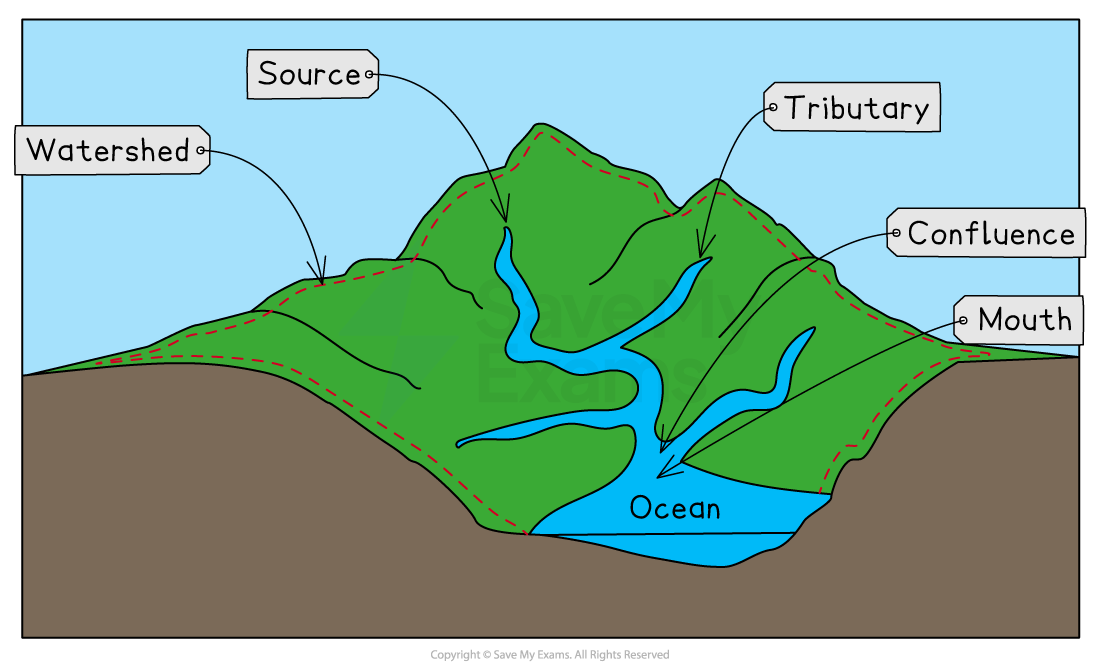
The main features of a drainage basin
The water cycle and drainage basins
Spec point — How the drainage basin operates within the water cycle
The water cycle & drainage basins
-
All drainage basins are part of Earth's hydrological cycle
-
The **hydrological cycle **is a closed system
-
Water is constantly recycled through the system
-
The hydrological cycle includes stores and** transfers**
- The stores and transfer processes of the hydrological cycle all take place within individual drainage basins
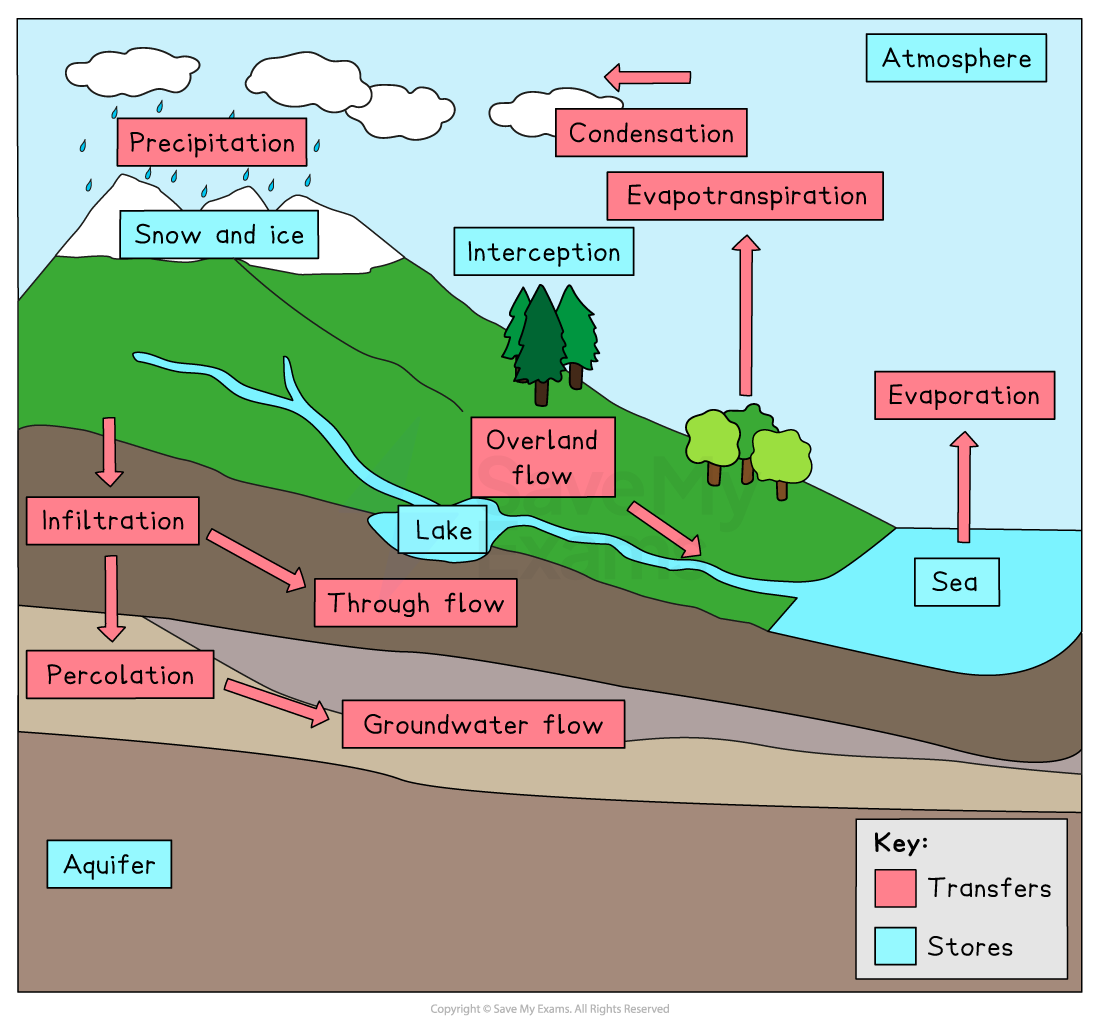
The stores and transfers of the hydrological cycle
Drainage basin processes
Spec point — Processes which operate in a drainage basin: precipitation, interception, infiltration, percolation, overland flow, channel flow, throughflow, groundwater flow, transpiration, evaporation, evapotranspiration
Stores
-
Stores are those places where water is held for a period of time
-
Stores of the hydrological cycle include:
- The atmosphere where water is stored in the form of water vapour or as water droplets in clouds
- Surface stores such as puddles, lakes, rivers and reservoirs
- Aquifers, which are permeable rocks such as limestone and sandstone which can hold water
- Ice and snow
- Seas and oceans
-
Interception is how precipitation is prevented from reaching the ground, usually by being caught on leaves or branches
- Some of the water will be stored on the leaves and evaporate into the atmosphere
- The remaining water will flow down the leaves, branches and trunk until it reaches the ground (stemflow)
Transfers
-
Transfers are how water is moved around the hydrological cycle and each drainage basin
-
Transfers include:
-
Evaporation is the change of water from a liquid to a gas (water vapour) due to heat from the sun
- This process transfers water from the surface up into the atmosphere
- Higher temperatures and strong winds lead to increased evaporation
-
Condensation, which occurs when water cools and changes from water vapour into a liquid (water droplets)
- Condensation leads to the formation of clouds
-
Transpiration, which occurs when plants release water vapour from their leaves
- This process transfers water from the plants into the atmosphere
-
Evapotranspiration is the combined transfer of water vapour from the Earth's surface and plants
-
Precipitation is the transfer of water from the atmosphere to the Earth's surface in the form of hail, sleet, rain or snow
-
Overland flow is any water flowing across the Earth's surface
-
When water is transferred from the surface into the soil, this is known as infiltration
-
Percolation is the transfer of water from the soil into the rocks and aquifers
-
Throughflow occurs when water is transferred through the soil between the surface and the water table
-
Groundwater flow is the transfer of water through rocks
-
Channel flow is water flowing in a river or stream
-
Exam Hint Remember there are no inputs and outputs in the hydrological system. There are only transfers and stores because it is a closed system. Each drainage basin is part of the hydrological cycle, so it is an open system with inputs and outputs.
Was this revision note helpful?
Build on this topic