Detailed Specific Example: Bangladesh (Cambridge International IGCSE Geography)
Specification link
This page covers section 5.3.3 of the CIE IGCSE specification .
-
5.3.3- One detailed specific example of a named country or region to include:
- The impacts of climate change
- The responses to climate change
- The strategies and techniques being used to manage climate change; including sustainable.
Background
- Bangladesh is responsible for 0.5% of the global greenhouse gas emissions
- As a developing country, it did not have to sign up to the Kyoto Protocol but Bangladesh did sign the Paris Agreement
- Despite its very low contribution to emissions, Bangladesh is extremely vulnerable to climate change
Impacts of climate change on Bangladesh
Spec point — One detailed specific example of a named country or region to include: • the impacts of climate change • the responses to climate change • the strategies and techniques being used to manage climate change; including sustainable.
Impacts of climate change on Bangladesh
Rising sea levels and flooding
-
Bangladesh is mostly a low-lying, flat delta
-
It is vulnerable to any changes in sea levels and flooding because:
- Over 75% of the country is less than 10 m above sea level
- The Ganges, Brahmaputra and Meghna rivers converge in Bangladesh
- Over 80% of the country sits on the low-lying floodplains of the delta
- The country is already prone to flooding and tropical monsoon conditions
-
Seasonal flooding is normal and necessary to provide fertile soil and irrigation
-
The size, intensity, and frequency of these events have increased
-
The monsoon rainfall is predicted to rise by 40% by 2030
- In 1998, 75% of Bangladesh was flooded, making 30 million people homeless
- Over 1,000 people died
- At least 700,000 hectares of crops were destroyed
-
Bangladesh is also vulnerable to sea level rise
- A rise of 1 meter would lead to the loss of 20% of the land area and impact 15 million people
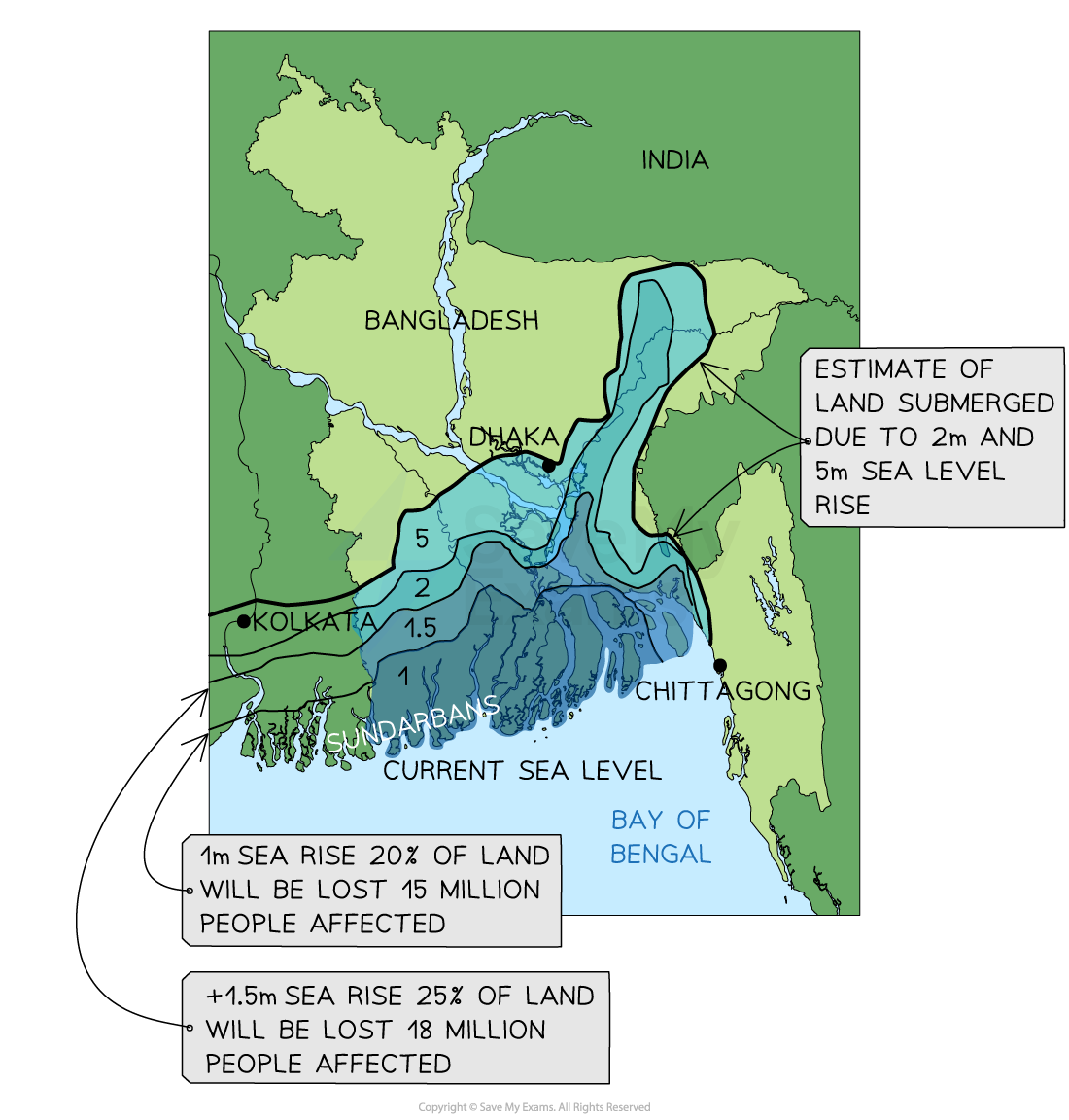
Effect on Bangladesh of sea level rise
Water resources
-
Changes in rainfall patterns have increased droughts in the west and northwest regions
-
The droughts have led to:
- crop failure
- livestock deaths
- food shortages
Health impacts
- Extreme heatwaves increase the risk of heatstroke
- Flooding increases the spread of waterborne diseases, and diseases like malaria
Economic impacts
-
Flooding and droughts lead to :
- loss of crops
- disruption to industry
- damaged infrastructure
-
These all impact on the country's economy
Biodiversity loss
-
Climate change impacts ecosystems, such as the Sundarbans mangrove forest
- This leads to habitat loss and biodiversity decline
Response to climate change in Bangladesh
Spec point — One detailed specific example of a named country or region to include: • the impacts of climate change • the responses to climate change • the strategies and techniques being used to manage climate change; including sustainable.
Response to climate change in Bangladesh
-
The government has taken steps to adapt to climate change and mitigate future climate change
-
The Bangladesh Climate Change Strategy and Action Plan was adopted in 2009. The plan:
- Identified the risks and challenges of climate change
- Outlines adaptations which can be made
- Identifies the need to reduce carbon emissions – Bangladesh has pledged to reduce emissions by 22% by 2030
-
It is estimated that Bangladesh will need US$5 billion a year to finance adaptation and mitigation projects
- This is far more than the country can afford
Strategies to manage climate change in Bangladesh
Spec point — One detailed specific example of a named country or region to include: • the impacts of climate change • the responses to climate change • the strategies and techniques being used to manage climate change; including sustainable.
Strategies to manage climate change in Bangladesh
Adaptations
-
Bangladesh is already vulnerable to coastal and river flooding. Global warming has worsened this vulnerability
- Increased melt from the Himalayas
- Increased frequency and severity of tropical cyclones
- Rising sea levels
-
Bangladesh has adapted in several ways
- Submersible roads which can withstand flooding or raised roads
- Over 2,200 shelters on stilts with a raised platform 'kills' nearby for livestock
- Community-based early warning system for tropical cyclones
- Flood protection and drainage schemes to protect urban areas
- Coastal embankment projects involving 6,000km of embankments
- Irrigation schemes
- Agricultural research programme to develop saline, drought and flood resistant, high yield varieties of crops
- Mangrove planting along 9,000 km of coastline
Mitigation
-
Although Bangladesh's emissions are low, it is looking at ways to reduce them, including:
- Improved agriculture practices to reduce the emissions of methane from rice fields
- Encourage people to stop using biomass stoves for cooking and eating
- Increase small-scale solar energy for homes
-
The Bangladesh Renewable Energy Policy (2008) aims to increase the amount of renewable energy to over 10%
-
The plans to build nine new coal plants have been abandoned
-
Bangladesh aims to have 15% of registered vehicles powered by electricity by 2030
-
The expansion of the public transport system – Mass Rapid Transit and Bus Rapid Transit in Dhaka as well as 798km of new rail lines by 2025
Was this revision note helpful?
Build on this topic