Changing employment structures (Cambridge International IGCSE Geography)
Specification link
This page covers section 9.1.2 of the CIE IGCSE specification .
- 9.1.2- The changing employment structure of low-income countries (LICs), middle-income countries (MICs) and high-income countries (HICs).
Changing employment structure
Spec point — "The changing employment structure of low-income countries (LICs), middle-income countries (MICs) and high-income countries (HICs). "
-
Employment structures change as economies develop
-
The primary sector dominates in the pre-industrial period, while the secondary and tertiary **sectors steadily grow
-
This structure is generally found in** low-income countries (LICs), as they have low-cost production and low-skilled jobs
- As economies grow, the reliance on the primary sector for jobs begins to decline
- LICs such as Ethiopia, Afghanistan and Madagascar are in this stage
-
During the industrial phase, employment in the secondary sector increases as manufacturing shifts from high-income countries (HICs) to emerging, low-cost economies
-
This is known as the global industrial shift
- The primary sector continues to decrease and the tertiary sector increases
- **Medium-income countries (MICs) **such as China and India have moved into this stage
-
In the post-industrial phase, the tertiary and** quaternary sectors increase** whilst the secondary and primary sectors decrease
- The tertiary sector dominates employment and GDP in the post-industrial period
- High-income countries such as Germany, Australia and the USA are in this stage
-
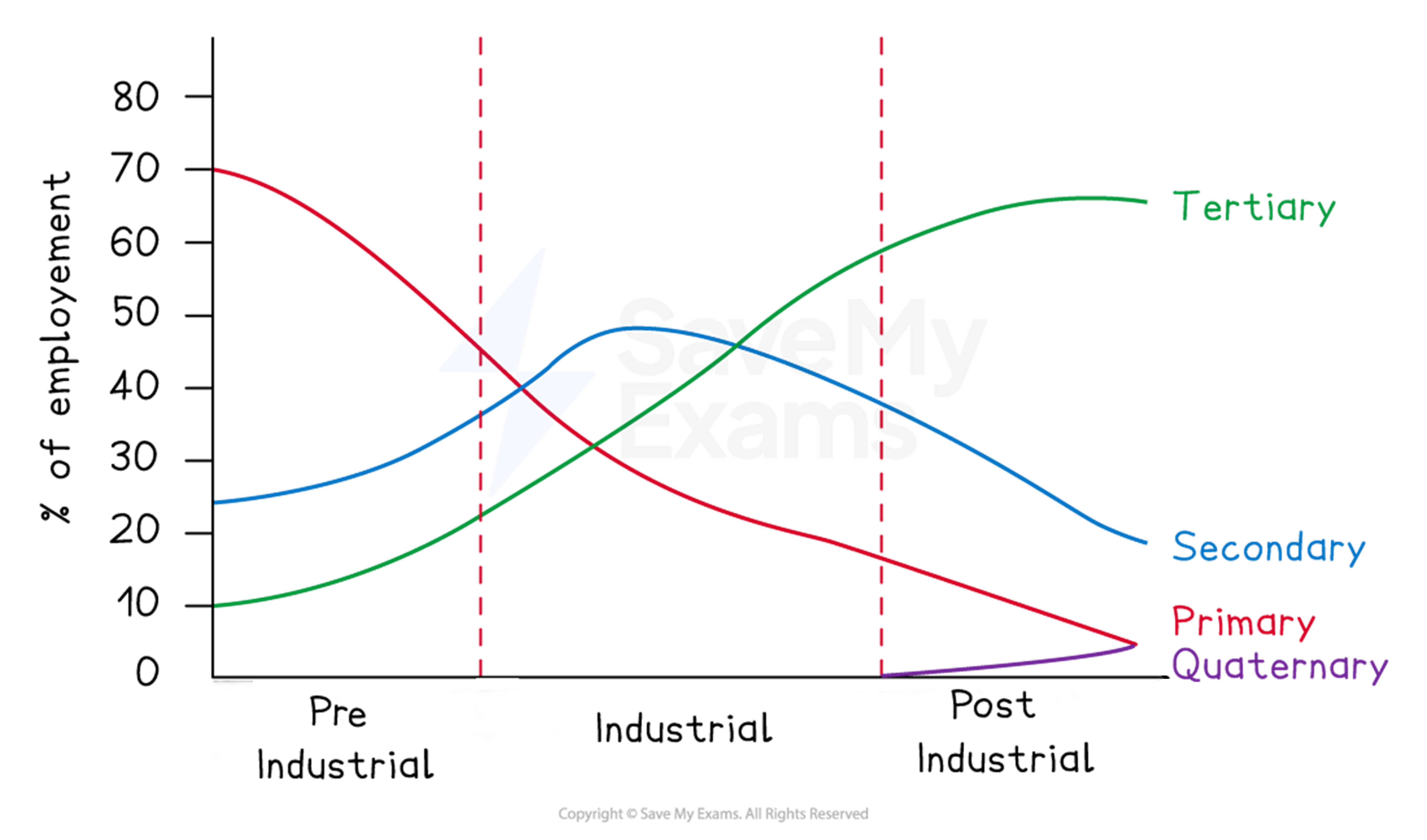
The Clark-Fisher Model
- As an economy advances, the proportion of people employed in each sector changes
- Places like the UK and the USA are ‘post-industrial societies’, where most work in the tertiary or quaternary sectors
- Places such as China and India are ‘industrial societies’, where many people work in the secondary sector
- Bolivia and Mozambique are ‘pre-industrial societies’, where most people work in the primary sector
- The Clark Fisher Sector Model above illustrates these trends, as do the examples below:
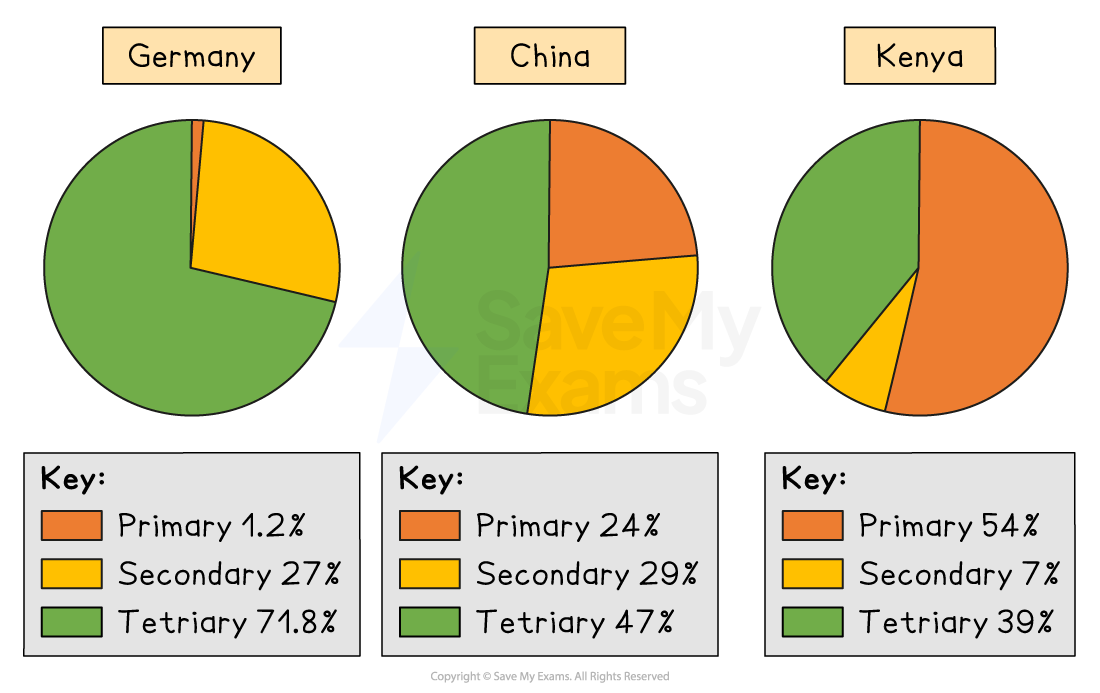
Employment by economic sector
Exam Hint You should be able to identify a country's stage of development by examining a pie chart or graph of the economic sectors.
A low-income country will be dominated by primary economic activities, an middle-income country is likely to have fairly equal amounts of each type of economic sector employment, and finally, a high-income country will be dominated by tertiary economic activities.
Causes of changes over time
-
There are several reasons for the change in percentages employed in each sector:
- Increasing mechanisation in agriculture leads to a decrease in the number of jobs available
- People moving to urban areas to find jobs in secondary and tertiary sectors
- Increasing mechanisation and global changes then lead to a decrease in secondary employment in some countries - this is known as deindustrialisation
- Technological improvements lead to an increase in tertiary and quaternary employment
- International corporations often set up factories in LICs where land and labour costs are lower
Was this revision note helpful?
Build on this topic