Kinematics Toolkit (Cambridge International IGCSE Further Maths)
Displacement, Velocity & Acceleration
What is kinematics?
- Kinematics is the branch of mathematics that models and analyses the motion of objects
- Common words such as distance, speed and acceleration are used in kinematics but are used according to their technical definition
What definitions do I need to be aware of?
-
Firstly, only motion of an object in a straight line is considered
-
this could be a horizontal straight line
- the positive direction would be to the right
-
or this could be a vertical straight line
- the positive direction would be upwards
-
-
Particle
- A particle is the general term for an object
- some questions may use a specific object such as a car or a ball
-
Time seconds
- Displacement, velocity and acceleration are all functions of time
- Initially time is zero
-
Displacement m
- The displacement of a particle is its distance relative to a fixed point
- the fixed point is often (but not always) the particle’s initial position
- Displacement will be zero if the object is at or has returned to its initial position
- Displacement will be negative if its position relative to the fixed point is in the negative direction (left or down)
-
Distance m
-
Use of the word distance needs to be considered carefully and could refer to
- the distance travelled by a particle
- the (straight line) distance the particle is from a particular point
-
Be careful not to confuse displacement with distance
-
if a bus route starts and ends at a bus depot, when the bus has returned to the depot, its displacement will be zero but the distance the bus has travelled will be the length of the route
-
Distance is always positive
-
-
Velocitym s-1
- The velocity of a particle is the rate of change of its displacement at time
- Velocity will be negative if the particle is moving in the negative direction
- A velocity of zero means the particle is stationary
-
Speed
space open vertical bar v close vertical barm s-1-
Speed is the magnitude (a.k.a. absolute value or modulus) of velocity
-
as the particle is moving in a straight line, speed is the velocity ignoring the direction
- if
space v equals 4 comma space open vertical bar v close vertical bar equals 4 - if
space v=−6 comma open vertical bar v close vertical bar=6
- if
-
-
Acceleration m s-2
-
The acceleration of a particle is the rate of change of its velocity at time
-
Acceleration can be negative but this alone cannot fully describe the particle’s motion
- if velocity and acceleration have the same sign the particle is accelerating (speeding up)
- if velocity and acceleration have different signs then the particle is decelerating (slowing down)
- if acceleration is zero the particle is moving with constant velocity
- in all cases the direction of motion is determined by the sign of velocity
-
Are there any other words or phrases in kinematics I should know?
-
Certain words and phrases can imply values or directions in kinematics
-
a particle described as “at rest” means that its velocity is zero,
-
a particle described as moving “due east” or “right” or would be moving in the positive horizontal direction
- this also means that
-
a particle “dropped from the top of a cliff” or “down” would be moving in the negative vertical direction
- this also means that
-
What are the key features of a velocity-time graph?
-
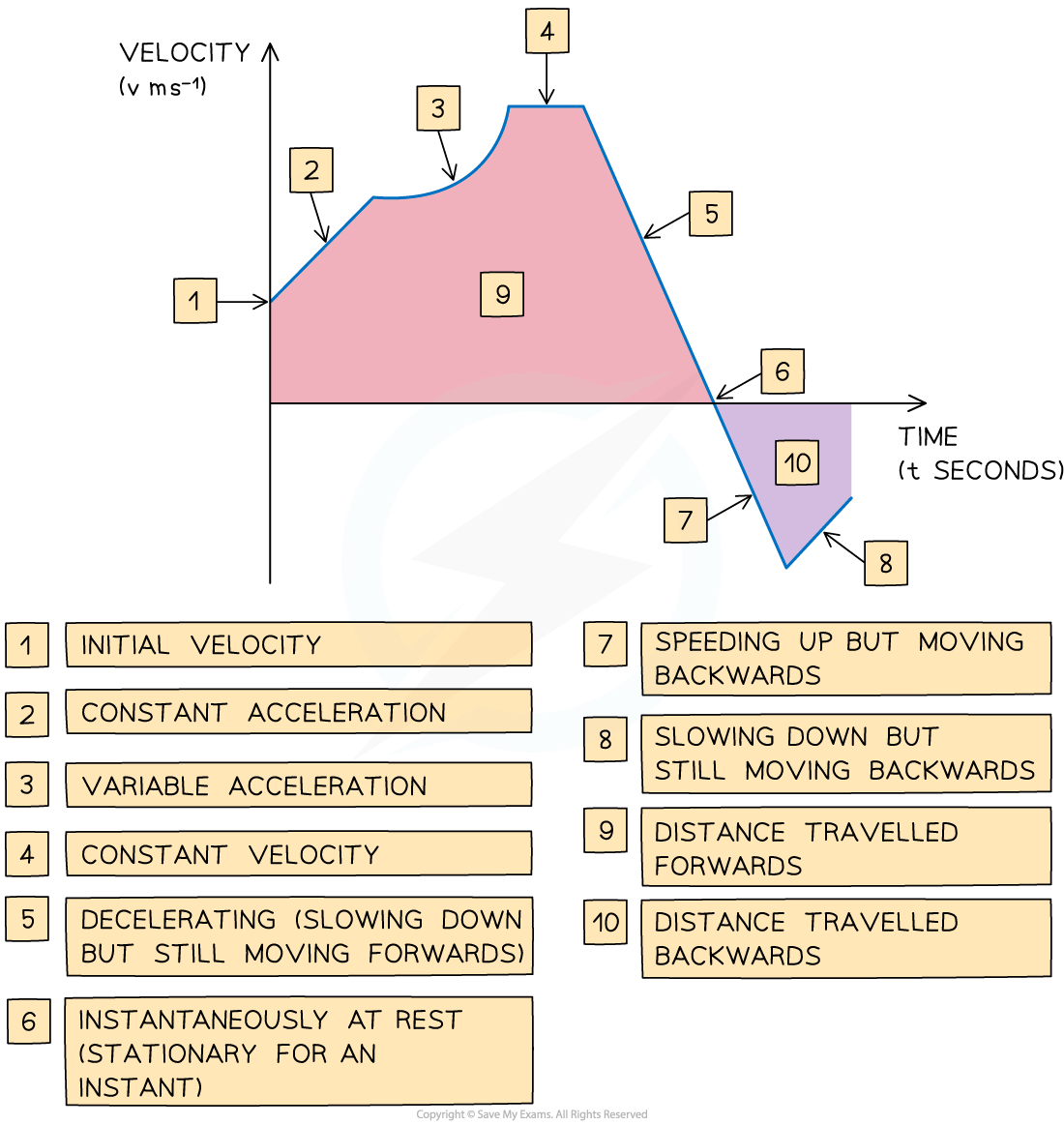
The gradient of the graph equals the acceleration ****of an object
-
A straight line shows that the object is accelerating at a constant rate
-
A horizontal line shows that the object is moving at a constant velocity
-
Graph above the x-axis means the object is moving** forwards**
- Graph below the x-axis means the object is moving backwards
- The area between graph and the x-axis tells us the change in displacement **of the object
-
The** total displacement **of the object from its starting point is the sum of the areas above the x-axis minus the sum of the areas below the x-axis
-
The** total distance travelled **by the object is the sum of all the areas
-
If the graph touches the x-axis then the object is** stationary at that time
-
If the graph is above the x-axis then the object has positive velocity and is travelling forwards
-
If the graph is below the x-axis then the object has negative velocity and is travelling backwards
Exam Hint
- In an exam if you are given an expression for the velocity then sketching a velocity-time graph can help visualise the problem
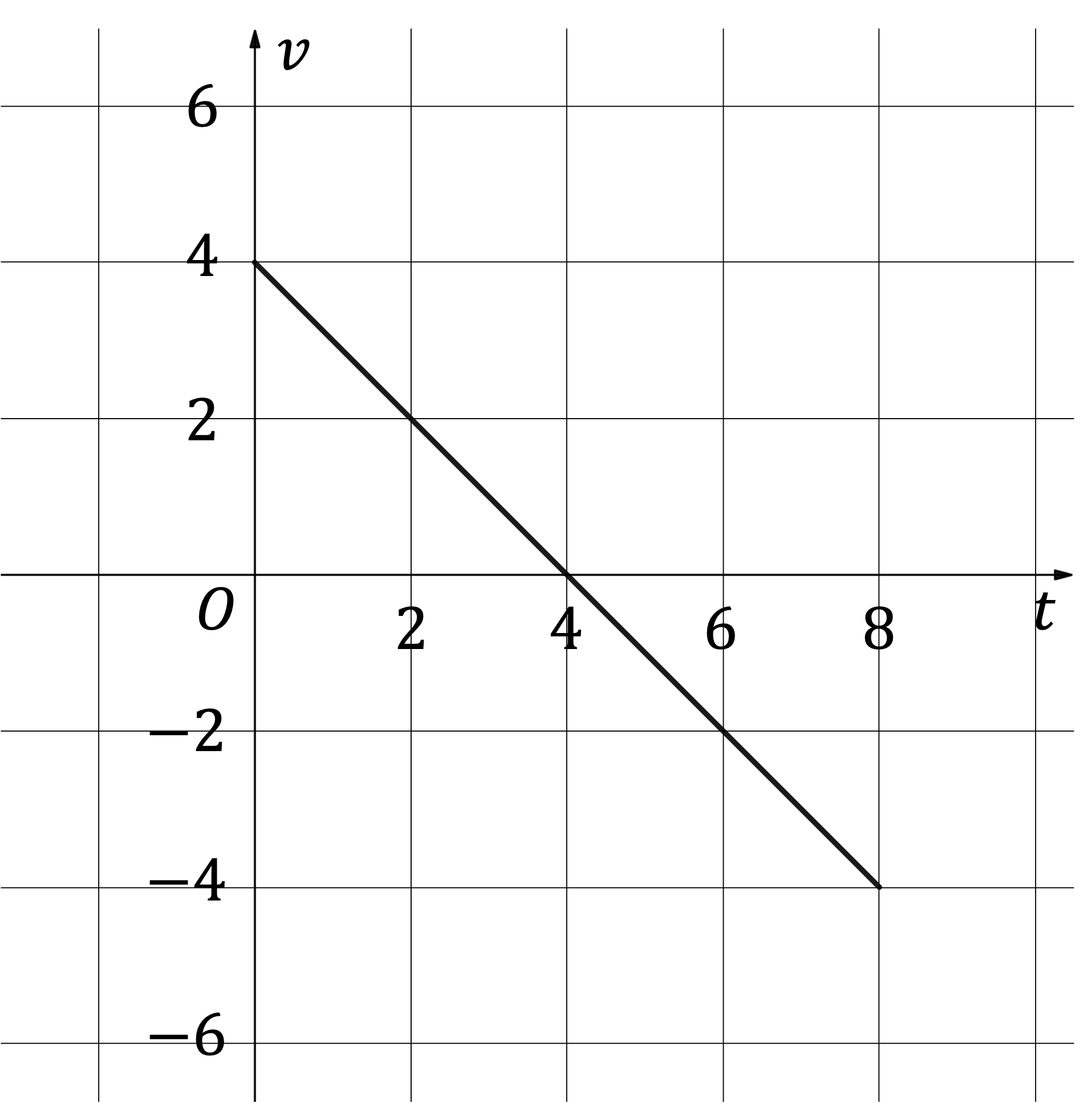
Worked Example A particle is projected vertically upwards from ground level, taking 8 seconds to return to the ground.
The velocity-time graph below illustrates the motion of the particle for these 8 seconds.
i) How many seconds does the particle take to reach its maximum height? Give a reason for your answer.
ii) State, with a reason, whether the particle is accelerating or decelerating at time.
*i) **At maximum height, velocity is zero. *
at * *
Final answer: The particle takes 4 seconds to reach its maximum height. This is because its velocity is 0 ms-1 at 4 seconds.**
**
ii)
At , velocity is positive
Acceleration is the gradient of velocity.
At , acceleration is negative
Final answer: At 3 seconds the particle is decelerating as its velocity and acceleration have different signs.
Was this revision note helpful?
Build on this topic