Causes & Impacts of Acid Rain (Cambridge International IGCSE Environmental Management)
How does acid rain form?
- Acid rain is precipitation or atmospheric deposits with a pH value below 5
- It occurs when sulphur dioxide and nitrogen oxides are released into the atmosphere through human activities such as car emissions and burning coal
- It can also come from natural sources, such as volcanic eruptions
- The equation for this process is:
sulphur dioxide + water + oxygen → sulphuric acid
-
Most acid rain is caused by fossil fuel combustion in factories and power stations, and motor vehicles, releasing sulphur dioxide (SO₂) and nitrogen oxides (NOₓ) into the atmosphere
- Power stations that burn coal and oil are major contributors to SO₂ emissions, while NOₓ emissions mostly come from vehicle exhausts
- Sulphur dioxide is released when fossil fuels containing sulphur compounds are burned
- Oxides of nitrogen are produced when nitrogen from the atmosphere reacts with oxygen at the high temperatures of vehicle engines and industrial furnaces
- These acidic gases settle directly onto surfaces (buildings, vegetation, soil) without rain
- This is known as dry deposition
-
When NOₓ and SO₂ react with water vapour and oxygen in the atmosphere, they form weak solutions of nitric acid (HNO₃) and sulphuric acid (H₂SO₄)
-
Sulphuric acid and nitric acid can dissolve in rainwater or snowflakes, forming acid rain
-
Acid rain can be moved by winds for hundreds of kilometres before it falls to the ground, so it can occur at some distance from the source; this is known as wet deposition
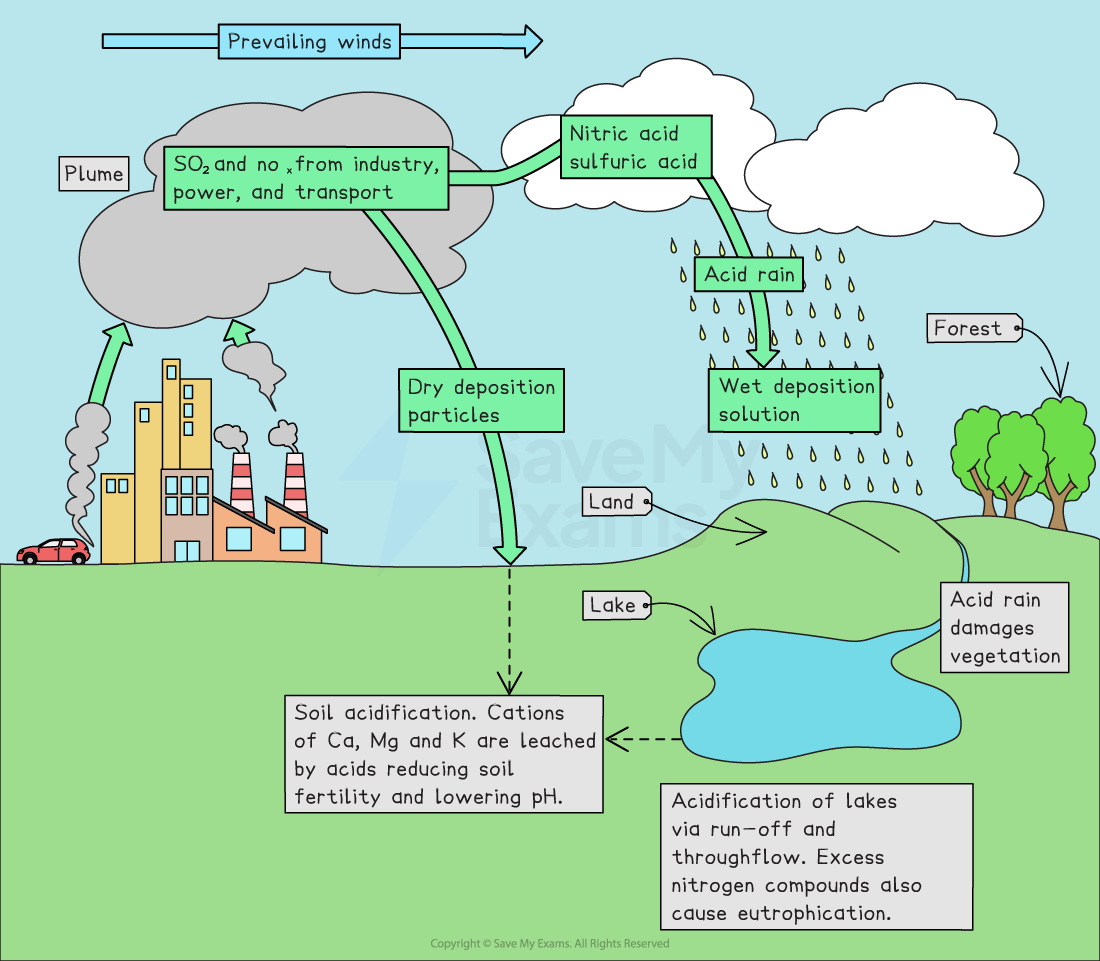
Acid rain formation
Impacts of acid rain
- Acid rain is not restricted to the immediate area of emission
- Acid rain is more likely to affect locations downwind of big industrial regions because winds can carry particles for long distances, causing transboundary pollution to occur in other countries
- Acid rain affects both the living and the non-living
Water
- Acidic rain directly affects bodies of water, aquatic food webs, and a quatic organisms such as fish, amphibians, and invertebrates
- When acid rain falls on bodies of water, pH levels fall and cannot support life, causing water acidification
- Food web destruction starts at the lowest level of the food chain, where tiny microorganisms that are food die
- As food sources dwindle, more and larger fish die
- This cascades through food webs, which further reduces water quality
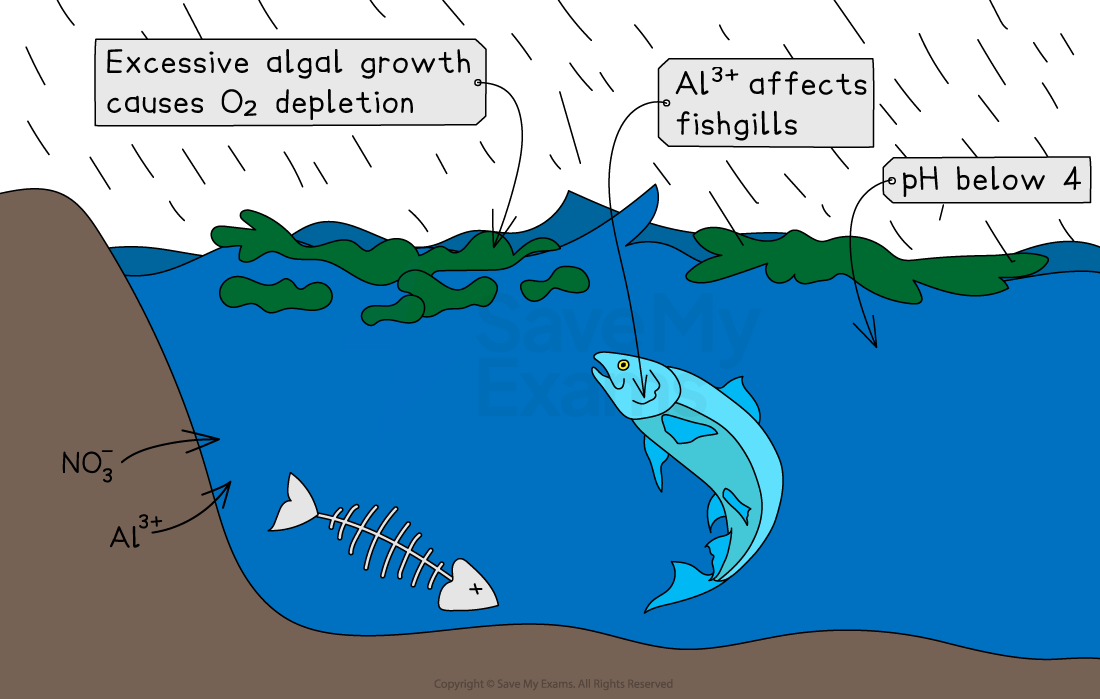
The impact of acid deposition on waterways
- Acid rain can leach copper, aluminium, and other heavy metals out of the soil and into runoff and drinking water
Soil and plants
-
Acid rain decreases the pH of the soil, causing its acidity to increase, which decreases the level of important nutrients found in the soil
- This makes it harder for plants to absorb nutrients and grow
-
Acid rain negatively impacts forests and trees as sulphur dioxide interferes with the process of photosynthesis
- When acid rain directly falls on leaves, it damages the protective waxy coating of leaves, interrupting water and gas exchange, which eventually kills the plant
-
Acid rain also damages foliage, causing defoliation and reduces nutrient absorption
- Acid rain is especially harmful to coniferous forests such as pine and spruce due to their shallow root systems and thin bark
-
Removing a whole tree can be equivalent to the effect of 60 years of acid rain
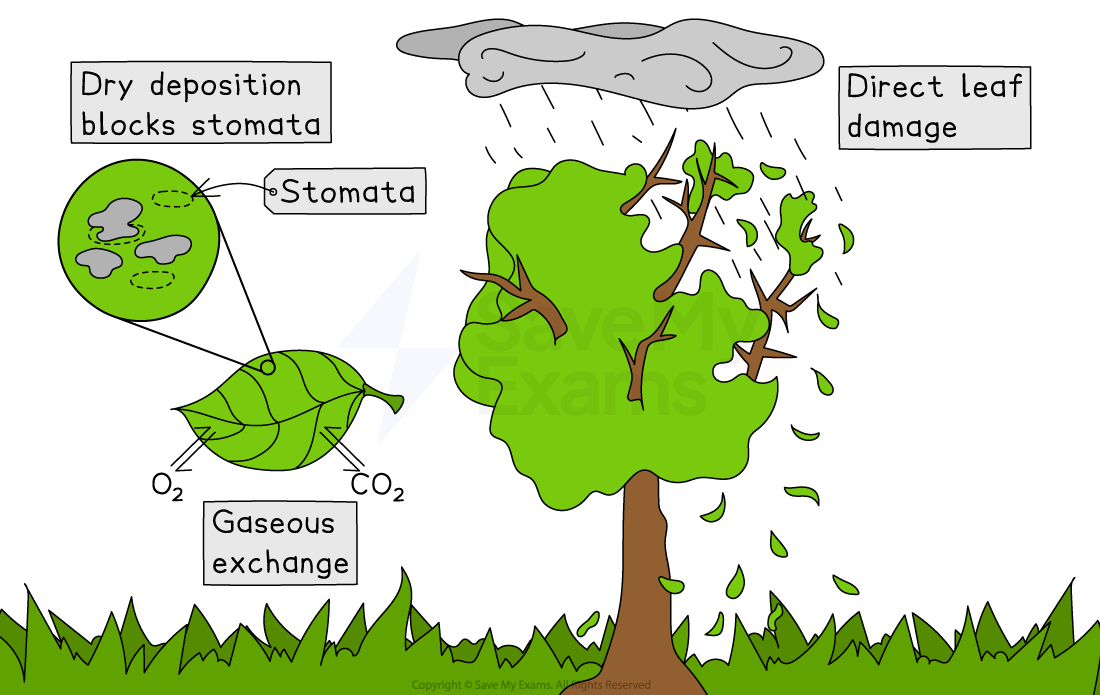
The impact of acid rain on plant life
Buildings
- Acid rain can react with metals and stone (such as limestone), damaging buildings and statues
- Limestone and marble both contain calcium carbonate (CaCO₃)
- The calcium carbonate reacts with sulphuric acid or nitric acid, causing stonework to corrode and weaken
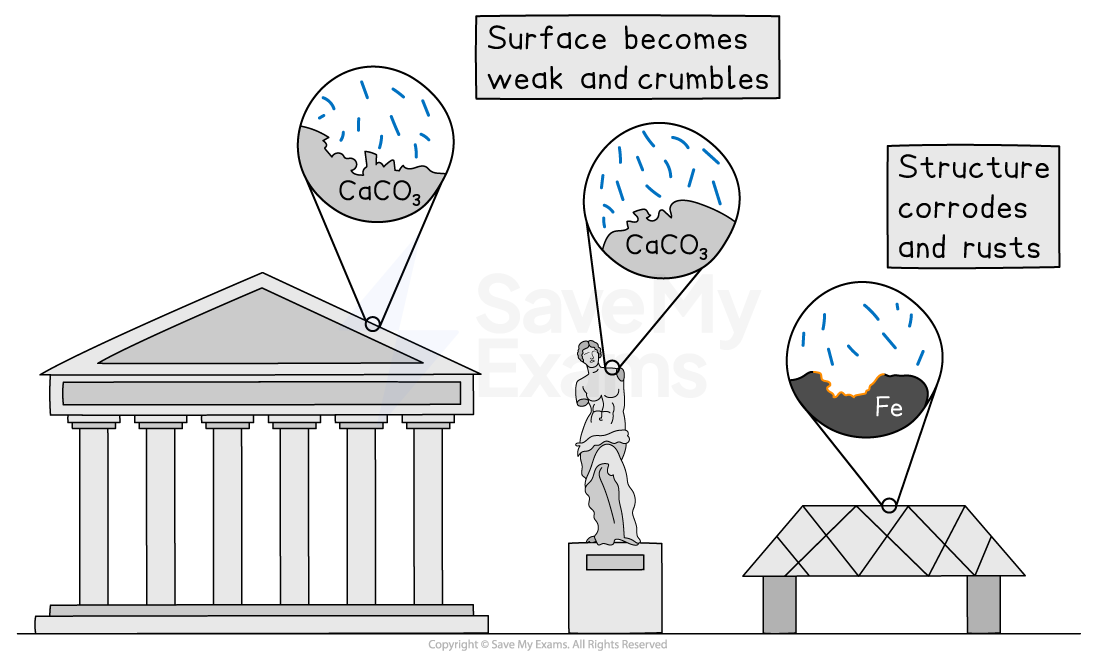
The impact of acid deposition can be seen on buildings, statues and metal structures
Case Study Acidification in Sweden
- It is mostly winds from other countries and international shipping that bring most of the acidifying pollutants that land in Sweden
- There isn't much limestone in Swedish soils, so they can easily become acidic
- Sweden has more than 18,000 lakes, and 4,000 of them are badly damaged by acidification
- About 9,000 lakes in Sweden, mostly in the south and centre of the country, are also losing a lot of fish population
- Sweden has up to 1.7 mg/l of aluminium in its water, which is higher than the safe limit of 0.2 mg/l
- High levels of mercury in fish have caused health problems when eaten
Was this revision note helpful?
Build on this topic