Strategies to Improve Water Quality (Cambridge International IGCSE Environmental Management)
Improved sanitation
-
Water quality improves when pollutants are reduced before they enter rivers, lakes or groundwater
- Key strategies include better sanitation, effective sewage treatment and strong pollution control laws
- These strategies protect both human health and aquatic ecosystems
-
Improved sanitation includes the use of facilities that separate human waste from human contact
- Reduces the spread of pathogens into water sources
-
Flush toilets are connected to safe sewage systems
- They move waste away from homes and reduce contamination of wells and streams
-
Pit latrines with sealed pits
- Prevent human waste leaking into surface water
- Suitable where no sewer network exists
-
Composting toilets
- Use dry material to break down waste safely, producing compost
- Reduce water use and contamination risk
-
Good sanitation:
- Prevents diseases such as cholera, dysentery and diarrhoea
- Keeps drinking water supplies safer for communities
Treatment of sewage
-
Sewage treatment is the process of removing harmful substances from wastewater so it can be:
- Safely returned to the environment
- Used for domestic purposes (e.g. for toilets, showers, drinking water)
-
It prevents pollution, protects public health, and helps conserve water by recycling treated water
The three stages of sewage treatment
Primary treatment
-
Purpose: Removes large solid materials (e.g. debris) and some suspended solids
-
Process:
- Screening: Large objects like sticks, rubbish, and plastic are filtered out using screens (usually made from metal bars)
- Comminution: Any remaining large solids are ground up by a device called a comminutor to prevent pipe blockages
- Grit removal: Sand and gravel settle to the bottom of the grit chamber
- Sedimentation: Wastewater flows into sedimentation tanks (also known as primary clarifiers), where smaller suspended solid particles settle at the bottom as sludge
- Skimming: Floating materials like grease and oil are skimmed from the surface
-
Result: Water is partially cleaned but still contains dissolved and smaller particles
Secondary treatment
-
Purpose: Breaks down organic matter using biological processes
-
Process:
-
Aeration: Oxygen is pumped into the wastewater to encourage bacteria to break down organic pollutants (e.g. human waste, food)
-
Biological degradation: Microorganisms (mainly bacteria) consume the organic waste, converting it into harmless by-products like carbon dioxide, water, and 'activated sludge'
- Activated sludge contains aerobic bacteria that decompose organic matter
-
Clarification: Water is again left to settle (in a secondary clarifier) so that any remaining sludge can be removed
- A portion of this sludge is reused as activated sludge in the aeration tank to continue the process of organic matter decomposition
-
-
Result: Water is significantly cleaner but may still contain some nutrients (e.g. nitrates, phosphates) and pathogens
Tertiary treatment
-
Purpose: Removes remaining nutrients, chemicals, and pathogens for maximum water quality
-
Process:
- Chemical treatment: Chlorine or ultraviolet light (UV) is used to disinfect the water and kill pathogens
- Nutrient removal: Processes like chemical precipitation are used to remove excess nitrogen and phosphorus, which can cause eutrophication if released into water bodies
- Filtration: Water may be filtered through sand, activated carbon, or other materials to remove any final impurities
-
Result: Effluent (treated water) is now clean enough to be safely discharged into rivers and lakes or reused
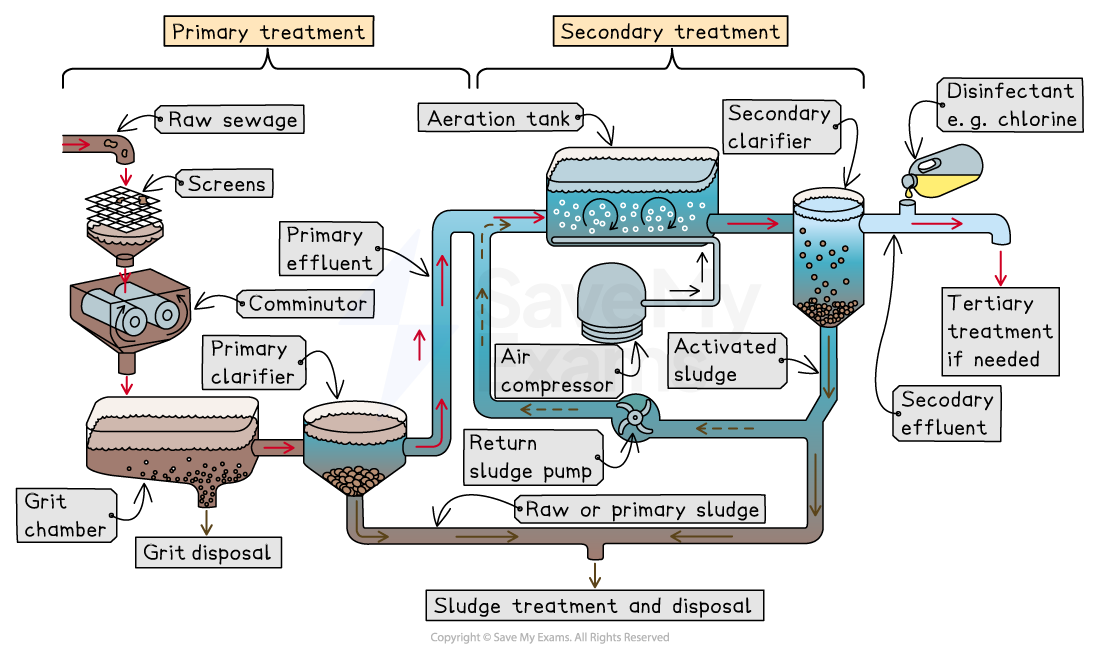
Primary and secondary water treatment stages
Pollution control & legislation
- Governments introduce rules to reduce pollutants entering air and water
Reducing acid rain pollutants
-
Cutting emissions of sulphur dioxide and nitrogen oxides reduces acid rain
- Achieved by reducing fossil fuel use in electricity generation and transport
-
Using low-sulphur fossil fuels
- Produces less sulphur dioxide during combustion
-
Clean Air Acts encourage industries and power stations to adopt these practices
Monitoring and enforcing pollution limits
-
Legislation may require companies to measure pollution levels from factories or wastewater discharge
- Keeps pollution within safe limits
-
There may be fines or legal penalties for exceeding limits
- This encourages companies to reduce emissions or improve waste treatment
-
In extreme cases, companies can be prosecuted or forced to shut down
Incentives for reducing pollution
-
Governments may offer grants or tax relief for organisations that successfully reduce pollution
- This encourages investment in cleaner technology
- Supports industries transitioning to sustainable practices
Was this revision note helpful?
Build on this topic