Floating Exchange Rates (Cambridge International IGCSE Economics)
Key exchange rate definitions
Spec point — "definitions of floating exchange rate, appreciation and depreciation • the demand for and supply of a currency "
Key exchange rate definitions
- A floating exchange rate is one that is determined by the forces of demand and supply in the foreign exchange market, without direct government or central bank control
- Appreciation occurs when the value of a currency rises compared to another currency in a floating system (e.g. £1 = $1.25 → £1 = $1.35)
- A depreciation occurs when the value of a currency falls compared to another currency in a floating system (e.g. £1 = $1.25 → £1 = $1.10)
Determination of the foreign exchange rate
Spec point — • the determination of the equilibrium foreign exchange rate
-
Different currencies can be bought and sold, just like any other product
-
The equilibrium exchange rate is where the quantity of a currency demanded equals the quantity supplied
- At this rate, the market is in balance — there is no shortage or surplus of the currency
- If demand increases or supply decreases, the currency appreciates
- If demand decreases or supply increases, the currency depreciates
Demand for a currency comes from:
- Foreigners buying the country’s exports
- Tourists visiting the country
- Foreign investors buying assets, shares or property
- Speculators who expect the currency to appreciate
The supply of a currency increases when:
- Citizens import more foreign goods and services
- Tourists travel abroad and need foreign currency
- Investors send money abroad
- Speculators sell the currency expecting it to fall in value
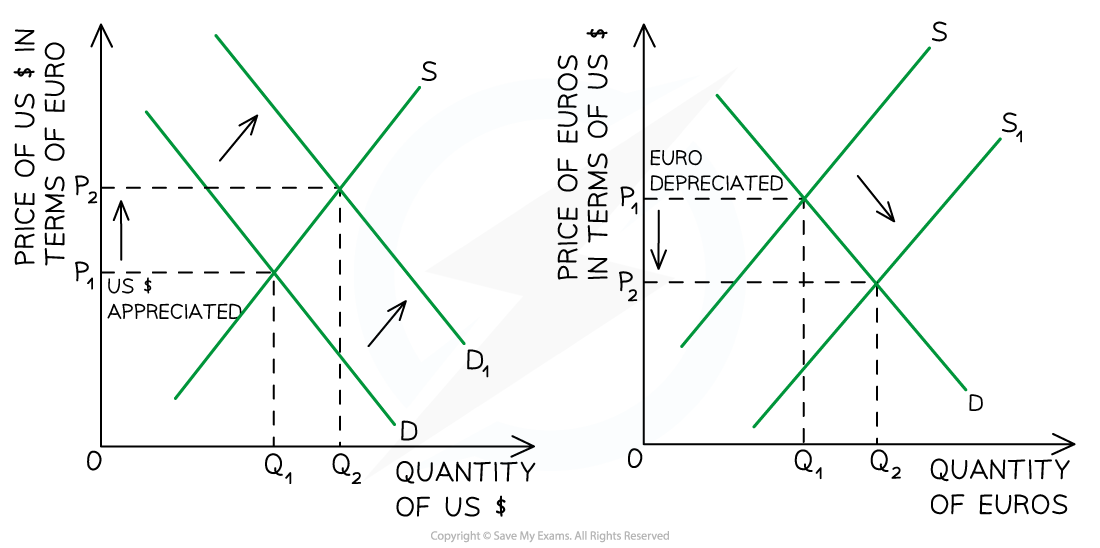
The relationship between the US it appreciates but by supplying their own currency it depreciates
Diagram analysis
-
The Euro/US$ market is shown by two market diagrams- one for the USD market on the left and one for the Euro market on the right
-
The initial exchange rate equilibrium is found at P1Q1 in both markets
-
When Europeans visit the USA, they demand US$ and supply Euros
- The **increased demand for the US$ **shifts the demand curve to the right, which results in the value of the $ appreciating from P1 → P2 in the USD market and a new market equilibrium forms at P2Q2
- The increased supply of the Euro shifts the supply curve to the right which results in the value of the Euro depreciating from P1 → P2 and a new market equilibrium forms at P2Q2
Causes of foreign exchange rate fluctuations
Spec point — "• causes of foreign exchange rate fluctuations – changes in demand for exports and imports – changes in the interest rate – speculation"
Causes of foreign exchange rate fluctuations
- Several factors cause exchange rates to change. Three of the most common include:
| Cause | Explanation |
|---|---|
| Changes in demand for exports and imports | - If a country’s exports rise, demand for its currency increases, causing appreciation - If imports rise, more of the home currency is sold to buy foreign currency, leading to depreciation |
| Changes in interest rates | - Higher interest rates attract foreign savers and investors, increasing demand for the currency and causing it to appreciate - Lower interest rates tend to reduce demand and cause depreciation |
| Speculation | - If traders believe a currency will rise in value, they buy more of it, which increases demand and causes appreciation - If they expect it to fall, they sell the currency, increasing supply and causing depreciation |
Was this revision note helpful?
Build on this topic