Causes & Consequences of Recession (Cambridge International IGCSE Economics)
Causes of recessions
Spec point — "definition of recession • how a recession may be caused by a decrease in total demand, a decrease in the quantity of resources or a decrease in the quality of resources • consequences of recession for consumers, workers, producers/firms and the government"
Causes of recessions
-
A recession is a period of at least six months (2 quarters) of economic decline which causes a decrease in the real gross domestic product (rGDP)
-
It can be caused by:
- A fall in any of the factors that influence total demand(consumption, investment, government spending, net exports). These are demand-side factors
- A decrease in the quantity of resources (supply-side factor)
- A decrease in the quality of resources (supply-side factor)
1. Decrease in total demand (demand-side recession)
-
A fall in total demand is caused by a fall in Consumption (C), Investment (I), Government spending (G), or Net exports (X–M)
-
Some examples of what may cause this include:
- Higher interest rates reduce borrowing and spending
- Falling consumer confidence leads to less household consumption
- Exports fall due to a global slowdown or stronger exchange rate
-
A demand-side recession leads to lower output and rising unemployment
2. Decrease in the quantity of resources (supply-side)
-
This is caused by a reduction in the available factors of production
-
Some examples of what may cause this include:
- Emigration reduces labour supply
- Natural disasters destroy productive land or capital
- Conflict or political instability disrupts production
-
A reduction in the quantity of resources reduces the ability of the economy to produce goods and services
3. Decrease in the quality of resources (supply-side)
-
This occurs when there is a lower productivity or efficiency in the use of existing resources
-
Some examples of what may cause this include:
- Skills shortages due to underinvestment in education and training
- An ageing or unhealthy population reduces workforce effectiveness
- The poor maintenance of infrastructure slows down production
-
A reduction on the quality of the factors of production causes long-term declines in productive capacity
-
The economic decline (recession) caused by supply-side interruptions can be illustrated using a production possibility curve (PPC)
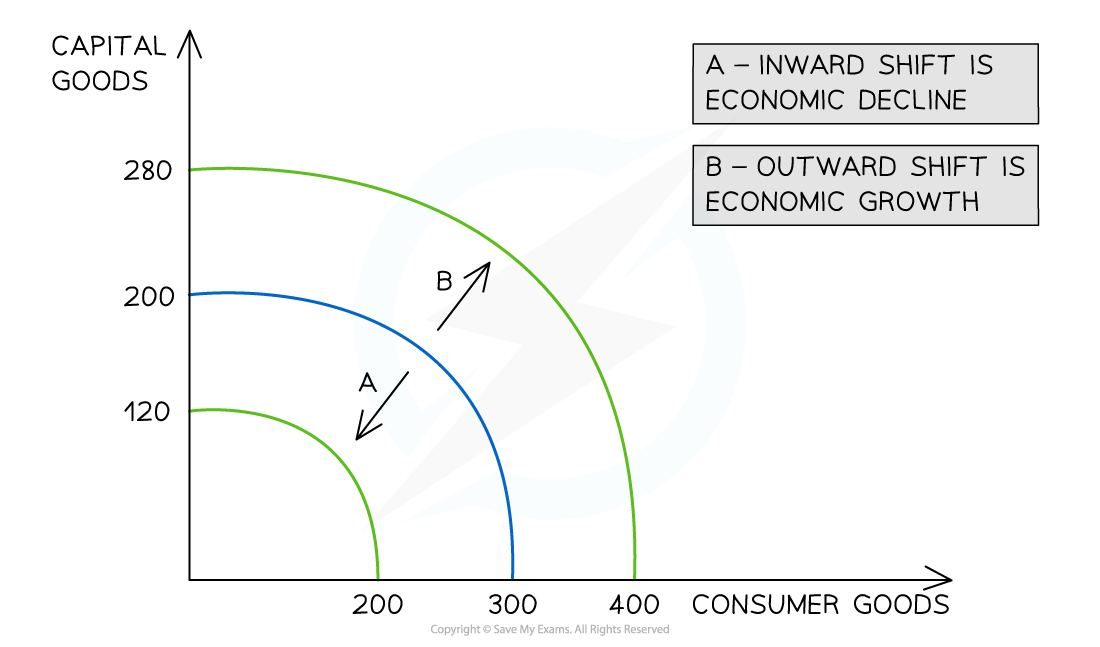
Outward shifts of a PPF show economic growth and inward shifts show economic decline (recession)
Diagram explanation
-
Recession (economic decline) occurs when there is any impact on an economy that reduces the quantity or quality of the available factors of production as depicted by the movement A
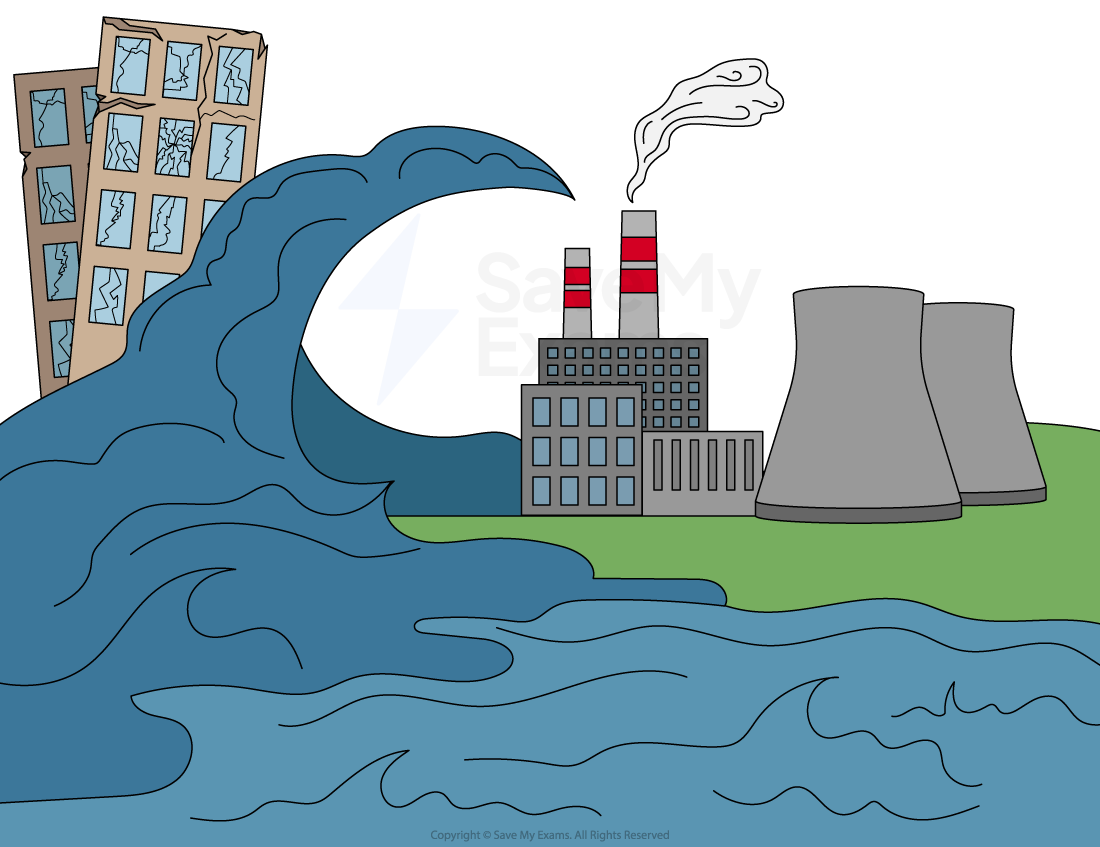
- E.g. The Japanese tsunami of 2011 devastated the production possibilities of Japan for many years. It shifted their PPC inwards, causing economic decline
Case Study The 2011 Japanese Tsunami – A Supply-Side Recession
Context
On 11 March 2011, a powerful magnitude 9.0 earthquake struck off the north-east coast of Japan, triggering a massive tsunami. The disaster caused widespread destruction in the Tōhoku region and led to a nuclear accident at the Fukushima Daiichi power plant. Over 15,000 people lost their lives, with many more injured or displaced.
Impact on the quantity of factors of production
- Labour – Thousands of workers were killed or injured, reducing the available workforce
- Capital – Factories, machinery, transport links, and housing were destroyed, removing productive assets from the economy
- Land – Large areas of farmland and coastal industrial zones were flooded or contaminated, reducing usable land for agriculture
- Energy supply – The Fukushima disaster forced the closure of nuclear reactors, cutting Japan’s electricity generation capacity
Impact on the quality of factors of production
- Labour skills – Skilled workers in specialised industries were lost or could not work, reducing overall productivity
- Capital quality – Damaged infrastructure and outdated replacements reduced efficiency in production
- Environmental damage – Contamination from the nuclear accident made some land unusable for decades, permanently reducing the quality of that resource
- Infrastructure reliability – Disruptions to transport, power, and communications systems reduced the efficiency of economic activity
Outcome for the economy
- Japan’s GDP contracted in 2011 as production fell sharply
- Major industries such as car manufacturing and electronics experienced significant delays because of damage to suppliers and parts shortages
- Recovery required substantial reconstruction spending, but the short-term effect was a supply-side recession, with reduced productive capacity rather than just falling demand
- The disaster highlighted Japan’s vulnerability to natural disasters and its heavy reliance on nuclear energy
Consequences of recessions
Spec point — "definition of recession • how a recession may be caused by a decrease in total demand, a decrease in the quantity of resources or a decrease in the quality of resources • consequences of recession for consumers, workers, producers/firms and the government"
Consequences of recessions
- A recession affects different economic agents in distinct ways, but the main connection is that falling output and incomes reduce spending power, confidence, and investment
Impact on consumers and workers
| Consumers | Workers |
|---|---|
| - Lower disposable income reduces the ability to buy goods and services | - Job losses as firms cut staff to reduce costs |
| - Falling house prices and share values can reduce household wealth | - Higher unemployment rates, especially in luxury industries |
| - Reduced access to credit as banks tighten lending criteria | - Increased competition for fewer job vacancies |
| - Decline in consumer confidence leads to postponement of major purchases | - Wage freezes or reductions as firms try to survive |
| - Higher risk of poverty, especially for low-income households | - Reduced working hours or shift patterns to save on wage bills |
| - Cuts in public services may reduce access to health, education and welfare support | - Loss of training and career development opportunities |
| - Emotional strain from financial pressures, potentially affecting mental health | - Increased job insecurity and stress in the workplace |
Impact on firms and governments
| Firms | Governments |
|---|---|
| - Falling sales revenue due to reduced consumer demand | - Lower tax revenue from income tax, corporation tax and sales taxes |
| - Underutilised capacity increases average costs per unit | - Higher spending on welfare benefits such as unemployment support |
| - Cash flow problems may lead to late payments or defaults | - Budget deficits and rising public debt levels |
| - Reduced profitability limits funds for investment and expansion | - May need to borrow more or cut spending in other areas |
| - Increased risk of bankruptcy, especially for smaller firms | - Political pressure to take action through stimulus measures |
| - Loss of market share if competitors can survive better | - Difficulty funding long-term projects due to short-term budget pressures |
| - Delayed product development and innovation | - Challenges in maintaining public services during falling revenues |
Exam Hint When answering 'analyse' or 'discuss' questions, show cause-and-effect links between the groups. For example: Falling consumer demand → lower firm revenues → job cuts → reduced tax revenue → higher government borrowing. This shows the full chain of analysis and strengthens your response
Was this revision note helpful?
Build on this topic