Causes & Consequences of Economic Growth (Cambridge International IGCSE Economics)
Causes of economic growth
Spec point — "how economic growth may be caused by an increase in total demand, an increase in the quantity of resources or an increase in the quality of resources • advantages and disadvantages of economic growth"
Causes of economic growth
- Economic growth is the increase in the output of goods and services in an economy over time, usually measured by the rise in real gross domestic product (GDP)
- Growth can be short-term (from better use of existing resources) or long-term (from an increase in productive capacity)
1. A change in total demand
-
Actual economic growth occurs when there is an increase in the quantity of goods and services produced in an economy in a given period of time - using existing resources
- If any component of real GDP increases (consumption, investment, government spending, net exports), there will be an increase in total demand
- This type of growth is short-run — it uses up idle resources but does not expand capacity permanently
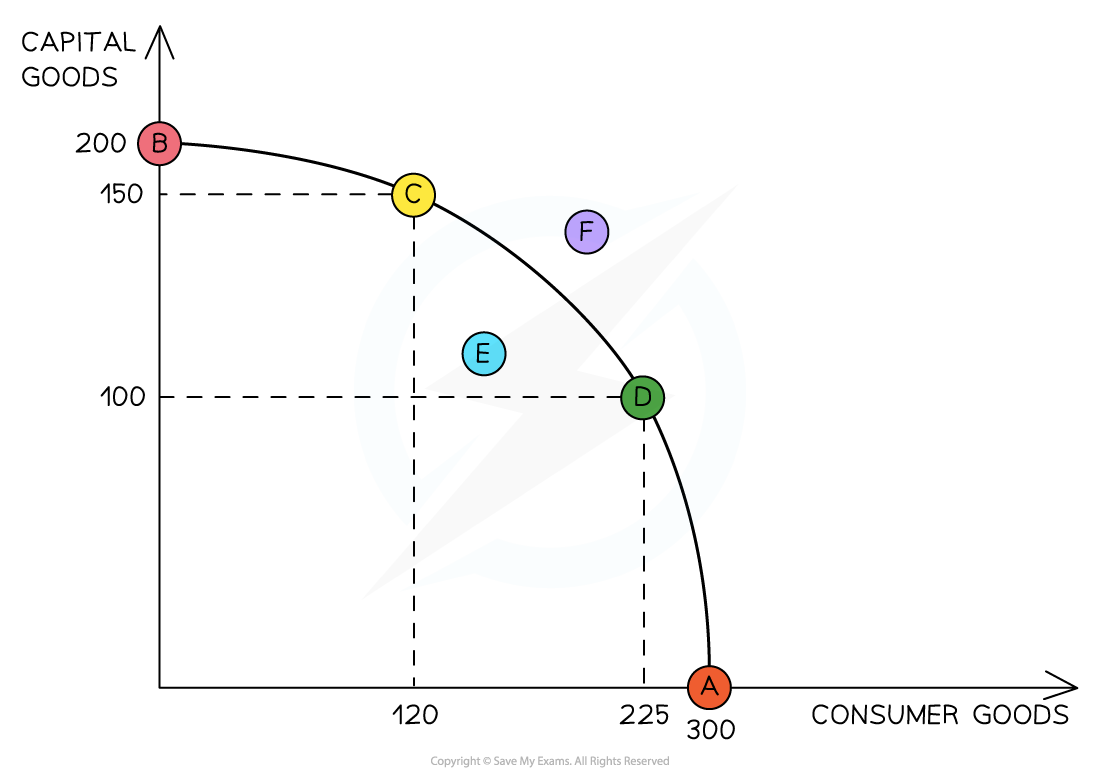
Any movement from Point E towards the PPC boundary represents actual economic growth and is caused by an increase in output (rGDP)
Diagram explanation
- Previously unused factors of production are now being employed
- This is demonstrated by a shift from inside the production possibilities curve (PPC) such as Point E, towards the boundary of the PPC
- At any given point in time, the actual economic growth may be less than the potential growth available to the economy
2. An increase in the quantity of resources
-
More resources allow the economy to produce more goods and services in the long run
-
Some factors that lead to an increase in resources include:
- More workers from population growth or immigration
- The discovery of new raw materials
- Increased capital stock from business investment
- More land brought into production for example through land reclamation such as that carried out in The Netherlands
-
This type of long-term growth expands the productive potential of the economy, shifting the production possibility frontier (PPF) outward
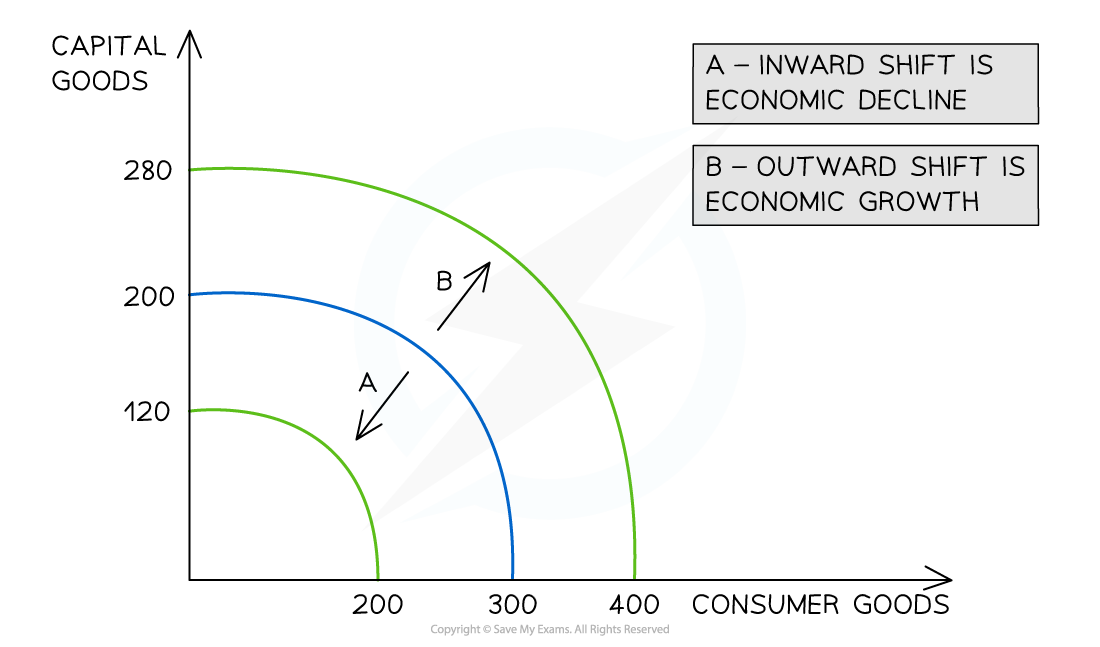
Outward shifts of a PPC show economic growth caused by changes to the quantity/quality of the FOP
Diagram explanation
-
Economic growth occurs when there is an increase in the productive potential of an economy
- This is demonstrated by an outward shift of the entire curve represented by B
- More consumer goods and more capital goods can now be produced using all of the available resources
3. An increase in the quality of resources
-
Higher-quality resources mean greater efficiency and productivity
-
Some factors that lead to an increase in the quality of resources include:
- Better education and training improving workforce skills
- Investment in advanced technology
- Improved infrastructure such as transport, communications and energy
- Health improvements increasing worker efficiency
-
These lead to sustainable long-term growth without inflationary pressure
-
This type of long-term growth expands the productive potential of the economy, shifting the production possibility frontier (PPF) outward
Exam Hint Remember this distinction, as MCQ often checks for this understanding:
- Growth caused by a change in total demand is represented by a movement from within the existing PPC towards its boundary
- Growth caused by a change in the quantity or quality of the factors of production (supply-side growth) moves the entire PPC curve outwards
The consequences of economic growth
Spec point — "how economic growth may be caused by an increase in total demand, an increase in the quantity of resources or an increase in the quality of resources • advantages and disadvantages of economic growth"
The consequences of economic growth
-
Economic growth is considered to be the main contributor to an improvement in the standards of living
-
Due to the negative aspects of economic growth, there is much controversy about maintaining it as a central macroeconomic aim
- Instead, arguments for a focus on societal well-being are gaining traction
The advantages and disadvantages of economic growth
| Advantages | Disadvantages |
|---|---|
| - Increased incomes lead to better standards of living - Decreased levels of absolute poverty - Improvement in the quality or quantity of environmentally friendly technologies - Higher sales revenue for firms and greater profits - Increased investment by firms increases the potential output of the economy - Higher government tax revenue due to rising incomes and surging corporate profits - Increased employment resolves some of the negative social impacts of unemployment | - Rising total demand causes demand-pull inflation and the purchasing power of people on fixed incomes may fall - Lack of equity in the distribution of income – the rich may get richer and the poor poorer - Environmental damage caused by negative externalities of production and consumption increases - Increased inflation can harm export sales - The level of imports usually increases, negatively impacting the current account - Increased income usually leads to greater consumption of demerit goods - Greater output often requires more time from workers and can decrease leisure time and well-being - Resources are depleted more rapidly |
Was this revision note helpful?
Build on this topic