The Objectives of Firms (Cambridge International IGCSE Economics)
Spec point —
3.6.5· survival, social welfare, profit maximisation and growth
The objectives of firms
-
The objectives of a firm are a reason for their existence or the desired focus of their owners
- These objectives typically include profit maximisation, growth, survival and social welfare
-
The objectives of a firm may change over time
1. Profit maximisation
-
Most firms have the rational objective of profit maximisation
-
Profit = total Revenue (TR) - total costs (TC)
-
To maximise profits, firms can either increase their sales revenue or decrease their costs
- Firms continuously analyse their costs to see if they can reduce them so that profit can be maximised
2. Growth
-
Some firms have the business objective of growth
-
Firms use the following metrics to help determine if they are growing:
- the number of employees
- their market share
- the size of their profits
- their market capitalisation
-
Firms with a growth objective often focus on increasing their sales revenue or market share
-
Firms will also maximise revenue in order to increase output and benefit from economies of scale
-
A growing firm is less likely to fail
3. Survival
- In the short term, many new firms focus solely on business survival
- Generally, as much as 25% of new firms fail in their first year of business
- Once a firm is established, it may then begin to focus on profit maximisation as its new objective
4. Social welfare
-
More firms than ever are launching with a social welfare objective
- These typically include a focus on climate action,addressing poverty or inequality
-
They still require profit to survive, but will accept less than if they were profit maximising as long as they are meeting their social objective
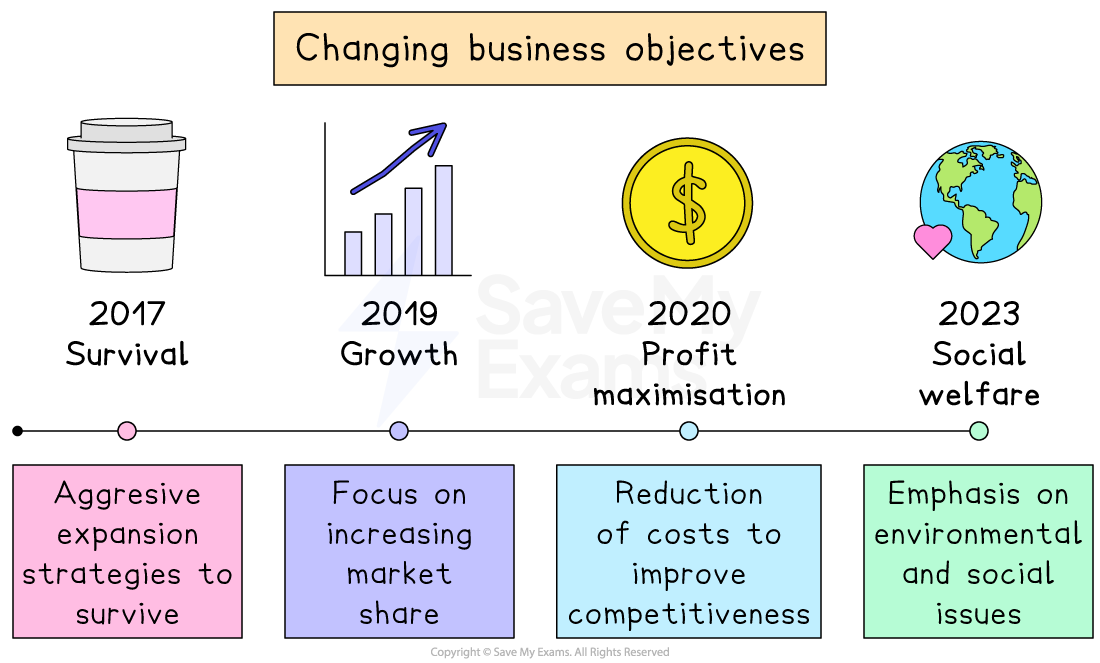
Case Study Changing Business Objectives Over Time
Background Luckin Coffee, founded in 2017 in China, entered the market with the aim of becoming the country’s leading coffee chain — directly challenging Starbucks. It began with a clear focus on rapid expansion and survival, offering huge discounts and cash-burning promotions to attract customers and investors.
1. Initial objective – survival
- In its first two years, Luckin focused solely on business survival and market entry.
- It prioritised aggressive store expansion, opening thousands of outlets across China within a very short time
- This strategy helped it build a large customer base quickly, a common approach for startups in competitive markets
2. Next objective – growth
- After securing a foothold, Luckin shifted to a growth objective
- It focused on increasing market share and surpassed Starbucks in number of stores in China by 2019
3. Then – profit maximisation
- With its brand now well established, Luckin sought to reduce promotional spending and increase margins
- It closed underperforming stores, invested in automation and began improving its product quality
- The aim was now to turn revenue into real profit, moving away from just expanding at all costs
4. Now – growth and social responsibility
After a major accounting scandal in 2023, the firm restructured under new leadership and repositioned its image
While it still focuses on growth, there’s now a noticeable shift towards ethical governance, employee welfare, and transparency.
- It also introduced sustainable packaging and promoted local sourcing to align with growing consumer interest in corporate social responsibility (CSR)
Was this revision note helpful?