The Government Budget (Cambridge International IGCSE Economics)
Key government budget terms
Spec point — "definitions of: – government budget – government budget deficit – government budget surplus • calculations of the size of a government budget deficit/surplus"
Key government budget terms
-
Government budget
- A statement of the government’s planned revenue (mainly from taxation) and expenditure (spending) over a specific period, usually one year
- Shows the government’s fiscal policy intentions
-
Government budget deficit
-
Occurs when government expenditure exceeds government revenue in a given period
-
Indicates that the government must borrow to finance the shortfall
- For example*, *UK public sector net borrowing in 2023/24 was around £120 billion
-
-
Government budget surplus
-
Occurs when government revenue exceeds government expenditure in a given period.
-
May be used to repay debt or saved for future spending
- For example,* *Norway often runs budget surpluses due to high oil revenues
-
-
-
Fiscal policy
-
The use of government spending and taxation to influence the economy
-
It can be:
- Expansionary – increasing spending or reducing taxes to stimulate growth
- Contractionary – reducing spending or increasing taxes to slow inflation
-
Calculating the surplus or deficit
- The budget balance is calculated using the following formula:
- If budget balance > 0 → surplus
- If budget balance < 0 → deficit
Worked Example
- Government revenue = $800 billion
- Government expenditure = $900 billion
Calculate the budget balance and determine if it in surplus or deficit
Step 1: Substitute the values into the formula
\text{Budget} balance=\ 800 \mathrm{b} – $ 900 \mathrm{b}$
Step 2: Calculate the answer and state if it is a surplus or deficit
equationequals space – $ 100 space billion equals space deficit
Reasons for government spending
Spec point —
4.2.2· main areas of government spending and the reasons for and effects of spending in these areas
- Public expenditure (government spending) represents a significant portion of the total (aggregate) demand in many economies
- Spending happens for the following reasons:
1. Provision of public goods
-
Goods that the market would not supply effectively due to the free rider problem
- E.g*.* national defence, street lighting, flood barriers
2. Provision of merit goods
-
Goods/services that would be under-consumed without government intervention
- E.g. education, healthcare, vaccination programmes
3. Welfare and social protection
-
Direct financial support to vulnerable groups to improve living standards
- E.g. unemployment benefits, pensions, disability support
4. Infrastructure investment
- Building and maintaining transport, energy, water and digital networks
- Supports business activity and long-term productivity growth
5. Debt interest payments
- Servicing existing government borrowing
- Prevents default and maintains credibility in financial markets
6. Environmental protection projects
- Funding for conservation, pollution control, and climate change adaptation
Reasons for taxation
Spec point — "reasons for taxation: raising revenue, discouraging consumption of demerit goods, reducing imports, redistributing income, influencing total demand, encouraging environmental sustainability"
Reasons for taxation
- Nearly every economy in the world is a mixed economy and has varying degrees of government intervention
- One of the main forms of government intervention is taxation and there are many reasons why it is necessary
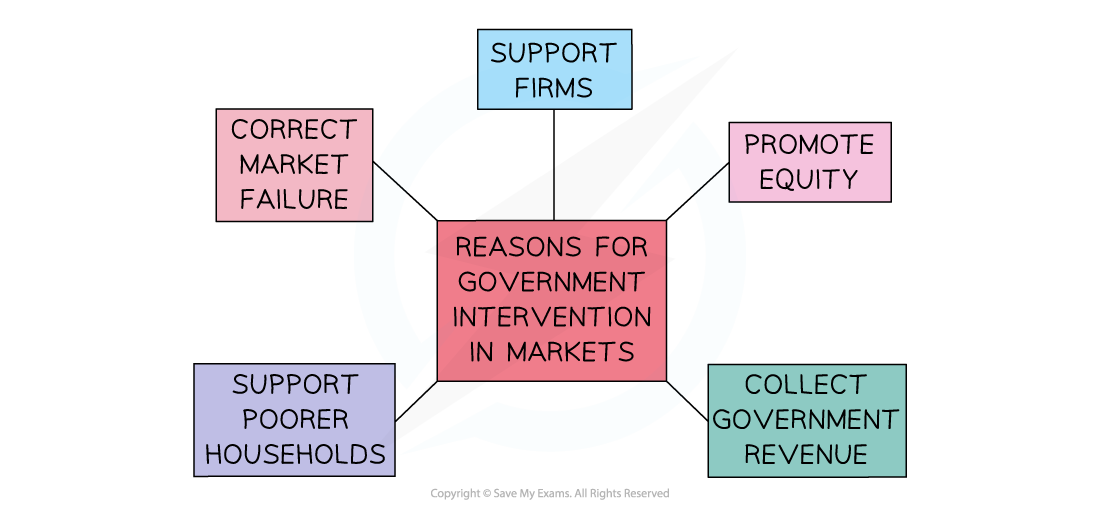
A diagram showing several reasons for government taxation in mixed economic systems
-
Correct market failure
-
In many markets there is a less than optimal allocation of resources from society's point of view
- The government aims to subsidise merit goods and tax demerit goods to address this market failure
-
-
Earn government revenue
-
Governments need money to provide essential services and public and merit goods
- Revenue to fund this is raised through taxation
-
-
Promote equity
- The wealthy are taxed to provide funds that can be utilised in reducing the opportunity gap between the rich and poor
-
Support firms
- In a global economy, governments choose to support key industries so as to help them remain competitive and taxation provides the funds to do this
-
Support poorer households
-
Poverty has multiple impacts on both the individual and the economy
- Intervention seeks to redistribute income (tax the rich and give to the poor) so as to reduce the impact of poverty
-
Was this revision note helpful?
Build on this topic