Monopoly Markets (Cambridge International IGCSE Economics)
Characteristics of monopoly markets
Spec point — Advantages and disadvantages of monopoly markets; The effects of monopoly markets on price, quality, choice and profit
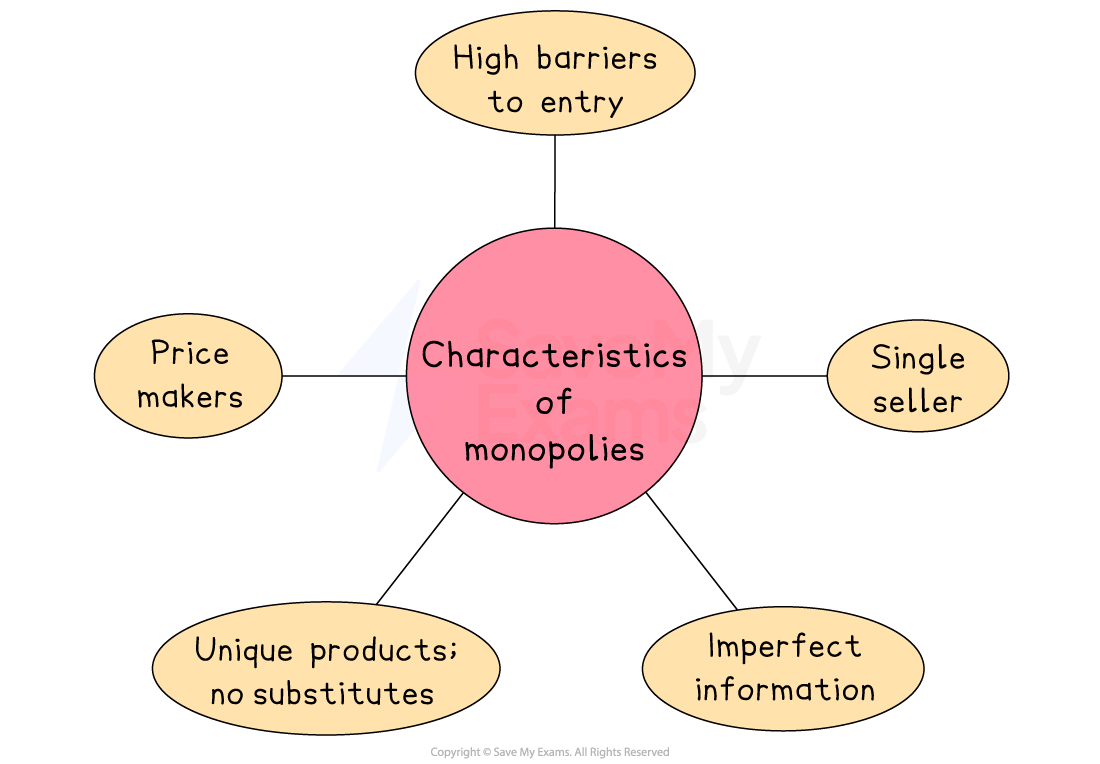
- A monopoly is a market structure in which there is a single seller
-
There are no substitute products
- The firms products are considered to be unique
-
The firm has complete market power
-
They are able to set prices and control output
- This allows the firm to maximise profit
- There is no long-run erosion of profit levels as competitors are unable to enter the industry
-
-
High barriers to entry exist
-
One of the main barriers is the ability of the monopoly to prevent any competition from entering the market
- For example, by purchasing companies who are a potential threat
-
-
Many governments define a monopoly as any firm having more than 25% market share
- Regulators act to prevent market share increasing beyond this level
- It helps to maintain competition within the market
Advantages and disadvantages of monopoly power
- When considering the pros and cons of monopoly power, it is useful to think about the pros and cons for different stakeholders
Evaluating monopoly power from the firm's point of view
| Advantages | Disadvantages |
|---|---|
| - Large profits generate money for continued investment in technology and product innovation - Market power enables the firm to increase its global competitiveness - Economies of scale can increase, thereby lowering the average cost - Price discrimination: **the firm can charge consumers different prices based on the different price elasticity of demand for the product, e.g., peak (inelastic) and off-peak (elastic) travel on trains | - Due to a lack of competition, there is a reduced incentive to be efficient - Cross-subsidisation can create inefficiencies - Monopolies lead to a** misallocation of resources as they limit supply in order to increase price - Due to a lack of competition, innovation sometimes lacks effectiveness. |
Evaluating monopoly power from the employee's point of view
| Advantages | Disadvantages |
|---|---|
| - Large profits often result in higher wages | - Having only one supplier in the industry limits the opportunity to change employers |
Evaluating monopoly power from the consumer's point of view
| Advantages | Disadvantages |
|---|---|
| - Product innovation due to the firm's large profits may result in a better-quality product - Cross-subsidisation can lower prices on some products that the firm provides - Prices may fall. If firms pass on their cost savings to consumers (due to economies of scale) in the form of lower product prices | - A lack of competition is likely to result in higher prices, as no substitute goods are available - A lack of competition reduces the need for product innovation and worsens product quality over time - May experience worse customer service as the incentive to improve it is limited - Cross-subsidisation is likely to increase prices on some products offered by the firm |
Evaluating monopoly power from the supplier's point of view
| Advantages | Disadvantages |
|---|---|
| - Increased sales volume for some suppliers as they are able to supply products that are distributed nationally or internationally | - There is less competition for their products and a monopoly often has the power to dictate what price they will pay to suppliers |
The effect of having only one firm
- Price: The monopoly can set prices above competitive levels
- Quality: Quality may fall if there is no competitive pressure, but it can also improve if profits fund innovation
- Choice: Very limited — consumers may have only one supplier
- Profit: Monopolies can earn abnormal (supernormal) profits in the long run due to lack of competition
Exam Hint When evaluating monopolies, demonstrate critical thinking by acknowledging the positives as well as the negatives. For example, Amazon has partly become a monopoly by being very good at what they do and consumers benefit from lower prices and greater choice. However, this power means that they can also abuse the suppliers on their platform
Was this revision note helpful?
Build on this topic