Calculation, Determinants & Significance of PES (Cambridge International IGCSE Economics)
The Definition and Calculation of PES
Spec point —
2.8.1· Calculation of PES using the formula and interpreting the significance of the result. Drawing and interpretation of supply curve diagrams to show different PES.
-
The law of supply states that when there is an increase in price (ceteris paribus), producers will increase the quantity supplied and vice versa
- Economists are interested in how much the quantity supplied will increase
-
Price elasticity of supply (PES) reveals how responsive the change in quantity supplied is to a change in price
- The responsiveness is different for different types of products
Calculation of PES
- PES can be calculated using the following formula
- To calculate a % change, use the following formula
Worked Example In recent months, the price of avocados has increased from £0.90 to £1.45. Bewdley Farm Shop in Wales have sought to maximise their profits by increasing the quantity supplied to market. They have been able to increase the supply of avocados from 110 units a week to 120 units a week. Calculate the PES of avocados and explain one reason for the value
Step 1: Calculate the % change in QS
****$% \Delta Q S = \frac{120 - 110}{110} \times 100
% \Delta Q S = 9.1 %$****
Step 2: Calculate the % change in P
$% \Delta \mathrm{P} = \frac{1.45 - 0.90}{0.90} \mathrm{x} 100
% \Delta \mathrm{P} = 61 %$
Step 3: Insert the above values in the PES formula
$\text{PE} S = \frac{% \Delta \text{in} Q S}{% \Delta \text{in} \mathrm{P} }
\text{PE} S = \frac{9.1 %}{61 %}
\text{PE} S = 0.15 $
Step 4: Explain one reason for the value
The PES value of 0.15 indicates that avocados are very price inelastic in supply. Even with a significant increase in price, suppliers are unable to supply more likely due to the time it takes to grow additional avocados
Exam Hint When doing elasticity calculations, make sure that your final answer is not expressed as a percentage. This is a common error and loses marks.
Interpreting PES values
The Values of PES Vary From 0 to Infinity (∞) and They Are Classified As Follows
| Name | Explanation |
|---|---|
| Perfectly inelastic Value = 0 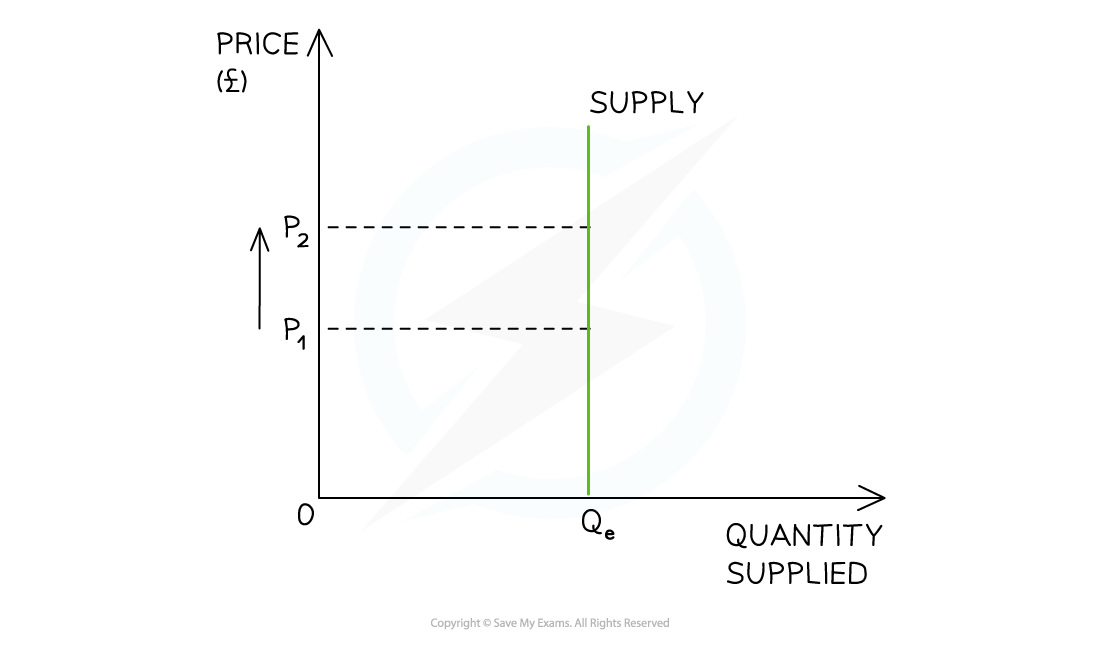 | - The QS is completely unresponsive to a change in P - E.g. Fixed number of seats in a theatre |
| Relatively inelastic Value = 0→1 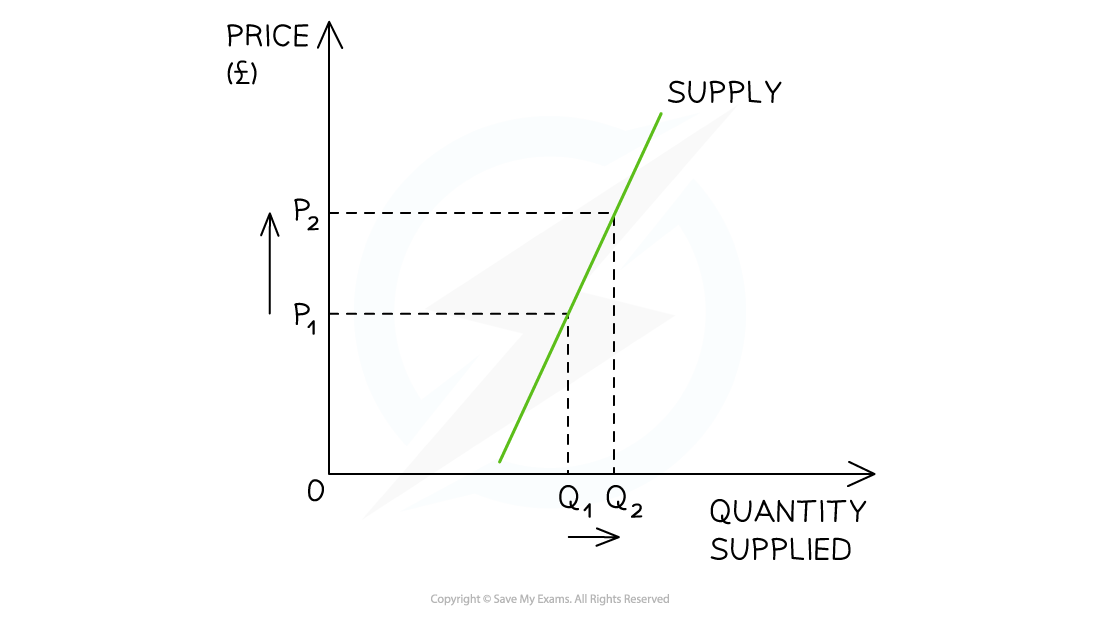 | - The %∆ in QS is less than proportional to the %∆ in P - E.g Agricultural products |
| Relatively elastic Value = 1 → ∞ 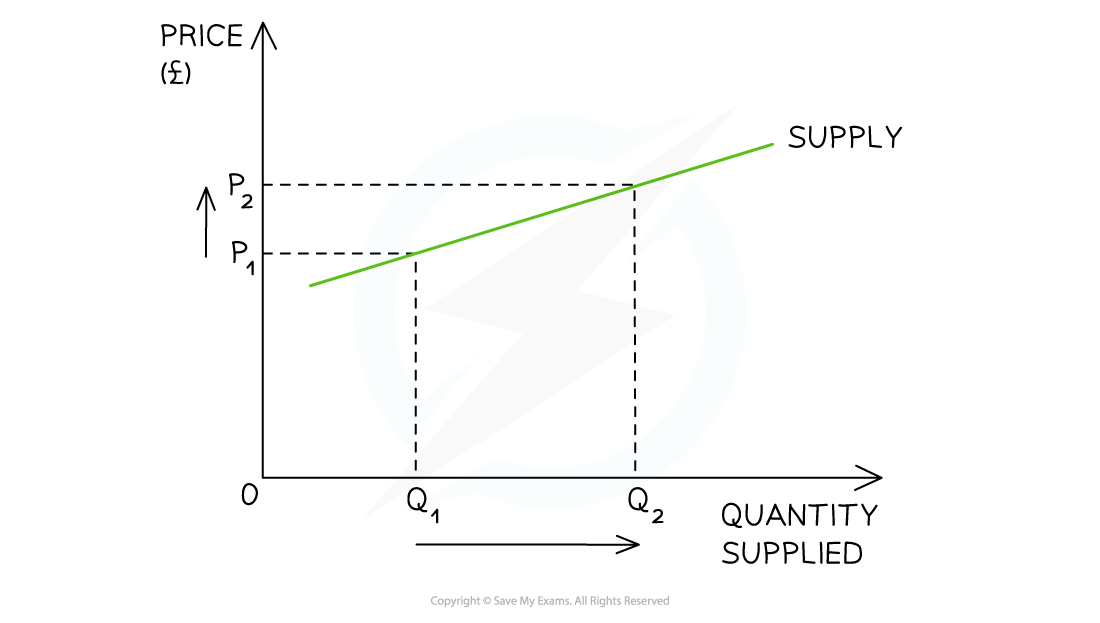 | - The %∆ in QS is more than proportional to the %∆ in P - E.g T-shirts |
| Perfectly elastic Value = ∞ 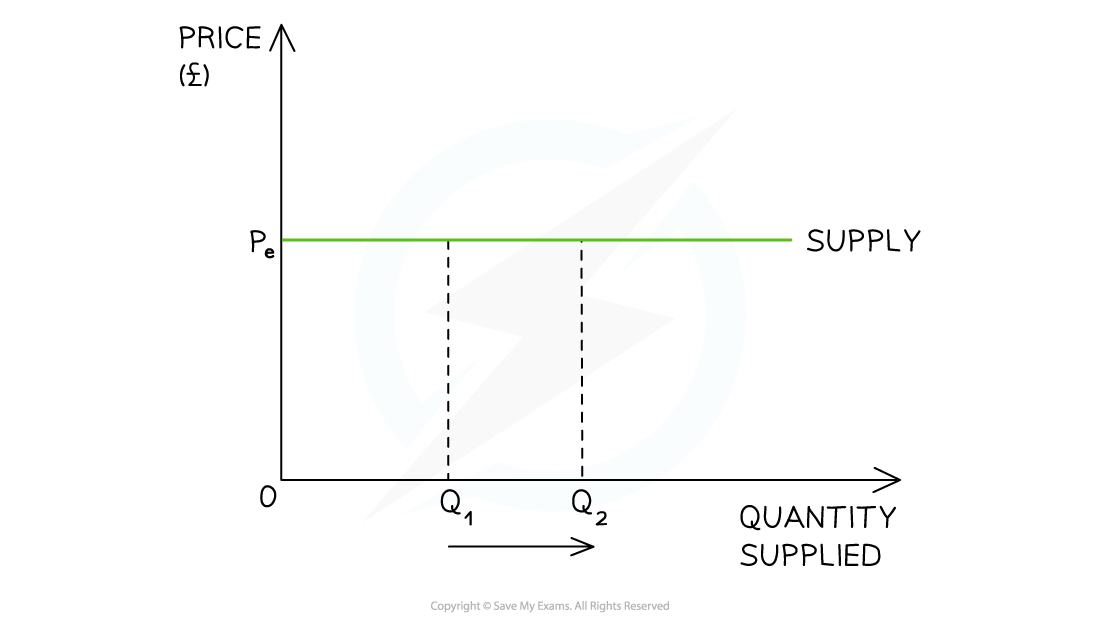 | - The %∆ in QS will fall to zero with any %∆ in P - Supply is unlimited at a particular price - This is a very theoretical scenario |
| Unitary elasticity **Value = 1 ** 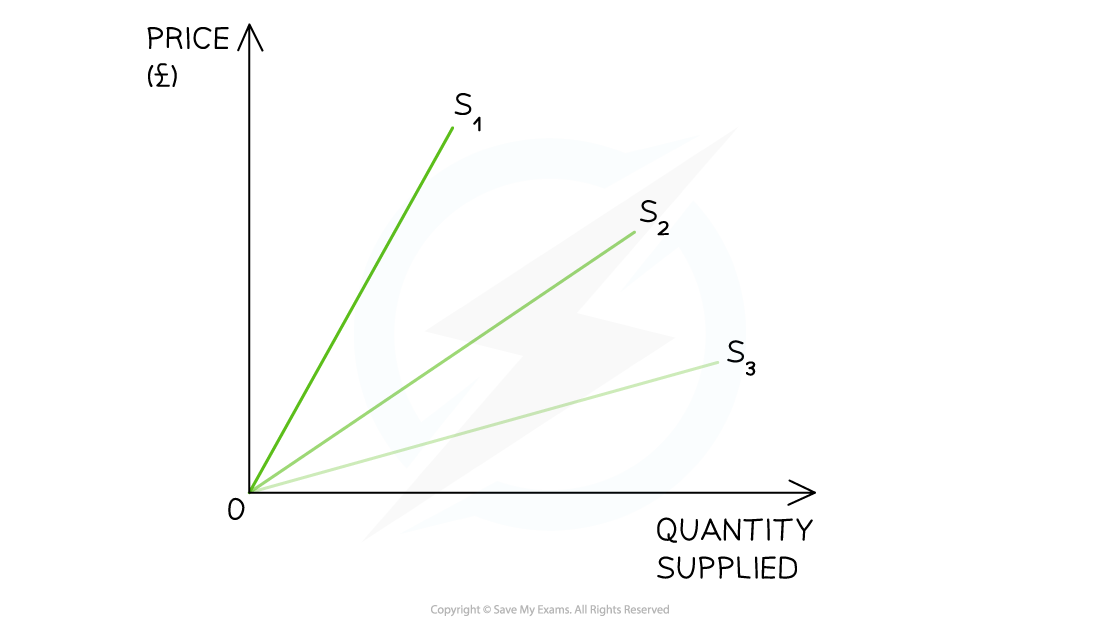 | - Any supply curve that starts at the origin - E.g. S1, S2 or S3 have a PES value equal to 1 - The** %∆ in P = %∆ in QS** |
The Determinants of PES
Spec point —
2.8.1· The key influences on whether supply is elastic or inelastic.
-
Some products are more responsive to changes in prices than other products
-
The factors that determine responsiveness are called the determinants of PES and include:
- Mobility of the factors of production If producers can quickly switch their resources between products, then the PES will be more elastic. For example, if prices of hiking boots increase and shoe manufacturers can switch resources from producing trainers to boots, then boots will be price elastic in supply
- Availability of raw materials If raw materials are scarce, then PES will be low (inelastic). If they are abundant, PES will be higher (elastic)
- Ability to store goods If products can be easily stored, then PES will be higher (elastic) as producers can quickly increase supply (for example, tinned food products). An inability to store products results in lower PES (inelastic)
- Spare capacity If prices increase for a product and there is capacity to produce more in the factories that make those products, then supply will be elastic. If there is no spare capacity to increase production, then supply will be inelastic
- Time period In the short run, producers may find it harder to respond to an increase in prices as it takes time to produce the product (e.g. avocados). However, in the long run, they can change any of their factors of production so as to produce more
Exam Hint Many students confuse PES with PED and inadvertently answer questions using knowledge from PED. When faced with PES questions, tell yourself to think like a producer (and not a consumer!) and it will help you to stay focused on providing the correct answer.
The Significance of PES for Stakeholders
Spec point —
2.8.1· The implications for decision making by consumers, producers and government.
-
If producers have a high PES (elastic), then they are able to respond to increases in price very quickly
-
This is desirable as it means producers can increase revenues and profits if they can supply more
-
Firms can increase their PES by:
- Creating more spare capacity on their production lines
- Maintaining larger inventories
- Using more modern technology
-
-
If producers have a low PES (inelastic) then they are less able to respond to increases in price
- This shortage in supply will mean that prices continue to rise, possibly causing inflation in the economy
-
Governments are very interested in the PES of key markets in the economy as they want to ensure that these markets can respond quickly to rising demand
-
One example is the housing market
- If the PES of housing is low (inelastic), property prices will become unaffordable with any increase in demand
-
Another example is the labour market
- If the PES of labour is low (inelastic) then production costs of firms will rise quickly during periods of increasing demand when firms need to hire additional workers
-
Was this revision note helpful?