The (Free) Market System (Cambridge International IGCSE Economics)
Definition and Characteristics
Spec point —
2.9.1· Definition of market economic system. Including examples of how it works in a variety of different countries.
-
A market economy is an economy that has no government intervention in the allocation of resources and distribution of goods/services
- This is also called a free market economy
- There is no purely free market economy in the world but some countries have less government intervention than others
-
An economy can be considered to be a market, mixed or planned economy
- The type of economy is determined by how the three economic questions are answered (see: 2.2.1 The (Free) Market System).
- This ultimately determines the amount of government intervention in an economy
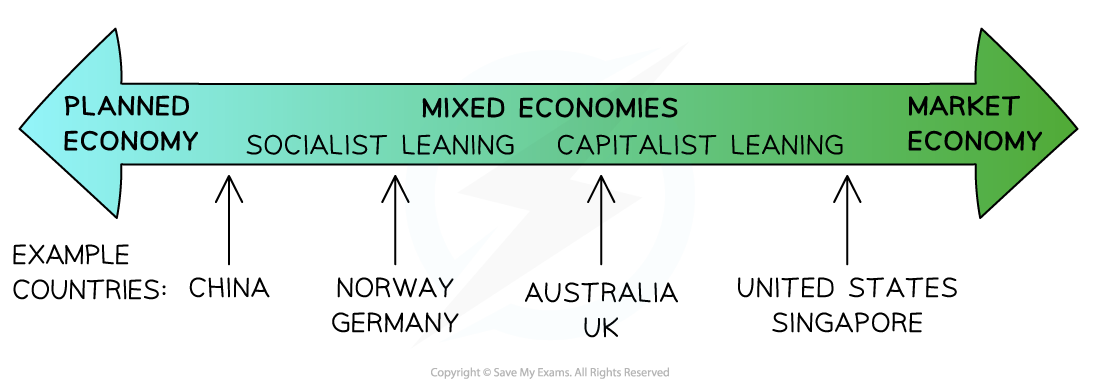
The spectrum of economic systems and where certain economies fall based on the degree of government intervention
- North Korea is a planned economy
- The United States, Japan and Singapore are mixed economies but have less government intervention than Norway, Germany or China Characteristics of a Market System
| Characteristic | Explanation |
|---|---|
| Property Ownership | - Individuals have the right to purchase the factors of production |
| Freedom of Choice | - Individuals are free to start their own business - Firms are free to decide what they are going to produce, how, and for whom - Workers are free to decide who they are going to work for - Consumers decided what goods/services best meet their wants/needs |
| Self Interest | - Entrepreneurs maximise profits - Workers maximise wages - Consumers maximise their well-being/satisfaction |
| Limited Government Intervention | - A pure market economy has no government intervention - Most free market economies have a low level of intervention, usually in the form of taxation, provision of defence, healthcare and education |
| Price Mechanism | - Changes in prices allocate scarce resources - Rising prices indicate a shortage of resources and falling prices indicate a surplus of resources |
Advantages and Disadvantages of a Market System
Spec point —
2.9.1
- Each economic system has numerous advantages and disadvantages
The Advantages and Disadvantages of Market Economies
| Advantages | Disadvantages |
|---|---|
| - Profit incentive motivates people to work or develop entrepreneurial ideas - Greater variety of goods/services - Competition leads to better quality of goods/services - Competition leads to lower prices of goods/services - Competition encourages innovation and product development - Profits, income and wealth are unlimited resulting in better standards of living - More efficient use of scarce resources | - Wealth gets concentrated in the hands of the few as they are able to keep buying up the scarce factors of production - This increases inequality such that the gap between the rich and the poor continues to grow - Sometimes product quality falls as firms lower quality standards in order to increase profits - Workers get exploited - Resource depletion and environmental degradation are often ignored - Monopolies develop as firms increase market power through mergers and acquisitions - This leads to exploitation of consumers and supply chains |
Exam Hint Multiple choice questions often explore your understanding of the different characteristics of market and mixed economic systems.
When answering structured questions that ask you to discuss/explain the difference between two systems, ensure that the disadvantages of one system are not always just the opposite points to the advantages of the other system. Develop some unique points for each system.
Was this revision note helpful?
Build on this topic