The (Free) Market System (Cambridge International IGCSE Economics)
Different Economic Systems
Spec point —
2.2.1· Establishing that the economic problem creates three key questions about determining resource allocation – what to produce, how, and for whom.
-
In order to solve the basic economic problem of scarcity, economic systems emerge or are created by different economic agents within the economy
- These agents include consumers, producers, the government, and special interest groups (e.g. environmental pressure groups or trade unions)
- Any economic system aims to allocate the scarce factors of production
-
The three main economic systems are a (free) market system, mixed economy, and planned economy
What determines the economic system of a country?
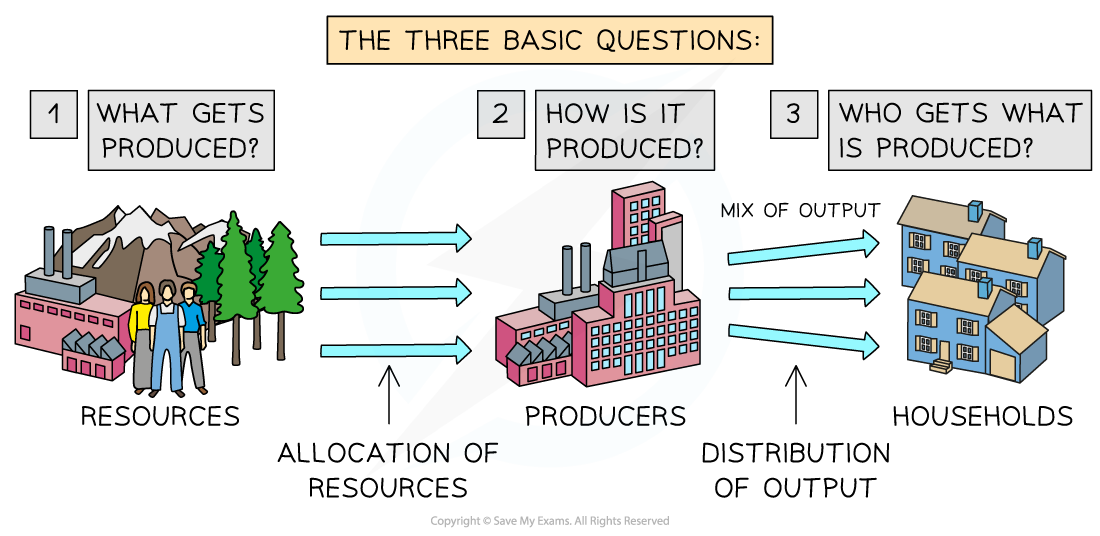
How the three questions are answered determines the economic system of a country
- Economic decisions need to be made to answer three important questions
- What to produce? As resources are limited in supply, decisions carry an opportunity cost. Which goods/services should be produced? e.g. better rail services or more public hospitals?
- How to produce it? Would it be better for the economy to have labour-intensive production so that more people are employed, or should goods/services be produced using machinery?
- For whom are the goods and services to be produced? Should goods/services only be made available to those who can afford them, or should they be freely available to all?
How These Questions Are Answered Determines the Economic System
| Type of System | What to Produce? | How to Produce? | For Whom? |
|---|---|---|---|
| Market system | - Demand and supply (the price mechanism) | - Most efficient, profitable way possible | - Those who can afford it |
| Mixed system | - Demand, supply and the Government | - Some efficiency but also a focus on welfare/well-being | - Those who can afford it, plus some provision to those who cannot afford it |
| Planned system | - The Government | - Ensure everyone has a job | - Everyone |
How a Market System Works
Spec point —
2.2.1· How a market system works; including buyers, sellers, allocation of scarce resources, . How the price mechanism provides answers to these key allocation questions.
How a Market System Works
-
A market system works to allocate scarce resources efficiently, purely through the forces of demand and supply (the price mechanism)
- There is no government intervention in a pure market system (no taxes or government spending)
- In reality, there is no economy which is a pure market system
-
In a market system, prices for goods and services are determined by the interaction of demand and supply
- A **market **is any place that brings buyers and sellers together
- Markets can be physical (e.g. McDonald's) or virtual (e.g. eBay)****
-
The price mechanism is the interaction of demand and supply in a free market
- This interaction determines prices, which are the means by which scarce resources are allocated between competing wants/needs
-
The price mechanism fulfils several functions in an economy:
-
Prices allocate (ration) scarce resources
- When resources become scarcer the price will rise further. Only those who can afford to pay for them will receive them
- If there is a surplus, then prices fall and more consumers can afford them
-
Prices provide information to producers and consumers where resources are required (in markets where prices increase) and where they are not (in markets where prices fall)
-
When prices for a good/service rise, it incentivises producers to reallocate resources from a less profitable market to this market in order to maximise their profits
- Falling prices incentivise reallocation of resources to new markets
-
Market Equilibrium and Disequilibrium
Spec point —
2.2.1· Market equilibrium, and market disequilibrium
-
Equilibrium in a market occurs when demand = supply
-
At this point, the price is called the market clearing price
- This is the price at which sellers are clearing their stock at an acceptable rate
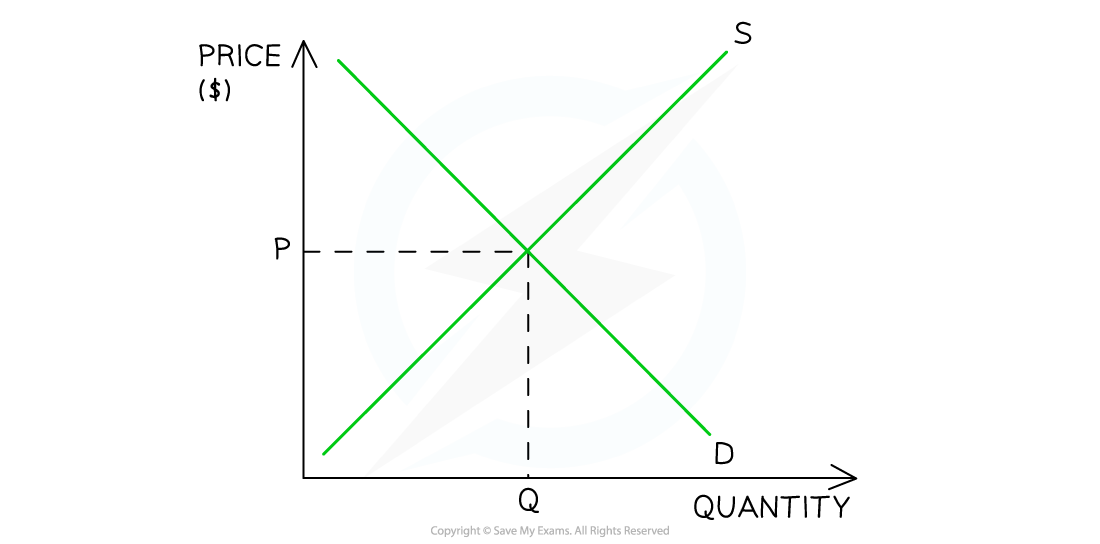
A graph showing a market in equilibrium with a market clearing price at P and quantity at Q
-
Any price above or below P creates disequilibrium in this market
- Disequilibrium occurs whenever there is excess demand or supply in a market
Was this revision note helpful?