Cloud Storage (Cambridge International IGCSE Computer Science)
Spec point —
3.3.5· 5 Understand what is meant by cloud storage
Cloud Storage
What is cloud storage?
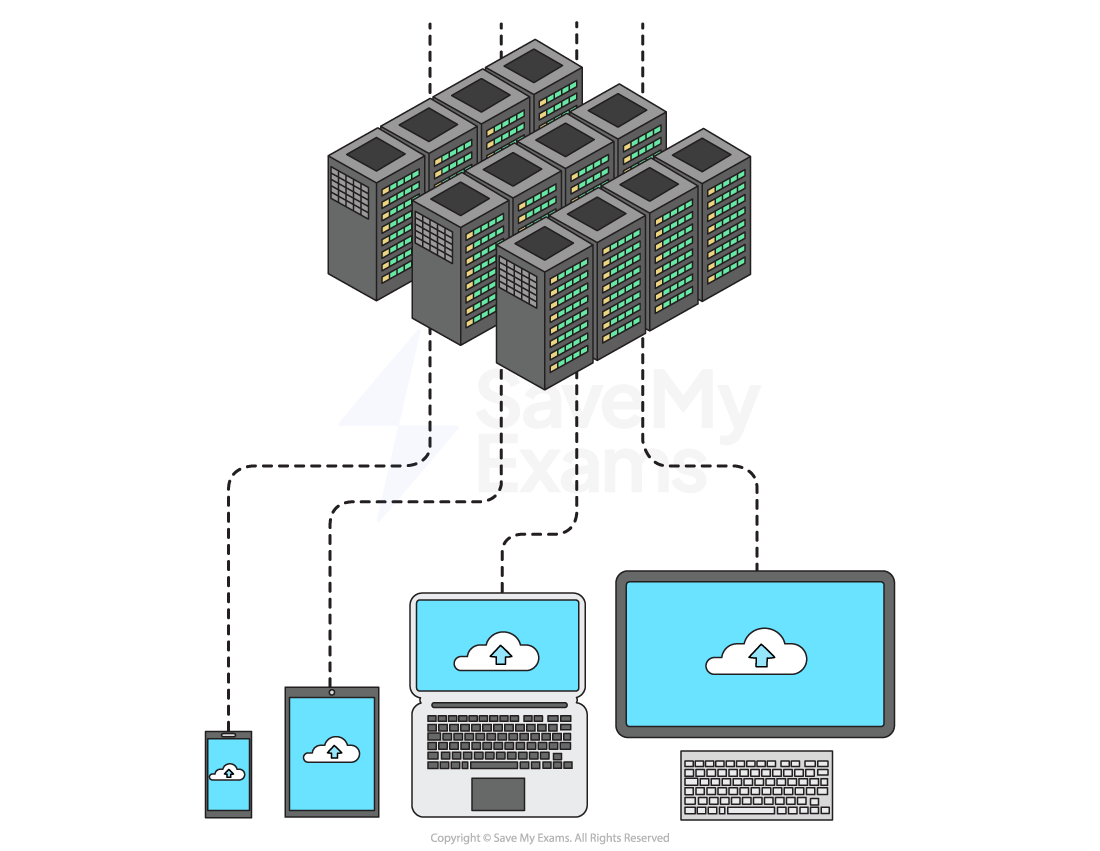
- Cloud storage is a term to describe long-term (secondary) storage of data that resides in a remote location, accessible only via a wide area network (Internet)
- Data is stored on remote servers, typically using magnetic storage (HDD), but increasingly using solid state (SSD)
| Advantages | Disadvantages |
|---|---|
| Reliability- Access data anywhere, any time, from any device | Cost- Typically a monthly/yearly subscription plan |
| Security - Automatic backups | Availability- No access without an internet connection |
| Capacity- Endless storage space (cost permitting), uses less space on own device | |
| Collaboration- Multiple people can access the same file at the same time |
Advantages of Cloud Storage
Spec point —
3.3.6· "6 Explain the advantages and disadvantages of storing data on the cloud in comparison to storing it locally"
Advantages of Cloud Storage
- Cloud storage offers several advantages over storing data on a local secondary storage device
| Benefit | Explanation |
|---|---|
| Accessibility | - Data can be accessed from anywhere - Data can be accessed by anyone with the relevant permissions, making it quick to share files and collaborate with others - Data can be accessed on any device with an internet connection |
| Scalability | - Cloud storage providers allow customers to increase or decrease their storage capacity as needed |
| Reliability | - Cloud storage providers often use multiple servers to store and backup data, reducing the risk of data loss due to hardware failure |
| Security | - Cloud storage providers offer advanced security features, such as data encryption and multi-factor authentication, to protect user data from unauthorised access - There is no need to hire specialist staff as IT services being provided by the cloud storage provider |
-
You also do not need to purchase local secondary storage devices
-
One cloud storage centre is more environmentally friendly than millions of individual servers
-
There are some drawbacks to using cloud storage
-
If the user has a slow or unreliable internet connection they would have problems accessing their files
-
If you are storing a lot of data it can be expensive
- You have to pay the cloud storage provider
- You may need to commit to an annual subscription
- You may have to pay for high download and upload data transfer limits
-
Data being sent over the internet has the potential to be intercepted
-
Security is managed by the cloud storage provider which means the user does not have complete control over it but is still legally responsible for ensuring any personal and sensitive data is secure
-
Worked Example A school currently stores all of their data on local servers. They are considering upgrading their system to utilise cloud storage.
Explain two disadvantages to the school of storing their data in the cloud.
[4]
- You need a constant internet connection [1]
- if the internet connection failed, teachers would not be able to access lesson files [1]
- if the internet connection failed, teachers would not be able to access student data/take electronic registers [1]
- if the internet connection failed, students would not be able to access their work/coursework [1]
- Reliant on third party to carry out security procedures [1]
- but the school is still legally responsible if data is accessed by unauthorised people [1]
- Data stored on the cloud could be hacked or intercepted [1]
Explain two advantages to the school of storing their data in the cloud.
[4]
- Additional storage can be purchased if needed [1]
- The cloud hosting company provides back up [1]
- The cloud hosting company provides security [1]
- Data can be accessed from anywhere and from any device provided there is an internet connection [1]
- So teachers would be able to access data from home [1]
- So students would be able to access work from home [1]
Was this revision note helpful?
Build on this topic