Data Transmission (Cambridge International IGCSE Computer Science)
What is data transmission?
-
Data transmission is the process of transferring data from one device to another using a wired or wireless connection
-
Wired data transmission can be completed in two ways:
- Serial
- Parallel
Serial & Parallel Transmission
Spec point — "2 (a) Describe how data is transmitted from one device to another using different methods of data transmission"
Serial & Parallel Transmission
What is serial & parallel transmission?
- Serial and parallel are methods of transmitting data (bits) from a sender to a receiver
- Each method determines how many bits can be transmitted at once
Serial transmission
- A stream of bits is sent in sequence, one after the other, along a single wire
- USB is an example of a wired serial connection

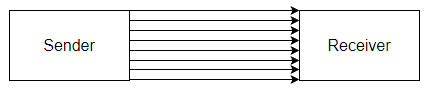
Parallel transmission
- Multiple bits are sent simultaneously, with each bit travelling on its own separate wire
- Parallel transmission is usually synchronous, using a clock signal to keep data aligned
- However, bits can arrive at slightly different times due to skew (timing differences between wires)
- A traditional printer cable is an example of a wired parallel connection
Advantages and disadvantages of serial & parallel transmission
| Transmission | Advantages | Disadvantages |
|---|---|---|
| Serial | - Reliable over longer distance - Cheaper to setup - Low interference | - Slow transmission speed |
| Parallel | - Very fast transmission speed | - Only used on short distances - Prone to high interference |
Simplex, Half-Duplex & Full-Duplex Transmission
Spec point — "(b) Explain the suitability of each method of data transmission, for a given scenario"
Simplex, Half-Duplex & Full-Duplex Transmission
What is simplex, half-duplex & full-duplex transmission?
- Simplex, half-duplex and full-duplex describe the direction in which data can be transmitted between a sender and receiver
Simplex transmission
- Data travels in only one direction
- Sending data from a computer to a monitor is an example of simplex transmission
Half-duplex transmission
- Data can travel in both directions, but only one direction at a time
- A printer cable which waits for the data to be received before sending back a ‘low ink’ message is an example of half-duplex transmission
Full-duplex transmission
- Data can travel in both directions at the same time
- Network cables can send and receive data at the same time and are examples of full-duplex data transmission
- Full-duplex is used in local and wide area networks
Advantages and disadvantages of simplex, half-duplex & full-duplex transmission
| Transmission | Advantages | Disadvantages |
|---|---|---|
| Simplex | - Simple and low-cost for one-way communication | - Cannot support two-way communication |
| Half-duplex | - Cheaper than full-duplex for two-way communication | - Slower due to one-direction-at-a-time |
| Full-duplex | - Fast, supports simultaneous two-way data transfer | - More expensive to implement |
- Wires can be combinations of serial, parallel, simplex, half-duplex and full-duplex
| Simplex | Half-duplex | Full-duplex | |
|---|---|---|---|
| Serial | Serial-Simplex | Serial-Half-duplex | Serial-Full-duplex |
| Parallel | Parallel-Simplex | Parallel-Half-duplex | Parallel-Full-duplex |
-
Serial-Simplex
- Data is transmitted one bit at a time in one direction only on a single wire
-
Serial-Half-duplex
- Data is transmitted one bit at a time, and can flow in both directions, but not at the same time
- This typically uses a single shared wire.
-
Serial-Full-duplex
- Data is transmitted one bit at a time in both directions simultaneously, but this requires two wires, one for each direction.
-
Parallel-Simplex
- Multiple bits are transmitted simultaneously in one direction only, using multiple wires
-
Parallel-Half-duplex
- Multiple wires send multiple bits of data in both directions, but only one direction at a time
-
Parallel-Full-duplex
- Multiple wires send multiple bits of data in both directions simultaneously
Worked Example A company has a website that is stored on a web server The company uses parallel half-duplex data transmission to transmit the data for the new videos to the web server.
Explain why parallel half-duplex data transmission is the most appropriate method.
[6]
Answer
- Parallel would allow for the fastest transmission [1] - as large amounts of data [1]
- can be uploaded and downloaded [1] - but this does not have to be at the same time [1]
- Data is not required to travel a long distance [1] - Therefore, skewing is not a problem [1]
Exam Hint Any four of these points qualifies as a full answer, however make sure your answer is cohesive.
Saying “Parallel would allow for the fastest transmission but this does not have to be at the same time” would qualify as one mark as only the first part makes sense and follows logically
Was this revision note helpful?