Number Systems (Cambridge International IGCSE Computer Science)
Exam board Cambridge International · IGCSEUpdated 2025-05-06
The Denary, Binary & Hexadecimal Number Systems
Spec point —
1.1.2· 2 (a) Understand the denary, binary and hexadecimal number systems
Exam Hint All conversions here are capped at 16 bits because that’s Cambridge’s limit. No distractions, just the format you’ll see in Paper 1.
What is denary?
- Denary is a number system that is made up of 10 digits (0-9)
- Denary is referred to as a base-10 number system
- Each digit has a weight factor of 10 raised to a power, the rightmost digit is 1s (100), the next digit to the left 10s (101) and so on
- Humans use the denary system for counting, measuring and performing maths calculations
- Using combinations of the 10 digits we can represent any number
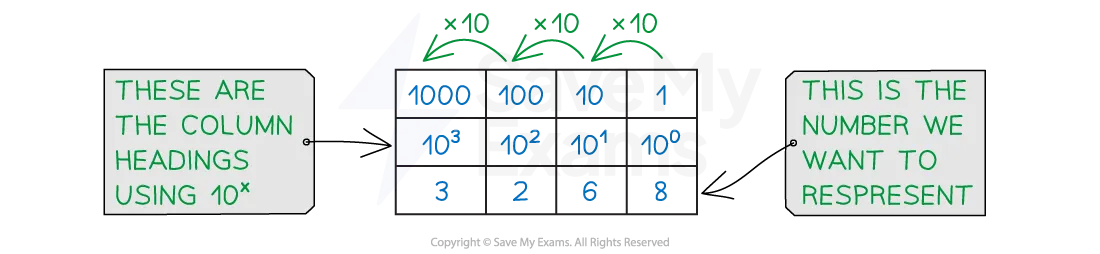
- In this example, (3 x 1000) + (2 x 100) + (6 x 10) + (8 x 1) = 3268
- To represent a bigger number we add more digits
What is binary?
- Binary is a number system that is made up of two digits (1 and 0)
- Binary is referred to as a base-2 number system
- Each digit has a weight factor of 2 raised to a power, the rightmost digit is 1s (20), the next digit to the left 2s (21) and so on
- Each time a new digit is added, the column value is multiplied by 2
- Using combinations of the 2 digits we can represent any number
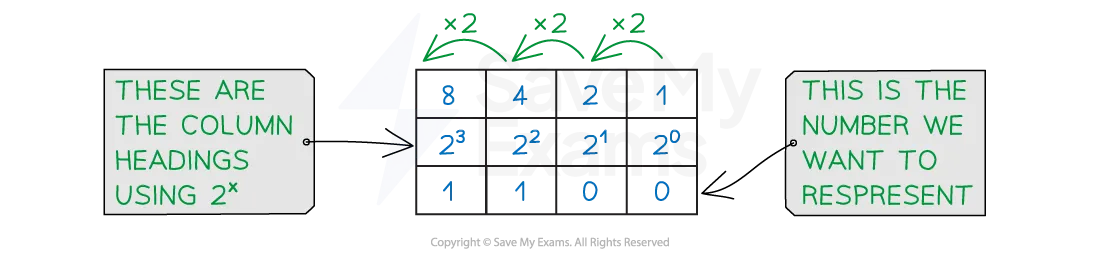
- In this example, Binary 1100 = (1 x 8) + (1 x 4) = 12
- To represent bigger numbers we add more binary digits (bits)
| 32,768 | 16,384 | 8,192 | 4,096 | 2,048 | 1,024 | 512 | 256 | 128 | 64 | 32 | 16 | 8 | 4 | 2 | 1 |
|---|---|---|---|---|---|---|---|---|---|---|---|---|---|---|---|
| 215 | 214 | 213 | 212 | 211 | 210 | 29 | 28 | 27 | 26 | 25 | 24 | 23 | 22 | 21 | 20 |
Exam Hint The largest denary number that can be represented using 16 bits is:
- 65,535 (Binary 1111111111111111)
What is hexadecimal?
- Hexadecimal is a number system that is made up of 16 digits, 10 numbers (0-9) and 6 letters (A-F)
| 0 | 1 | 2 | 3 | 4 | 5 | 6 | 7 | 8 | 9 | 10 | 11 | 12 | 13 | 14 | 15 |
|---|---|---|---|---|---|---|---|---|---|---|---|---|---|---|---|
| 0 | 1 | 2 | 3 | 4 | 5 | 6 | 7 | 8 | 9 | A | B | C | D | E | F |
- Hexadecimal is referred to as a base-16 number system
- Each digit has a weight factor of 16 raised to a power, the rightmost digit is 1s (16^0), the next digit to the left 16s (16^1)
- In GCSE you are required to work with up to and including 2 digit hexadecimal values
| 16s | 1s | |
|---|---|---|
| 1 | 3 | |
| 1 x16 | 3 x 1 | = 19 |
- A quick comparison table demonstrates a relationship between hexadecimal and a binary nibble
- One hexadecimal digit can represent four bits of binary data
Exam Hint You must be able to convert binary to hex and back using nibbles. Write out the hex digits (0–F) during the exam to avoid confusion—it’s a top tip that examiners mention every year.
| Denary | Binary | Hexadecimal |
|---|---|---|
| 0 | 0000 | 0 |
| 1 | 0001 | 1 |
| 2 | 0010 | 2 |
| 3 | 0011 | 3 |
| 4 | 0100 | 4 |
| 5 | 0101 | 5 |
| 6 | 0110 | 6 |
| 7 | 0111 | 7 |
| 8 | 1000 | 8 |
| 9 | 1001 | 9 |
| 10 | 1010 | A |
| 11 | 1011 | B |
| 12 | 1100 | C |
| 13 | 1101 | D |
| 14 | 1110 | E |
| 15 | 1111 | F |
Was this revision note helpful?
Build on this topic