Validation & Verification (Cambridge International IGCSE Computer Science)
Validation
Spec point — " (a) Understand the need for validation checks to be made on input data and the different types of validation check"
Validation
What is validation?
-
Validation is an automated process where a computer checks if a user input is sensible and meets the program's requirements.
-
There are six categories of validation which can be carried out on fields and data types, these are
- Range check
- Length check
- Type check
- Presence check
- Format check
- Check digit
-
There can be occasions where more than one type of validation will be used on a field
-
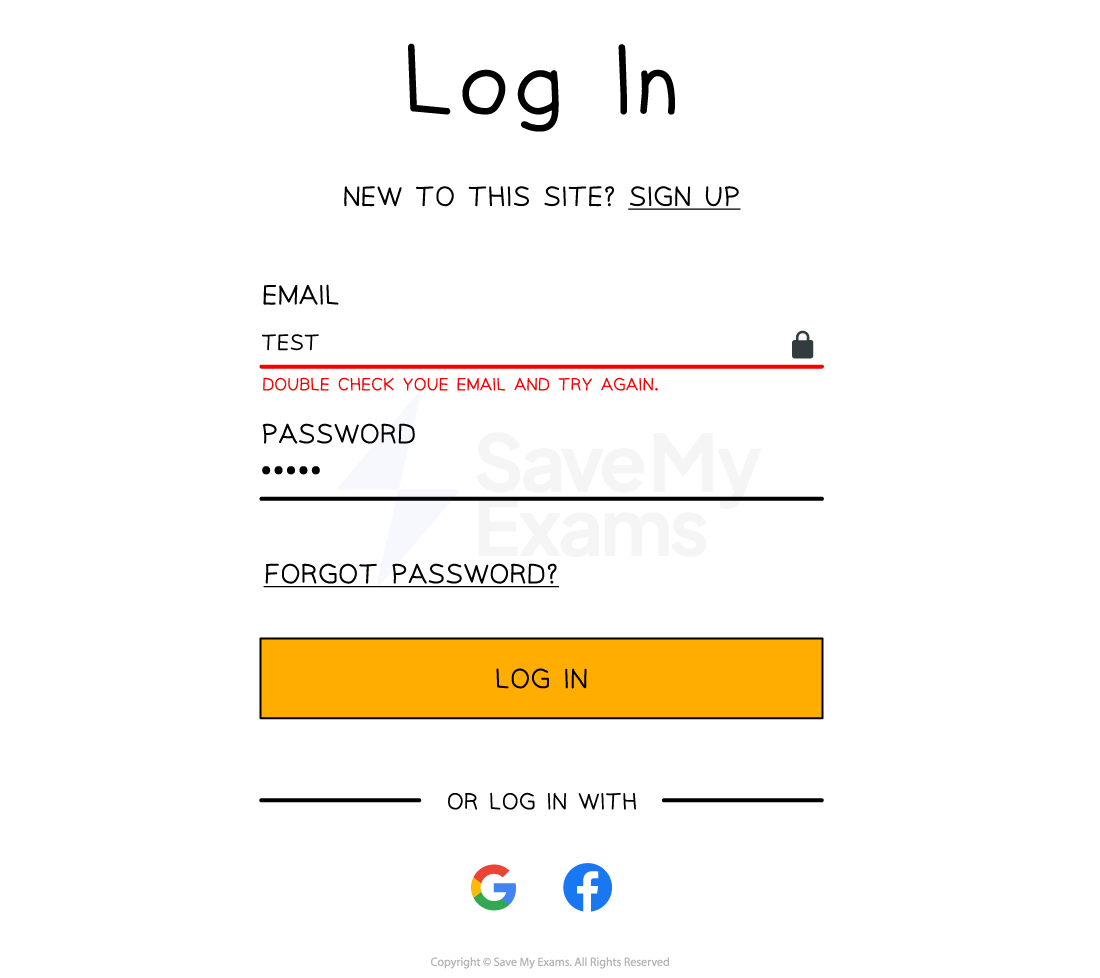
An example of this could be a password field which could have a length, presence and type check on it
Range check
- Ensures the data entered as a number falls within a particular range
| Pseudocode | Ensures a percentage number is between 0-100 inclusive |
|---|---|
| Python | Ensures a user's age has been entered and falls between the digits of 0-110 inclusive |
|---|---|
Length check
- Checks the length of a string
| Pseudocode | Ensures a pin number can only contain 4 digits |
|---|---|
| Python | Ensures a password is 8 characters or more |
|---|---|
Type check
- Check the data type of a field
| Pseudocode | Ensures an age should be entered as an integer (whole number) |
|---|---|
| Python | Ensures an age should be entered as an integer (whole number) |
|---|---|
Presence check
- Looks to see if any data has been entered in a field
| Pseudocode | Ensures username and password are both entered |
|---|---|
| Python | Ensures when registering for a website the name field is not left blank |
|---|---|
Format check
- Ensures that the data has been entered in the correct format
- Format checks are done using pattern matching and string handling
| Pseudocode | Ensures a six digit ID number is entered against the format "XX9999" where X is an uppercase alphabetical letter and 9999 is a four digit number |
|---|---|
| Explanation | |
| - The first two characters are checked against a list of approved characters - The first character is compared one at a time to each valid character in the ValidChars array - If it finds a match it stops looping and sets ValidChar to True - The second character is then compared one at a time to each valid character in the ValidChars array - If it finds a match then it also stops looping and sets ValidChar to True - Casting is used on the digits to turn the digit characters into numbers - Once the digits are considered a proper integer they can be checked to see if they are in the appropriate range of 0-9999 - If any of these checks fail then an appropriate message is output |
| Python | Ensures an email contains a '@' and ' full stop (.) which follows the format "email@address.com" |
|---|---|
Check digits
- Check digits are numerical values that are the final digit of a larger code such as a barcode or an International Standard Book Number (ISBN)
- They are calculated by applying an algorithm to the code and are then attached to the overall code
Verification
Spec point — "(b) Understand the need for verification checks to be made on input data and the different types of verification check"
Verification
What is verification?
-
Verification is the act of checking data is accurate when entered into a system
-
Mistakes such as creating a new account and entering a password incorrectly mean being locked out of the account immediately
-
Verification methods include:
- double entry checking
- visual checks
Double entry checking
- Double entry checking involves entering the data twice in separate input boxes and then comparing the data to ensure they both match
- If they do not, an error message is shown
| Pseudocode |
|---|
Visual checks
- Visual checks involve the user visually checking the data on the screen
- A popup or message then asks if the data is correct before proceeding
- If it isn’t the user then enters the data again
| Pseudocode |
|---|
Worked Example Describe the purpose of validation and verification checks during data entry. Include an example for each.
[4]
Answers
Validation check
[1] for description:
- To test if the data entered is possible / reasonable / sensible
- A range check tests that data entered fits within specified values
[1] for example:
- Range / length / type / presence / format
Verification check
[1] for description:
- To test if the data input is the same as the data that was intended to be input
- A double entry check expects each item of data to be entered twice and compares both entries to check they are the same
[1] for example:
- Visual / double entry
Was this revision note helpful?
Build on this topic