Economies & Diseconomies of Scale (Cambridge International IGCSE Business)
Economies of scale
Spec point — concept of economies of scale: purchasing, marketing, financial, managerial, technical
-
As a business grows, it is able to increases its scale of output which generates efficiencies that lower its average costs (AC) of production
- These efficiencies are called economies of scale
- Economies of scale help large firms lower their costs of production beyond what small firms are able to achieve
-
Economies of scale can result in lower average (or unit) costs, not lower total costs
- The total costs will increase, but at a decreasing rate per unit
Explaining economies of scale
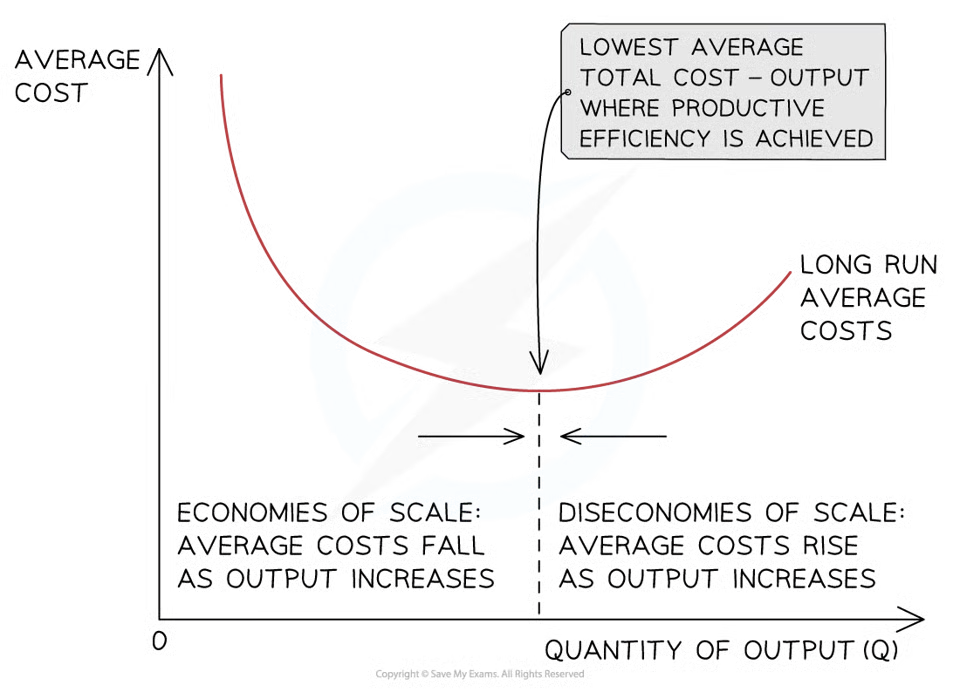
Economies of scale lower average costs as the scale of output increases
-
With relatively low levels of output, the firm's average costs are high
-
As the firm increases its output, it begins to benefit from economies of scale, which lower the average cost per unit
-
The business will reach a level of output at which costs are minimised
- This point is found at the dotted line in the image above
Types of economies of scale
- Economies of scale are generated by several internal factors, some of which the business has control over
| Type of economy of scale | Explanation |
|---|---|
| Purchasing economy | - Occurs when large firms buy raw materials in greater volumes and receive a bulk purchase discount - This lowers the average cost and provides a competitive advantage over smaller businesses |
| Managerial economy | - Occurs when large firms can employ specialist managers who are more efficient at certain tasks - This efficiency lowers the average cost - Managers in small firms often have to fulfil multiple roles and are less specialised |
| Marketing economy | - Occurs when large firms spread the cost of advertising over a large number of sales, reducing average costs - They can also reuse marketing materials in different geographic regions, which further lowers the average costs |
| Financial economy | - Banks are more willing to lend to large businesses, as they present less of a risk than small businesses - They are charged a lower rate of interest on borrowing, reducing average costs |
| Technical economy | - Occurs as a firm is able to use its machinery at a higher level of capacity due to increased output - This spreads the cost of the machinery over more units and lowers the average cost |
Exam Hint A common mistake is to think economies of scale always reduce total costs. They actually reduce average cost per unit – total costs will still rise as output increases
Diseconomies of scale
Spec point — "concept of diseconomies of scale: poor communication, lack of commitment or loyalty from employees, weak coordination, lack of control"
Diseconomies of scale
- A diseconomy of scale occurs when an increase in the scale of output results in a higher cost per unit
- As a firm continues increasing its scale of output, it will reach a point where its average costs (AC) will start to increase
Explaining diseconomies of scale
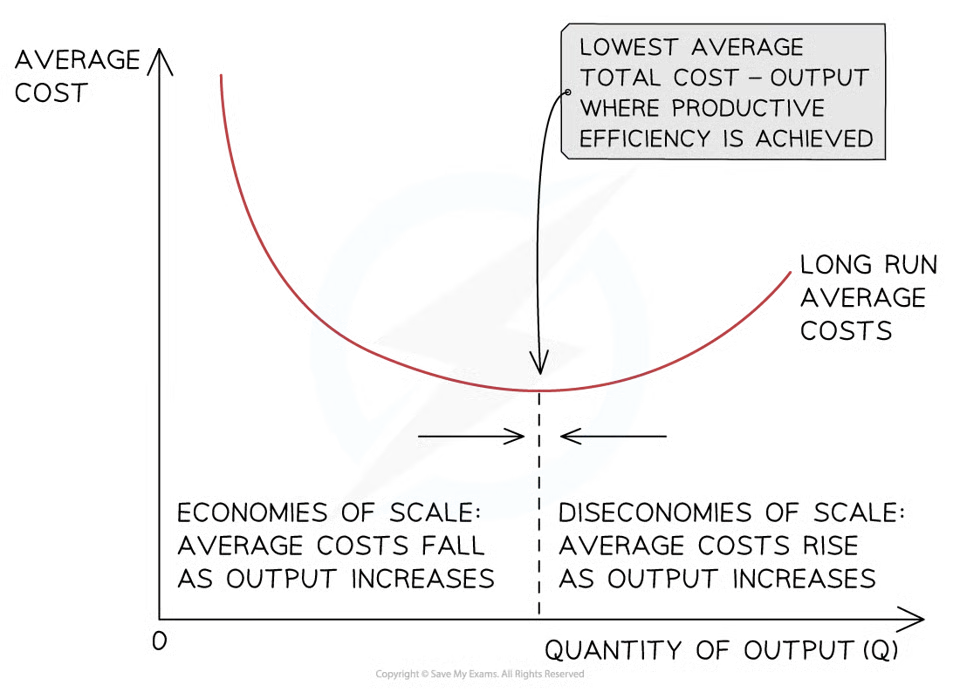
* Diseconomies of scale occur when average costs increase with increasing output*
- At some level of output, a firm will not be able to reduce costs any further. This point is called productive efficiency
- Beyond this level of output, the average cost will begin to rise as a result of diseconomies of scale
- This indicates that there is an optimal level of output that exists when the state of technology and capital (machinery) is fixed
Types of diseconomies of scale
-
Diseconomies of scale highlight that it is possible for a business to become so large that it becomes less and less efficient
-
A business experiencing diseconomies of scale may reconsider its organisational structure to improve communication and coordination problems
- Many very large businesses often break themselves up into autonomous smaller units, which can communicate more effectively
The causes of diseconomies of scale
| Type of diseconomy of scale | Explanation |
|---|---|
| Poor communication | - As a business increases in size, more managers and employees will join the business - Communication becomes slower and mistakes may be made, leading to worsening efficiency |
| Weak coordination | - Time-consuming decision-making may make it harder to coordinate workers and physical resources - The chain of command is likely to lengthen, limiting interaction with employees |
| Lack of commitment from employees | - As the business grows workers may feel less valued as their interaction with management is limited - Workers may become demotivated, leading to a fall in output which can increase average costs |
Was this revision note helpful?